
Lecture
Categories of ethics are the basic concepts of ethical science, reflecting the most essential elements of morality. Categories of ethics are not merely theoretical constructs. What forms the formal apparatus of theory also exists, at the same time, in the spontaneously forming consciousness of society. For example, the category of justice, whose content was already given an interpretation by Aristotle, exists in the consciousness of every person, in the consciousness of any society or social group. Given the whole variety of approaches to defining a system of ethical categories, one can single out the generally recognized categories that are most important in theoretical and practical terms:
The categories of ethics also include the meaning of life, happiness, and others. Unlike many sciences, ethics uses concepts that are words of everyday language and are most often used in ordinary speech («good» and «evil», «happiness», «duty», «justice», etc.).
In domestic ethical theory, the categories of ethics are divided:
in accordance with the structure of morality and morals as follows:
categories of moral consciousness (ideas, norms, principles, values, etc.);
categories of moral practice (an act, requital, etc.);
categories of moral relation (conflict, authority, reputation, etc.).
The specificity of the categories of ethics consists:
in the fact that they express a certain content of morals, reflecting various moral positions;
in the fact that they represent morality as such.
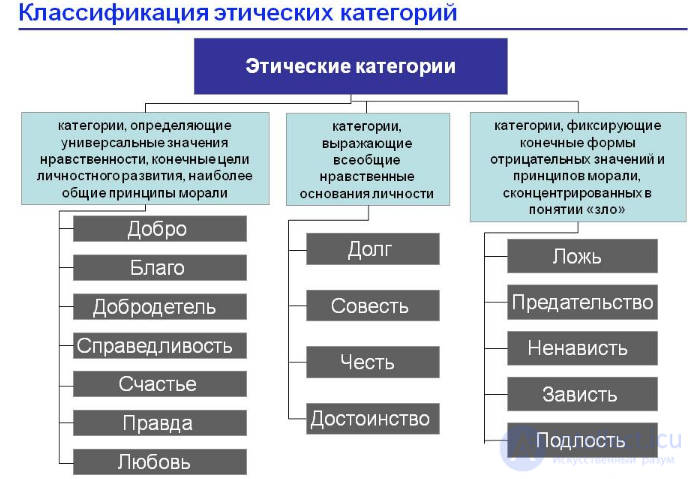
The categories of ethics are used to evaluate the most varied acts. At the centre of ethical inquiry lie the eternal problems of human existence. That is why the basic concepts of morality «good», «evil», «happiness», «duty», «justice», «honour», «dignity» do not undergo substantial change over time.
The basic categories of ethics are: «good», «evil», «the good», «justice», «duty», «conscience», «responsibility», «dignity», «honour», «the meaning of life», «happiness».
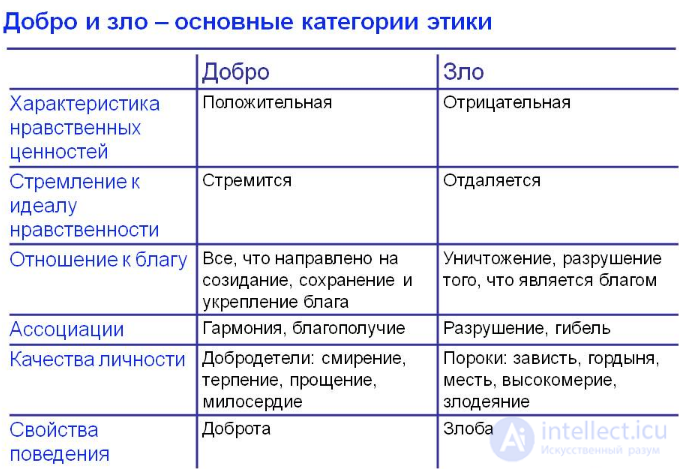
Good and evil — the most general forms of moral evaluation, delimiting the moral from the immoral. What, then, do they represent?
Good — a category of ethics uniting everything that has a positive moral significance, that serves to distinguish the moral from the immoral, and that stands opposed to evil. Since ancient times good and evil have been interpreted as two forces ruling over the world, supernatural and impersonal.
Evil — a category of ethics whose content is the opposite of good, generally expressing the notion of the immoral, that which contradicts the requirements of morality and deserves condemnation.
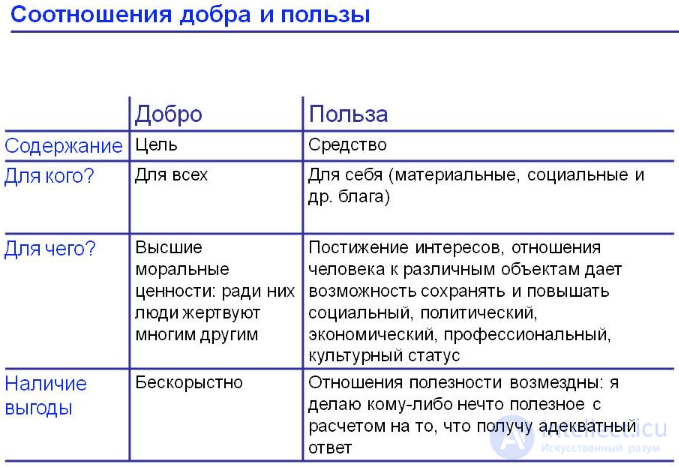
The good — everything that promotes human life, serves to satisfy the material and spiritual needs of people, and is a means for achieving a goal; here there are both natural goods and spiritual ones (education, cognition, objects of culture, etc.).
With this approach, good is a kind of spiritual good. In ethical terms, however, the concept of «the good» is often a synonym for good.
Justice means a state of affairs regarded as due, as the inalienable right of a person, the correspondence between an act and requital for good and evil, between rights and duties, between merits and their recognition.
Justice is the measure of correspondence between the content of a given act and its evaluation by public opinion.
«The general principle of justice,» wrote Vl. Solovyov, «requires that we treat others as we wish them to treat us.»
The idea of justice, the demand for justice, permeates the legislation of contemporary democratic society; justice is considered a synonym for law-enforcement activity, for the administration of justice. It is not for nothing that since ancient times justice has been depicted blindfolded, with scales and a sword. This means that the one who judges must be impartial, that before deciding he must precisely weigh all the «pros» and «cons», and, having decided, must unswervingly carry the just decision into life. In law-enforcement and legal activity, the problem of the relationship between legality and justice is fundamental. Owing to a whole range of circumstances, situations may arise in which a decision that formally corresponds to the letter of the law turns out to be unjust.
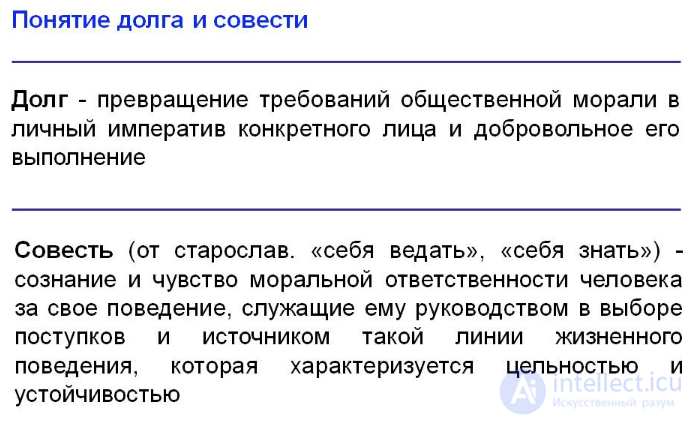
Duty — a category of ethics denoting the relation of the individual to society and to other people, expressed in a moral obligation toward them under specific conditions.
Duty — a moral task that a person formulates for himself on the basis of the moral requirements addressed to everyone.
Duty can be social: the patriotic duty of a judge, the duty of an investigator, or personal: parental, filial, marital, comradely.
In the eyes of society, a police officer is an unbending guardian of legality, moved only by a sense of duty, admitting no compromises or deals with his conscience, serving only legality and justice. But to act in this way, it is not enough to hold a particular office and know the laws. The appropriate moral qualities are necessary, allowing one to stand firmly on guard of justice regardless of any external factors.
An officer who observes the «Code of Honour…» swears to be impartial and just, as duty and his conscience command him.
Conscience — a category of ethics characterizing a person's capacity to exercise moral self-control, an inner self-assessment from the standpoint of whether his behaviour corresponds to the requirements of morality, to formulate moral tasks for himself independently and to demand of himself their fulfilment.
Conscience — the subjective awareness by the individual of his duty and responsibility before society and other people, functioning as a duty and responsibility before himself.
The feeling of conscience guards a person against what is bad and vicious, and stimulates nobility and responsibility. The role of conscience is especially important when an officer faces a moral choice and external control by public opinion is either excluded or difficult.
Responsibility — a category of ethics characterizing the individual from the standpoint of the fulfilment of moral requirements, and of the correspondence of his moral activity to moral duty.
Responsibility presupposes taking into account a number of factors: whether a person is capable of fulfilling the moral obligations prescribed to him; whether he has correctly understood them; whether he must answer for the consequences of his actions, which are influenced by external circumstances; whether a person is capable of foreseeing these consequences.
Responsibility — a philosophical-sociological concept. Responsibility in ethics and responsibility in law are closely interrelated. For example, the theoretical grounding of criminal responsibility, of the principle of personal and culpable responsibility.
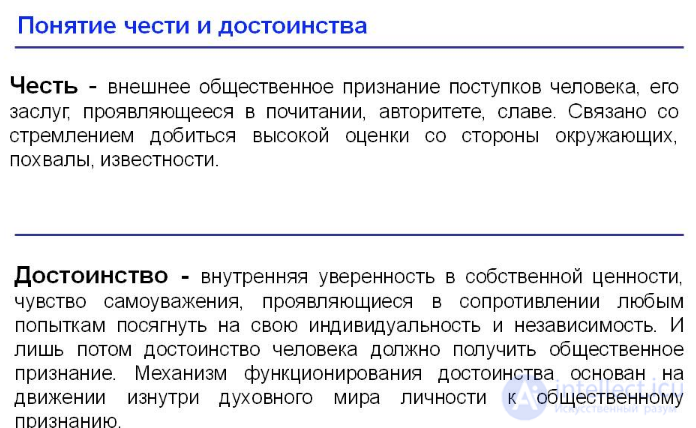
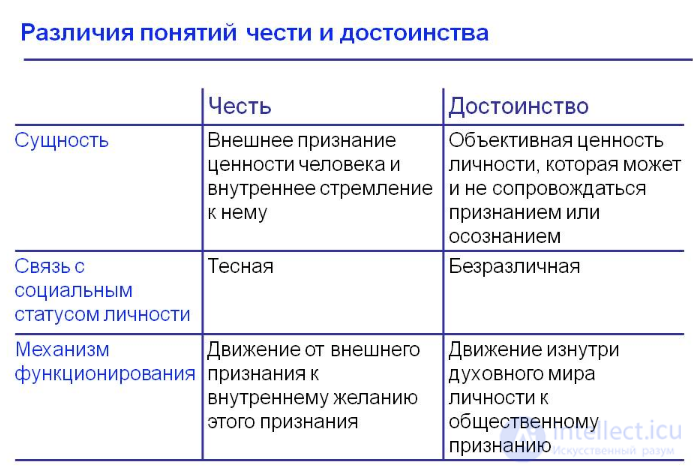
Dignity — a category of ethics denoting a person's special moral attitude toward himself and the attitude toward him on the part of society and those around him, based on the recognition of the value of the person as an individual.
A person's awareness of his own dignity is a form of self-consciousness and self-control.
Dignity — the expression of a person's responsibility for his own behaviour before himself, a form of the individual's self-assertion. Dignity obliges one to perform moral acts, to bring one's behaviour into conformity with the requirements of morality.
The concept of the dignity of the individual also rests on the principle of the equality of all people in the moral respect, and is based on the equal right of every person to respect, on the prohibition against demeaning his dignity regardless of what social position he occupies.
Human dignity is one of the highest moral values.
Honour, as a category of ethics, means a person's moral attitude toward himself and the attitude toward him on the part of society and those around him, when the moral worth of the individual is linked to a person's moral merits, to his specific social position, occupation, and the recognition accorded to his moral merits (the honour of an officer, the honour of a judge, the honour of an investigator, the honour of an operative, the honour of an advocate).
Honour and dignity are closely interrelated, yet unlike dignity, which is based on the recognition of the equality of all people, honour evaluates people differentially.
The concept of «honour» means to venerate, to hold in esteem; in modern conditions it is a synonym for «the Motherland», «glory», «loyalty». In Russia, an officer was always seen as a true knight, and his honour as the highest manifestation of all virtues. Among officers the conviction was widespread: «An army perishes if it loses its honour».
An officer is obliged to choose a circle of acquaintances in which moral principles predominate. An officer is especially required to avoid debauchery, drunkenness, gambling, gain by dubious means, and to avoid rashly giving his word of honour. These firm principles of life are no less necessary in the system of law-enforcement activity.
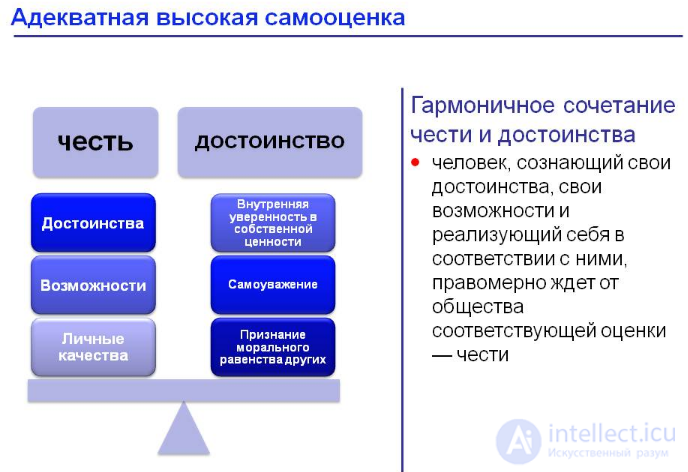
Adequate high self-esteem. A harmonious combination of honour and dignity: a person, aware of his merits, his abilities, and realizing himself in accordance with them, legitimately expects from society a corresponding evaluation — honour
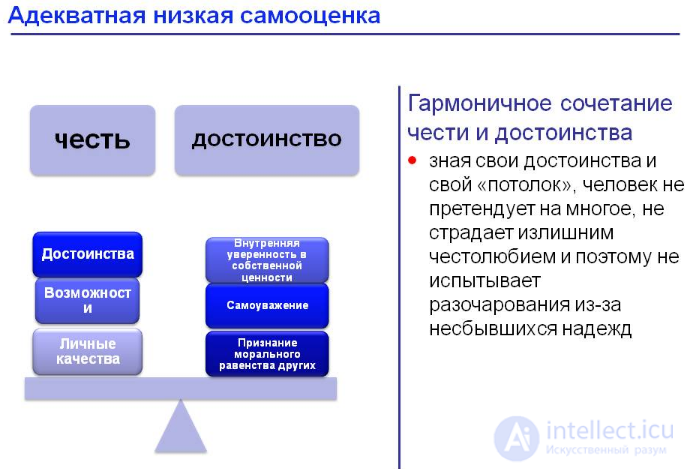
Adequate low self-esteem. A harmonious combination of honour and dignity: knowing one's merits and one's own «ceiling», a person does not lay claim to much, does not suffer from excessive ambition and therefore does not experience disappointment over unfulfilled hopes
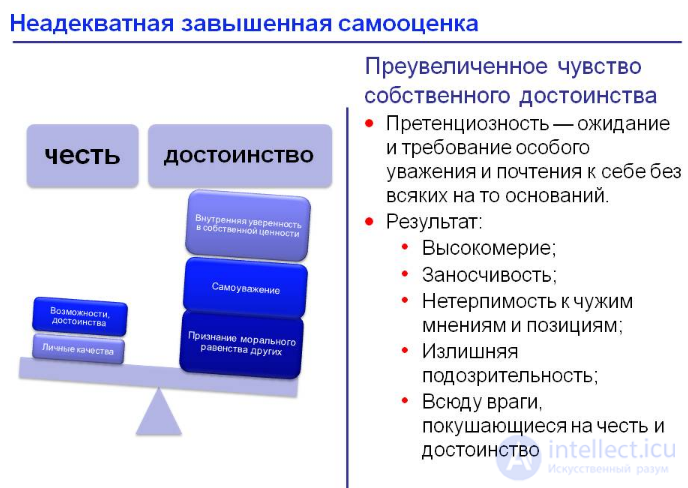
Inadequate inflated self-esteem. An exaggerated sense of one's own dignity. Pretentiousness — the expectation and demand of special respect and reverence for oneself without any grounds for it. The result: arrogance; haughtiness; intolerance of others' opinions and positions; excessive suspicion; enemies everywhere, encroaching on one's honour and dignity.
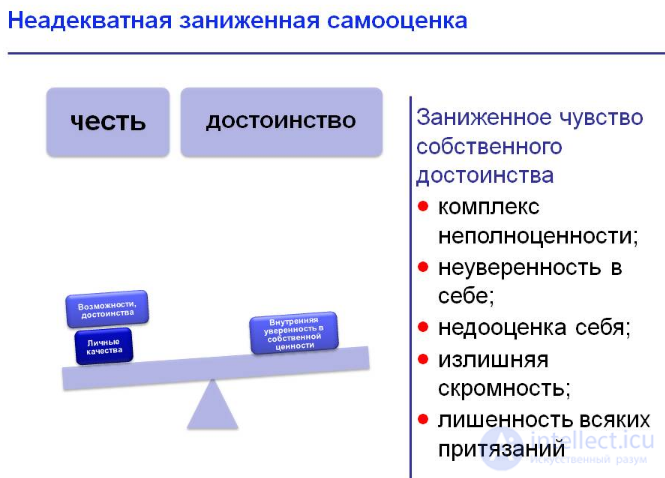
Inadequate deflated self-esteem. A diminished sense of one's own dignity: an inferiority complex; lack of self-confidence; self-underestimation; excessive modesty; the absence of any aspirations.
Happiness and the meaning of life are the goal-setting categories of ethics. The meaning of life, as an ethical category, denotes the highest, strategic moral value (or their integral totality), which the individual chooses and presents as socially significant. One of the central problems of ethics is determining a person's place in life, the meaning of his existence. There have existed various historical conceptions – from Ancient Greece to the present day – that proposed different models of the meaning of life based on the content of universal human values:
Meaning — is the objective fullness, the substantive criterion of life; meaningfulness — is the subjective attitude toward life, the awareness of its meaning. An individual's life can have meaning irrespective of its being reflected upon.
Objectively, the meaning of a person's life is realized in the process of his life-activity, which unfolds in various spheres. It can therefore appear as a spectrum of meanings and goals. But in any case a person must fulfil himself, must have the opportunity to present himself to the world, to express his essence. Life becomes filled with meaning when it is useful to others, when a person engages in his work with satisfaction and full dedication, when his existence is imbued with moral good and justice. Then the objective significance, the meaning of his life, coincides with his personal, subjective aspirations and goals. The best case is a situation in which meaning and meaningfulness form a harmonious unity. For to become aware of the meaning of one's life is to find one's «place under the sun».
Closely linked with the awareness of the meaning of life is the concept of a goal. In a person's consciousness, a goal appears as the image of that future state of reality which corresponds to his conceptions, needs and ideals. A goal is not identical to the meaning of life.
A goal – is a definite milestone, while the meaning of life — is the general line determining goals, the overall direction that affects the whole of a person's behaviour, his whole life. The goal of life — lies ahead; it is a subjective conception of the future. The meaning of life – is the objective content of life itself and, at the same time, — the striving toward the highest goal.
The meaning of life is not handed to us ready-made; it cannot be learned. Ethical theory gives us only orientation. A person is not destined to learn the meaning of life, but to find it in the experience of his own existence, to suffer it out in the process of self-assertion and complex moral searchings. The attainment of a genuine, rather than a false, meaning is an extremely complex process, involving errors and mistakes, a distorted or incomplete realization of intentions, a discrepancy between the meaning of life in its universal-human aspect and its individual interpretation.
The difficulty of the problem lies in the fact that knowing something about the meaning of life, defining it for oneself, and living one's life meaningfully are far from being the same thing.
Thus, the answer to the question "is there meaning in life?" largely depends on the person himself, on whether he will want and be able to find the highest moral value capable of giving meaning to his existence. If we ourselves are not able to fill our life with meaning, then no one will do it for us.
As long as we define the meaning of life naturalistically, we move in a closed circle of arbitrarily accepted assertions. On the one hand, it is asserted that the meaning of life is happiness or pleasure, but at the same time it is unconsciously implied that being happy and taking pleasure has meaning (and this is quite problematic). It is useful to seek the meaning of life in life itself, but one should probably not equate the manifestations of life with its meaning.
Earthly life must receive its moral meaning from an authoritative source. For it is not so good in itself, and its value is quite doubtful. First, it contains too much evil, too much suffering. In the brief span of a human lifetime one fails to attain any seriously significant goals, whether material or, still more, spiritual. Second, what meaning does existence have when at its end there is nothing, "being-toward-death". The difficulties of the naturalistic approach likewise incline one to think that behind the everyday manifestations of life one must uncover its ideal essence, otherwise the bustle of life will receive no moral justification.
For religion, the search for such a "higher" principle presents no particular difficulty: our existence has meaning insofar as it is oriented toward divine commandments and values. The meaning of life cannot be identified with any specific goal. For then, having attained the goal, we would each time lose our life-meaning orientation. Not only a material but also a spiritual goal, even the most exalted, does not constitute meaning. The meaning of our life is conditional; the being of a person in itself is not important, what is important is its correlation with an absolute value. Evidently one must not so much obtain "information about the meaning of life" as live through meaning, feel that this is precisely what one has always craved. This means that the essence of being must be grasped not speculatively but by actually living, that is, practically and in deed affirming one's way of life as one possessing meaning. This, probably, is precisely what constitutes the chief meaning of human existence: it is the path of creating meaning, of making meaningful that which, without our effort, would remain blind necessity, meaninglessness. The meaning of life is not given, not preset; it must be affirmed and proven, if one wants it to exist. In this very act we affirm ourselves as people deserving of immortality. Meaning must be lived through, that is, not found, but forged as one's own path.
Closely linked with the category «the meaning of life» is the concept «happiness». If the meaning of life is, as it were, an objective assessment of the significance of a person's existence, then happiness is a personal experience, accompanied by a feeling of deep moral satisfaction, of the fullness of one's being and of the results of one's life-activity. Happiness is therefore always linked with a sense of an extraordinary upsurge of spiritual and physical strength, with a striving to experience the whole multidimensionality of being, while the state of happiness is directly opposed to the state of passivity, indifference and inertness.
“Teaching a person to be happy” - this is the standpoint of eudaemonism. Eudaemonism (ancient Greek εὐδαιμονία — prosperity, bliss, happiness) — an ethical movement that recognizes as the criterion of morality and the basis of human behaviour his striving to attain happiness.
According to the adherents of eudaemonism, the highest good for a person is happiness. In the words of Aristotle, whose teaching is classed as eudaemonism, happiness is «something we always choose for its own sake and never for the sake of something else» . Among medieval thinkers eudaemonism was characteristic of the teaching of Thomas Aquinas and came down to the assertion that the highest happiness consists in the knowledge of God and the possibility of beholding him in the life to come.
Representatives of the hedonistic strand within eudaemonism, among whom are numbered Gassendi, La Mettrie, Voltaire, and Holbach, identified happiness with pleasure. However, unlike hedonism, pleasure here is placed in direct dependence on a person's virtues. According to Epicurus, the highest kind of pleasures are not base physical pleasures but refined spiritual ones. Happy is he who has attained a state of complete tranquillity, or ataraxia.
One of the critics of eudaemonism in ethics was Immanuel Kant, who held that the motive of a genuinely moral act could only be duty, and not the striving for happiness.
In contemporary psychology, the movement known as positive psychology traces its history back to the teachings of the ancient Greek philosophers on eudaimonia.
In Eastern philosophy, one can class as belonging to the eudaemonistic teaching Buddhism, with its postulate of deliverance from all suffering in order to attain nirvana. In the words of the 14th Dalai Lama, «The basic goal of human life is happiness. This is obvious. Regardless of whether we are atheists or believers, Buddhists or Christians, we all seek something better in life. Thus, in my opinion, the basic movement in our life is a movement toward happiness…» .
Representatives of eudaemonism: Aristotle, Voltaire, Holbach, Diderot, Montaigne, Seneca, the Stoics, Spinoza, Thomas Aquinas, Epicurus, and others.
In 1867—1869, L. Feuerbach wrote the work «Eudaemonism», published only after his death. «Eudaemonism» represents Feuerbach's most important ethical work. It was first translated into Russian by S. Bessonov and published in the Collected Works of Feuerbach, vol. I, 1925.
G. S. Pomerants cites a remark by K. N. Leontiev that in all his wanderings Dostoevsky remained a «eudaemonist», believing in the possibility of happiness for all people .
Eudaemonism in politics became one of the conceptual foundations of the United States Declaration of Independence. The right to the pursuit of happiness is proclaimed inalienable, and one of the purposes of establishing government is recognized as the realization of this right.
We hold these truths to be self-evident, that all men are created equal, that they are endowed by their Creator with certain unalienable rights, that among these are life, liberty, and the pursuit of happiness. That to secure these rights, governments are instituted among men, deriving their just powers from the consent of the governed. That whenever any form of government becomes destructive of these ends, it is the right of the people to alter or abolish it, and to institute new government, laying its foundation on such principles and organizing its powers in such form, as to them shall seem most likely to effect their safety and happiness.
Yet if happiness is understood merely as a feeling of satisfaction, then one would have to acknowledge the equivalence of any experiences of satisfaction, and therefore of happiness: both in the case of doing good and in the case of doing evil. That is why there exist many «models» of happiness — commonly accepted and personal ones — within which happiness is correlated with the good — with possessing it or creating it. But here too «variants are possible».
In humanistic ethics there is a view: in order for a person to be happy, he must not have, but be (E. Fromm) — must be a morally autonomous, self-sufficient personality distinguished by certain moral qualities. Therefore happiness is the realization of inner freedom, the process of fulfilling one's deepest personal «wanting». The necessary conditions of happiness:
Objective — satisfaction of a person's basic vital needs. Therefore material well-being and comfort in life are not yet happiness, but only the norm of human existence, a condition for happiness.
Subjective — the inner readiness and capacity of the individual for happiness — a kind of talent in which the depth and brightness of the personality, its inner energy, are manifested. Ultimately this is the normal state of a human being. And therefore renouncing happiness is a betrayal of the personality, a suppression of one's own individuality, while the loss of the capacity for happiness is an indicator of the degradation of the personality, of inner chaos, of an inability to find the main line in life.
Thus, the following conditions are necessary for happiness:
optimal satisfaction of material needs;
self-realization of the personality through professional activity and disinterested communication. Some features and «laws» of happiness
Happiness cannot be absolute. It is not the complete absence of misfortunes, but the ability to overcome adversities and failures. Happiness is temporary, transient. When we are happy, we always experience an unconscious fear: the fear of losing happiness, the fear that it will pass, will end. This, on the one hand, darkens happiness, gives it a bitter aftertaste, and on the other hand, orients us toward a careful, cherishing attitude toward happiness.
Happiness is not serenity and calm; it is always bound up with struggle — with overcoming one or another circumstance. The experience of the fullness of being, the achievement of deep inner satisfaction, is impossible without overcoming one's own inertia, passivity, external circumstances, and finally, without overcoming «oneself».
Happiness can be based not only on lofty moral values; its foundation can also include anti-values for the sake of which a person sometimes consciously proceeds toward the self-destruction of the personality, being unable to give up moments of happiness, however illusory.
The measure of happiness depends on the degree of an individual's morality: pleasure in life can be experienced by anyone, but happiness — only by a truly moral person.
Ethical categories and principles cannot be scientifically substantiated. They are not material. They cannot be measured, broken down into components, subjected to thorough structural analysis. They are goal-setting in character; they set the direction for the development of the personality, being realized in deeds, in a person's behaviour.
1. The goal-setting categories of ethics:
2. Honour and dignity are …
3. Indicate the basic categories of ethics

Comments