
Lecture
Moral consciousness represents a distinctive fusion of feelings and representations in which the deepest, most fundamental aspects of human existence are specifically expressed — the individual's relations with other people, with society, with the world as a whole. This specificity is expressed in corresponding concepts: good and evil, justice, conscience, dignity, and others, in a striving toward the highest values.
Depending on its bearer, moral consciousness is divided into individual and social.
The researcher's starting point is the "living," concrete human being. And morality itself, too, is addressed above all to the individual. Therefore we should first of all examine the inner world of the individual person. Since antiquity, three parts have been distinguished in the human soul: the rational, the volitional, and the feeling. In accordance with this we can identify three basic components of individual moral consciousness. The first of them — concepts and representations of good and evil, duty, conscience, the highest values, and so on, the rational part of individual moral consciousness. Even Socrates and Plato emphasized the important role of reason in a person's moral life. It is reason that works out the strategy of moral behavior, analyzes this or that situation, and the tactics of concrete actions. Reason is aided by moral feelings (the feeling of conscience, the feeling of Duty, the feeling of justice, etc.) — the second component of individual moral consciousness.
The role of feelings is also great in a person's moral life. His moral experience is accumulated in them. It is they that catch those nuances of actions and situations that "cold" reason simply does not notice. They are also a powerful stimulator of this or that action, the translation of intentions into concrete deeds. Representatives of ethical sensualism (Shaftesbury, Hume, and others), in contrast to ethical rationalism, emphasized (and at times absolutized) the significance of moral feelings in human life.
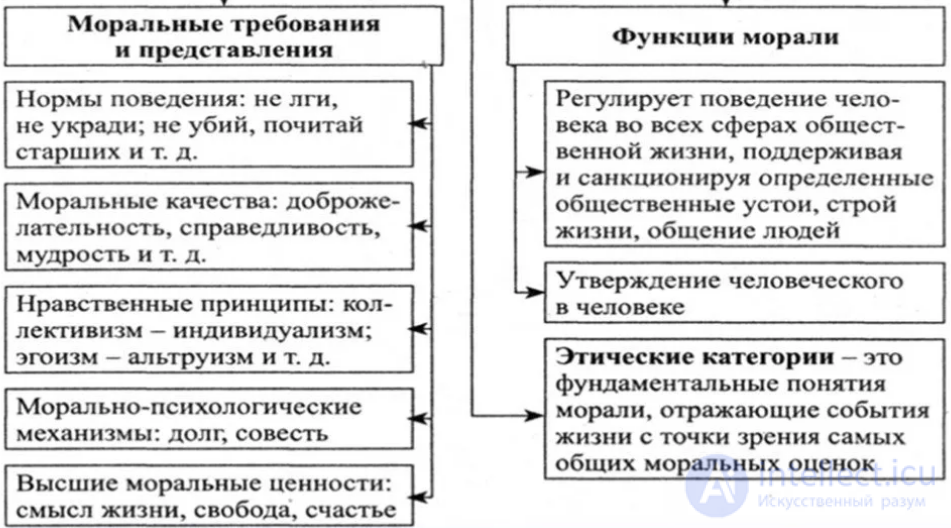
The regulatory function. It regulates people's behavior in accordance with the requirements of morality. In its scope and the universality of its effect on the individual, morality is broader than law. It exercises its regulatory capacities by means of normative instructions, normative requirements, normative prohibitions, normative frameworks, restrictions, as well as normative models (etiquette).
The value-orientation function. It orients a person within the surrounding world of cultural values. It develops a system of preference for some moral values over others and makes it possible to identify the most sound moral evaluations and lines of behavior.
The cognitive (epistemological) function. What is presupposed is knowledge not of objective characteristics but of the meaning of phenomena as a result of practical development. Thanks to this function, ethical knowledge, principles, norms, and codes help to form a model of moral behavior in specific conflict situations.
The educational function. It leads to a definite educational system of moral norms, habits, customs, mores, and generally accepted models of behavior.
The evaluative function. It evaluates a person's engagement with reality from the standpoint of good and evil. The objects of evaluation are actions, relations, intentions, motives, moral views, and personal qualities. The motivational function. It allows a person to evaluate and, where possible, to justify his behavior by means of moral motivation. Pure and noble motives are the most important element of a person's moral behavior.
The communicative function. It serves as a form of communication, of transmitting information about life values and people's moral contacts. It ensures mutual understanding and communication among people on the basis of the development of shared moral values, and hence - official interaction, a «sense of comradeship», support and mutual assistance.
The conclusion suggests itself that for a genuine moral life the harmonious interaction of reason and feeling is important. In fact, they do not exist in isolation from one another and together form the moral convictions of the individual.
Such cases prompt us to recall the third component of moral consciousness - the will, which manifests itself in steadfastness, resolve, a certain psychological disposition, and readiness for concrete actions.
Individual moral consciousness is formed in interaction with social moral consciousness, whose bearer is society as a whole. Social moral consciousness makes far greater use of the experience of the moral quests of preceding generations.
Social moral consciousness is not uniform - it has its own structure. Let us note its simplest variant, which includes everyday moral consciousness and theoretical moral consciousness. By its nature, everyday moral consciousness represents our everyday judgments on various problems of morality and the corresponding evaluations, moral feelings. Theoretical moral consciousness is directed to a greater degree at the central, life-meaning questions of human existence, and is characterized by greater clarity, consistency, rationality, and systematicity.
Morality exists not only in the form of consciousness. Moral feelings and representations are manifested in the most varied actions, in which one's attitude toward other people, toward society as a whole, and finally toward oneself is expressed. In a word, it can be considered that moral relations constitute moral practice.
But moral relations are one of the types of relations that exist in society. What is the specific character of moral relations?
First, and this suggests itself, in the process of these relations moral values are embodied, and the life of the individual is correlated with the highest values.
Second, moral relations do not arise spontaneously (as, for example, is often the case with economic relations, relations to nature, and so on, which are often carried out, one might say, mechanically, without due reflection), but purposefully, consciously, and freely. One can buy goods or receive wages without much deliberation (deliberation, of course, in the sense of determining their place in social life), but one can hardly be spontaneously kind, responsible, or just. The latter requires correlating concrete acts and situations with the highest moral values.
+Finally, third, moral relations do not, as a rule, exist in pure form, on their own, but are a component, an aspect, of economic, political, religious, and other relations. Good, for example, is realized in the process of the most varied actions (some help, advice, support, etc.), and not in the form of idle daydreams. In this respect moral relations depend to a significant degree on the character of the relations between the individual and society that exist in a given historical epoch, in a specific country, on the political system, and on the foundations of economic life. Moral relations bear the imprint of the peculiarities of culture and of this or that religion (for example, the moral life of a Muslim and a Christian will, of course, not be identical in detail), and of nation.
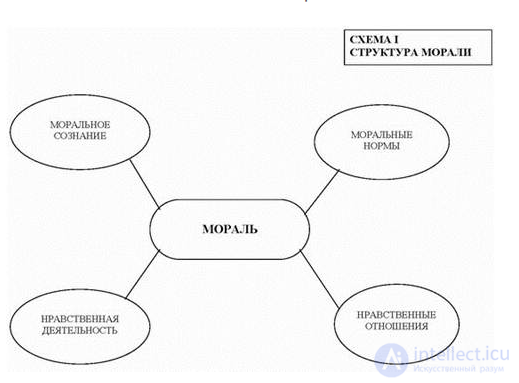
Fig. structure of morality
Moral activity - the most important component of morality, manifested in actions. An act, or a set of acts characterizing a person's behavior, gives an idea of his true morality. Thus, only activity and the realization of moral principles and norms give a person the right to be recognized as possessing a genuine moral culture.
Morality is a system with a definite structure and autonomy. The most important elements of morality are moral consciousness, moral relations, moral activity, and moral values.
Moral consciousness is one of the forms of social consciousness, which, like its other forms, is a reflection of people's social being. Moral consciousness includes values, norms, and ideals. Here morality manifests itself as a striving for perfection. Moral consciousness is the spiritual side of morality: norms and principles of behavior, goals, emotions, feelings, sentiments, convictions, volitional acts, and other ideal factors. It reflects the vital-practical and historical experience of people in the form of individual and collective representations, performs the functions of a mechanism of social continuity, regulation and organization of life, and provides for the evaluation of the results of individual behavior.
Moral consciousness functions at two levels of regulating relations between people: the emotional-sensory level (everyday consciousness) and the rational-theoretical level (ethics). The emotional level is a person's psychic reaction to an event, relation, or phenomenon. It includes emotions, feelings, and mood.
Emotional-sensory moral consciousness determines a person's relations:
The rational level - the individual's capacity for logical analysis and self-analysis - is the result of the purposeful formation of moral consciousness in the process of education, upbringing, and self-education.
Moral identity. This is a person's awareness of himself and of his place in the social activity of people.
Self-awareness is an inseparable component of the structure of morality. Self-awareness at its foundation carries a moral principle, since, firstly, it is permeated by the presence (significance) of others. And secondly, the image of the «self» from the outset contains an «ideal self», or a striving for perfection.
Moral behavior, grounded in the moral consciousness of a person who realizes his moral relations, is the result of the formation of the personality and of his free choice. Moreover, if moral consciousness is the subjective form of these relations, then moral behavior is the form of their objectification, their materialization. In this sense a person's behavior is an indicator of his moral culture. Moral practice includes genuine morality, actions, and moral relations. Acts and deeds reflect the moral side of human activity. They may have a positive or negative orientation and imply moral responsibility. In criticizing others, in evaluating ourselves, we, as it were, compare a concrete act with a certain image, norm, or ideal. The degree of correspondence or non-correspondence to the model allows us to criticize and evaluate someone as a whole, and from a moral point of view it fosters an acceptable level for building relations between people.
The act is the central moment of moral behavior, which characterizes a person's ability consciously to set goals, to choose suitable means, and to act independently, through a morally responsible action. Besides the action itself, motivation and evaluation (self-evaluation) occupy an important place in a person's moral behavior. Motivation (motive, intention) plays the role of an impulse, a stimulus to action: the motive precedes the action and continues to operate while it is being carried out. This is a very strong regulator of human behavior, no less important than the deed itself: there are no unmotivated actions. However, motives and actions may not correspond to one another; the relationship between them is ambiguous.
Evaluation within the system of moral regulation expresses condemnation or approval of a person's actions, behavior, mode of thought, or way of life on the basis of moral requirements. The basis for evaluation is moral principles, norms, and ideals that prescribe correct human behavior. Evaluation itself characterizes the correspondence of what exists (what has been done) to what is correct. Evaluation of future actions is also possible, serving as an ability to predict the consequences of an action; in this it can simultaneously serve as its motivation.
Moral relations are the central element in the structure of morality, in which the properties of any human activity are fixed from the standpoint of its moral evaluation. The most significant in the moral sense are such types of relations as a person's relation to society as a whole, to other people, and to himself.
Moral feelings play a very important role in morality. Moral feelings include feelings of love, compassion, reverence, shame, conscience, hatred, anger, and so on. Moral feelings are partly innate, that is, given to a person from birth by nature itself, and partly they are socialized, formed through upbringing. The level of development of a subject's moral feelings characterizes his moral culture. A person's moral feelings must be keen, and must react sensitively and correctly to what is happening. The outstanding twentieth-century moralist Albert Schweitzer wrote, for example, of conscience, that «a clear conscience is an invention of the devil».
V.S. Solovyov, as has been noted, took as the subjective foundations of morality three feelings which he considered innate in man and therefore universal - namely, shame, compassion, and reverence. Shame regulates a person's attitude toward that which has lower value, compassion toward that which is equal to man in value, and reverence toward that which has higher value. At the same time V.S. Solovyov did not deny the existence of objective foundations of morality, in particular its social foundations. Contemporary ethics does not deny the primary importance of the feelings of shame, conscience, compassion, and reverence for a moral being. However, it does not reduce all the subjective preconditions of morality to them.
A moral norm is a rule of human action, formulated by a person's reason on the basis of definite moral values. Norms are regarded in ethics as one of the most important elements of morality as a whole. And this is connected with the regulatory function of morality as its most important social function. However, norms play an important role not only in morality, but also in law, in politics, in religion, and in other spheres of activity.
How are moral and legal norms, as the main types of social norms, related to one another? From a formal standpoint, moral and legal norms may not differ. In the structure of a moral norm, as in a legal norm, one can distinguish a disposition, which expresses the content and character of the requirement, as well as a hypothesis, indicating the condition for fulfilling the norm, and a sanction, expressing the ways or means of ensuring its enforceability.
Norms are based on certain values. Properly speaking, a norm is a definite requirement placed on a subject's behavior in the realization of a definite value. This is precisely why the number of moral norms and principles is not limited. Principles are the most general norms. And the problem arises of choosing the most significant principles. A special place in morality is occupied by so-called universal principles, such as: «Honor your father and mother», «Do not kill», «Do not steal», «Do not bear false witness». Among the universal principles, the «golden rule of morality» stands out for its significance, which states: «Treat another person the way you would want him to treat you».
Moral norms are universal; they are addressed to all people. And that is why in morality an identity of subject and object is observed, in which the norm that the subject proposes for the object is also binding for the subject himself.
Moral norms are characterized as non-institutional. This means that sanctions for observing or violating moral norms are imposed not by social institutions, as in legislation, where this function is retained by the state, but by the moral consciousness of the subject himself and by public opinion.
Many moral norms and principles can be divided into requirements and permissions. Requirements, in turn, are divided into obligations and natural duties. Natural duties are divided into positive and negative. Permissions are also subdivided into indifferent, or adiaphoric, and supererogatory.
Requirements are distinguished by the fact that they are strictly obligatory, categorical. Permissions, though desirable, are merely possible. A distinctive feature of a requirement is that its negation is impossible - violation of a requirement takes the subject beyond the bounds of good into the sphere of evil. Requirements can appear as universal ("natural") and as simple duties. Universal duties must be fulfilled by everyone. An example of universal duties are the so-called "universal" moral standards, such as "Do not kill!", "Do not steal!". Among moral norms, universal duties stand out as the most categorical. Natural duties are duties to follow one's conscience, one's sense of duty, and so on. In ethics it is held that negative requirements, beginning with the particle "not," are the most strictly necessary.
Obligations, as requirements, are a norm only for certain persons. The binding force of these norms is determined by the conditions of their application, that is, obligations are fulfilled under certain conditions. Such obligations are, for example, the norms of any "professional" ethics or the norms of "professional codes," which are connected with the specifics of an activity or a person's social status. Thus one can and must speak of the duties of a manager, a teacher, an investigator, a politician, and so on. Among moral standards, obligations are the most hypothetical, generally accepted.
Permissions are possible, desirable. Among them are distinguished those that go beyond the limits of "ordinary duty" or additional duty. Such, for example, are the principles of self-sacrifice, "love of enemies," celibacy, self-denial, and so on. These "supererogatory" norms appear ideal to a person; their fulfillment is an unquestionable good, while their non-fulfillment is neither an evil nor a sin, and this distinguishes them from adiaphoric permissions.
Supererogatory permissions, like universal duties, are very important for man's moral being, because through them the essence and the real possibility of a person's spiritual perfection are revealed, along with the prospects for the development of a moral world order.
Moral consciousness includes three components.
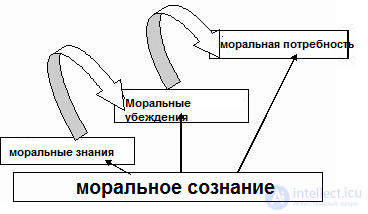
Moral knowledge exists in the form of a reflection of the objective world in a person's consciousness through concepts, judgments, theories, and so on. Knowledge serves as a guide to action provided it is transformed into conviction, which presupposes combining its informative side with direction, a stimulus to action. Moral knowledge is acquired in the process of education through familiarization with the essence of morality, its content, its functioning in society, the system of its requirements, and the sanctions for deviating from established norms. Moral knowledge makes it possible to compare one's own moral standards with professional, socially significant ones and to correct one's moral position accordingly.
Moral convictions - the basic moral disposition that determines the aim and direction of a person's actions, a firm certainty in what and why, grounded in a particular idea and worldview. It is the highest stage in the development of a specialist's personality and consciousness, since at its basis lies a profound and many-sided evaluation by the person of the moral norms known to him, tested by social practice and by life and professional experience.
Moral convictions:
Moral knowledge, which has already become moral conviction, forms a moral need. A need is a state of a human personality, a social group, or society as a whole, that expresses a necessity for something and is the driving force of their activity.
Moral need - the highest degree of moral consciousness, characterized by the presence of a moral need to observe the requirements of professional ethics. When observance of the requirements of professional ethics becomes a person's inner need, he organizes all his volitional and emotional qualities in accordance with ethical principles, and directs his efforts toward resolving ethically complex problems precisely from the standpoint of morality. In this case, observance of the requirements of professional ethics becomes a stable quality of the personality, a significant factor that mobilizes it to organize its behavior and activity, a matter of duty and conscience, honor and dignity.
A high level of development of moral and ethical consciousness and of moral qualities gives one the moral right to occupy a leading position in society.
A high level of a person's morality presupposes the ability to understand another person, to help tactfully, without reproach or moralizing.

Comments