
Lecture
The concept of «ethics» comes from the ancient Greek ethos (ethos). At first, ethos was understood as a place of shared dwelling, a home, an abode, an animal's den, a bird's nest. Later it came to denote mainly the stable nature of some phenomenon, a disposition, a custom, a character.
Understanding the word «ethos» as character, Aristotle introduced the adjective «ethical» in order to designate a special class of human qualities, which he called ethical virtues. Qualities of character could be considered to include: moderation, courage, generosity. To designate the system of ethical virtues as a special sphere of knowledge, and to single out this knowledge as an independent science, Aristotle introduced the term «ethics».
For a more precise translation of Aristotle's term «ethical» from Greek into Latin, Cicero introduced the term «moralis» (moral). He formed it from the word «mos» (mores – plural), which, as in Greek, was used to denote character, temperament, fashion, the cut of clothing, custom.
Thus, in their original meaning, «ethics», «morality», «morals» – were three different words, even though they had been one term. Over time the situation changed; in the course of the development of philosophy, as the distinctiveness of ethics as a field of knowledge was revealed, these words began to acquire different meanings.
Thus, by ethics is meant above all the corresponding field of knowledge, the science, while by morality (or morals) is meant the subject it studies. Although researchers have made various attempts to distinguish the terms «morality» and «morals». For example, Hegel understood morality as the subjective aspect of actions, and morals as the actions themselves, their objective essence.
On the whole, in general cultural usage all three words continue to this day to be used interchangeably. In these lectures we will adhere to the position that «ethics» is a science, a field of knowledge, an intellectual tradition, while the terms «morality» or «morals» will be used as synonyms and understood to mean what is studied by ethics, its subject matter.
State service - a specific type of activity connected with implementing the policy of the state and carrying out, on behalf of the state, the principal economic, social and political programs among the population. The origins of state service are traced back to the origins of the formation of the state; thus in the twentieth century BCE the first uprising for social justice against the state apparatus occurred in Ancient Sumer, and it was there that the beginnings of a bicameral parliament and of the ethical rules of state service also appeared.
Ancient Greece and Imperial Rome played a large role in shaping the ethics of state service as prototypes of modern bourgeois states. In them the nature of power was subjected to analysis, and in philosophy the concepts of «power», «interaction with society», and «the role of law» began to take shape.
A substantial role in the formation of the ethics of state service was played by the historical realities of the formation of state service in one country or another. They made the ethical requirements more concrete, conditioned by the historical realities of the given country.
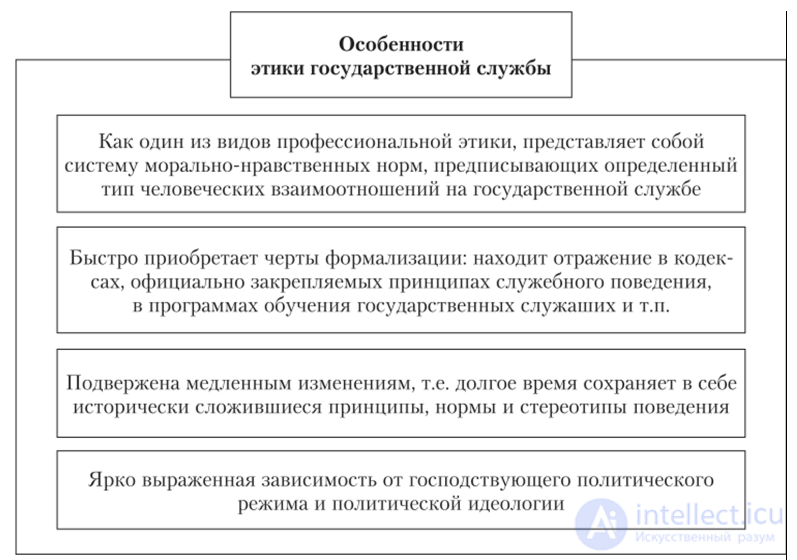
State service presupposes that everyone employed in it has some degree of authoritative, administrative powers, and therefore the ethics of state service includes all the basic elements of the ethics and culture of management (decision-making, its preparation, implementation, anticipation of the consequences of decisions taken, etc.). At different levels of state service the scope of authoritative-administrative powers differs. At the lower levels the scope of these powers is small owing to the strict centralization of the activity of state service, and rank-and-file employees perform executive functions, but nevertheless they do possess a certain set of powers.
The ethics of state service includes a whole range of elements of the ethics of ideologized systems: the requirement that a person's basic personal qualities be subordinated to the specifics of the idea being achieved (realized), and the exclusion of all those incapable of applying the methods and means necessary for achieving the goals set. In the system of state service there have always existed official or informal ways of monitoring the behaviour of state officials for compliance with the standards imposed on state employees in a given period. There exists a system of internal penalties for state employees.
In the organization of state service and its functioning there are many specific aspects that operate in contradiction with the moral qualities required of the state employee. The morals of officials are corrupted, as it were, from within. Such features, which negatively affect the morality of state employees, are:
The specific form of remuneration in state service;
Its territorial structure;
Vertical alignment by direction of activity;
The particular nature of workforce turnover;
The particular interest of certain segments of the population in the activity of state service.
Thus, the ethics of the state employee appears to be a rather unstable complex of qualities, vulnerable and heavily dependent on circumstances. On the other hand, the state employee is the face of the state and the nation, a guarantee of the successful functioning of the state. Therefore there exists a range of qualities that a state employee must necessarily possess. In this connection, law plays a decisive role in the organization of state service.

Comments