
Lecture
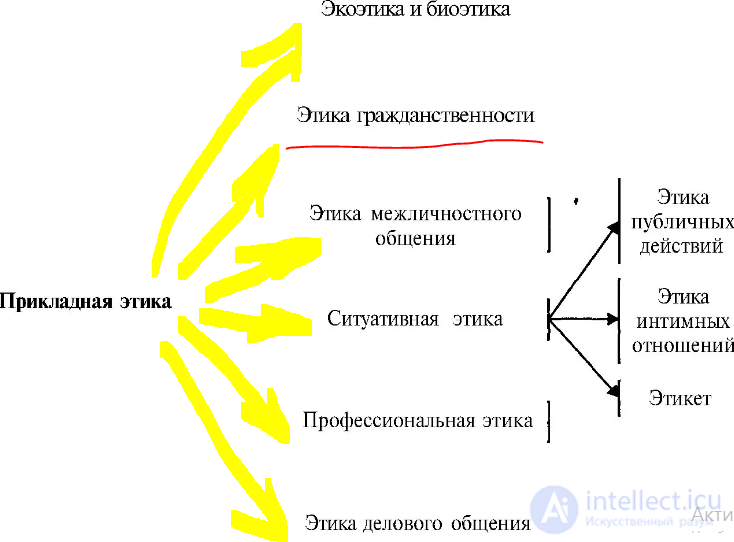
Civic ethics is the primary normative ethics. Civic ethics is directly connected with the concepts of «citizen» and «civil society».
Civil society – is a society that represents a totality of economic and non-political relations between people, groups of people and organizations that are independent of the state.
Civil society is formed on the basis of a person's private and public life. In such a society, every individual can determine their own goals and actions in each specific situation.
Consequently, civil society is shaped by individual persons without regulation by the state. In such a society people can achieve self-realization autonomously; they are protected by legal norms from having their activity managed by state bodies. In such a society, social inequality among people arises, as well as their industrial-economic relations. However, the advantage of such a society is healthy competition, initiative, the emergence of democratic institutions, and also improved cooperative activity among individual members of societies and groups of citizens.
Features of civic ethics. The ethical norms of civic conduct regulate the behaviour of citizens. It relies on moral norms and values, as well as on political morality, which regulates the actions of people whose lives are connected with politics. However, the difference between civic ethics and political morality is that the former regulates not only the sphere of politics but also the relations of citizens in the sphere of economic activity and the economy. In this case, citizens of the state are not only political subjects but also citizens to whom applies the law of non-interference by the state in their independent determination of their own life tactics and strategies.
Civic ethics does not require a person to love and have compassion for their neighbour. However, such an ethics does require the citizen to show respect for all members of society. Besides this, civic ethics regulates an individual's belonging to a particular group of people.
Features of civic ethics
The core value of civic ethics is the personal freedom of every individual, the freedom of their moral choice, the self-determination of conscience, and the distinguishing of the concepts of «good» and «evil». It is precisely the manifestation of such qualities by individual persons, and their interest in the development of society, that constitute the concept of «civic-mindedness». A person who observes civic ethics can be regarded not only as a citizen but also as a patriot of their state.
The political and legal foundation of civic ethics is human rights: personal (inalienable), political, socio-economic and cultural.
Civic-mindedness represents a set of views and convictions which, on the one hand, presupposes a high degree of independence of individual judgments in society, and on the other hand - strong social solidarity, expressed in a person's participation in the life of society.
The most significant elements of civic-mindedness are:
According to the degree of a person's civic activity, levels of civic-mindedness can be distinguished:
Level I – civic qualities (responsibility, conscientiousness, conscience);
Level II – civic stance (a person's definite attitude as a citizen toward what is happening around them);
Level III – civic competence – the mechanism ensuring the exercise of rights and the performance of duties determined by the status of citizenship. This competence has 3 aspects: cognitive (readiness to master the knowledge necessary to ensure civic-mindedness: about the structure of political and economic systems, etc.), procedural (the knowledge and abilities necessary for the active exercise of rights and duties) and civic (the possession of skills and abilities necessary for the practical realization of one's knowledge) .
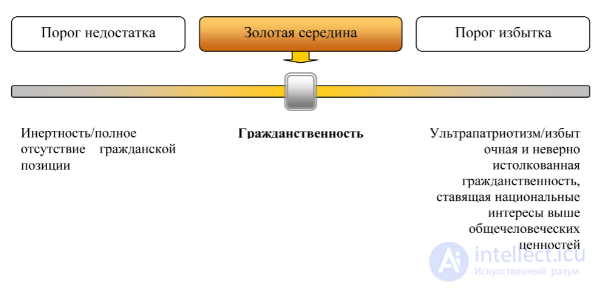
Civic-mindedness may also have another multilevel structure, based on the criterion of how developed civic-mindedness is:
low – civic stance is not formed, the presence of civic qualities is traced indistinctly, low readiness to exercise the rights and duties of a citizen.
medium – civic stance and qualities are at the stage of formation, partial readiness to exercise the rights and duties of a citizen.
high - civic qualities are formed, an active civic stance, high readiness to exercise the rights and duties of a citizen.
Graphically, the position of civic-mindedness depending on the degree of development of civic stance and civic qualities can be represented as follows:
Human rights are inseparable from a person's duties. According to the Constitution, the main duties of citizens are as follows:
Everyone within the territory of our country is obliged to observe its Constitution and laws and to respect national traditions. Everyone is obliged to respect the dignity, rights, freedoms and legitimate interests of other persons. Everyone is obliged to preserve the historical-cultural and spiritual heritage and other national values. Protection of the natural environment is the duty of everyone. Citizens are obliged to take part in financing state expenditures by paying state taxes, duties and other payments. Defence of our state is the duty and sacred obligation of a citizen .
Civic ethics is distinguished by a number of characteristic features:
Thus, civic ethics is naturally connected with the concepts of «citizen» and «civil society». If the former is the bearer and «executor» of the norms and requirements of civic ethics, the latter serves as the main institutional condition for its formation and the field of its realization. In this approach, the concept of the institutionalization of ethics at the meso- and macro-levels by N. Vasilyevene (Lithuania, Kaunas) proves highly productive, making it possible to examine the status and mechanism of action of civic ethics depending on the situations of a specific society.
Let us agree that by civil society we mean the integral totality of non-political, spiritual and economic relations between persons, groups and organizations independent of state power. Civil society, as is known, is formed at the intersection of public and private life, giving a person the opportunity to determine independently the goals and means of their actions. The main morally significant features and orientations of such a society are:
In such a society people appear not as «political creatures» – subjects of the state, but as citizens, who are protected by law from state interference and act by determining their life strategies and tactics quite independently. The ethical imperative of civil society presupposes constant voluntary respect for the other, requires an understanding of the actions of others, the use of freedom and one's own hierarchy of values, and, on this basis, the making of personal decisions under personal responsibility (A.A. Guseinov, V.I. Bakshtanovsky). It is evident that the very features and guarantees of civil society presuppose the presence of a highly developed moral self-regulation of citizens' behaviour. At the same time, the self-evidence and habitualness of these conditions turns the aforementioned ethical imperative into a natural regulative principle that does not require special attention from society to the purposeful formation of the civic qualities of the individual. In civil society, civic ethics, which is the result and indicator of the moral culture of society, relies, on the one hand, on universal moral norms and values, and, on the other hand, on political morality – values and norms oriented toward preserving stability and the sustainable development of such a society. Institutionally, the phenomenon of civic-mindedness manifests itself in such a society through the creation and functioning of various parties, societies, and corporations.
Matters stand differently in a non-civil society and in a society oriented toward becoming civil but not yet having become so. In such societies, which lack or have not yet acquired the necessary moral foundations and features of civil society, relations with civic ethics develop in a far from simple way. In a non-civil, and consequently authoritarian (or, in the extreme case, totalitarian) society, those in power, in their desire to preserve the status< quo, are interested in a low level of self-awareness and of the moral and political culture of society and in a non-autonomous individual. Moreover, the manifestation of civic self-awareness may be dangerous here for the individual, may be persecuted by the authorities and rejected by the bulk of the population (dissidence in the USSR). Under such conditions the phenomenon of civic-mindedness manifests itself mainly at the level of the underground, in silent discontent with the actions of the authorities, or in rare outbursts of civil disobedience on the part of individual citizens or organized and coordinated by opposition parties.
Only under the conditions of the formation of civil society, of movement toward it and, consequently, of society's gradual acquisition (conquest) of the above-listed qualities, does civic ethics become genuinely in demand, serving as a prerequisite and necessary basis for people drawn into the orbit of political life to carry out those transformations that will contribute to the conversion of a non-civil or pre-civil society into a civil one.
The formation of civic ethics presupposes, above all, an intensive raising in society of the level of political culture, which must combine within itself political competence, flexibility of thinking, tolerance of dissent, and the rejection of individual and group egoism.
Political competence includes the formation and development of knowledge and understanding of political theories, political history, and the current political situation in society. Knowledge of theory presupposes an objective analysis of ideological, political-science and sociological concepts, a comprehensive assessment of alternative socio-political movements and paths of societal development from the standpoint of universal human values and interests. Knowledge of history presupposes the preservation and transmission of the historical and national memory of the people, familiarity with the authentic facts of national and world history and culture. Knowledge of the real situation presupposes the comprehensive and reliable awareness of people about events in the country and the world. The acquisition of knowledge occurs, above all, in the process of obtaining an education and through the system of ideological upbringing. A necessary condition for the formation of objective knowledge is full openness, the absence of political censorship over the mass media and other forms of the spiritual life of society, pluralism, and the inadmissibility of bias in the presentation of information.
Flexibility, variability of thinking is manifested in the capacity for broad political thinking and radical action, in the reconsideration of political dogmas and stereotypes, norms and ideals, and in the rejection of outdated templates, ideological mythologems and utopias that hinder radical processes of transformation. Today's needs and interests of society demand their fundamental review and reconsideration, and rejection of them as a «guide to action».
Tolerance, toleration of dissent is based on treating it as a necessary component of civic activity. The ability to propose something new, an unconventional solution, and to see in it a rational kernel should be welcomed, and everything new should be tested and used for the benefit of society and its renewal, rather than branded as hostile. Tolerance, which fosters not only progress but also civic peace and accord, is incompatible with such manifestations of civic anti-culture as intolerance of dissent, the search for «enemies», and political and national extremism.
The rejection of individual and group egoism, manifested in an unwillingness to relinquish power, to admit the failure of one's own practice, ideology, goals and means (apparatus egoism); in demanding exclusive rights for one's own people at the expense of the rights of other peoples and universal human interests (national egoism); in the egoism of particular collectives and groups (professional, age-based, etc.) demanding special conditions for themselves; in the egoism of religious confessions and the like, is likewise an element of political culture.
The presence and manifestation of these qualities act as factors contributing to the formation of civil society. The absence or weak degree of development of these components is evidence of the political «pre-culture» of society and constitutes the main obstacle to its socio-economic and political renewal. Moreover, a subjective factor hindering the formation of civil society is the authoritarianism of the moral consciousness of the majority or a significant part of society – the antipode of civic ethics. This is, above all:
The persistence of these barriers is a serious obstacle to the formation of civil society. In this situation civic ethics plays an enormous role, acting as the most important preconditional factor for the transition from authoritarianism to democracy and civil society.

Comments