
Lecture
In computer graphics, tessellation (tiling) is the division of sets of polygons (sometimes called vertex sets) representing scene objects into structures suitable for rendering. For real-time rendering, data in, for example, OpenGL 4.0 and Direct3D 11 is typically broken down into triangles.
A key advantage of tessellation for real-time graphics is the ability to dynamically add and remove detail from a three-dimensional polygonal mesh and its contours depending on control parameters (often camera distance). In previously leading real-time technologies, such as parallax mapping and bump mapping, surface detail could be modeled at the pixel level, but the detail of silhouette contours was fundamentally limited by the quality of the original data set.
In the Direct3D 11 pipeline (part of DirectX 11), the graphics primitive is the patch. The tessellator generates a triangle-based tessellation of the patch according to tessellation parameters, such as TessFactor, which controls the degree of mesh detail. Tessellation, together with shaders such as the Phong shader, makes it possible to create smoother surfaces than those that would be generated by the original mesh. By offloading the tessellation process to the graphics processing unit hardware, smoothing can be performed in real time. Tessellation can also be used to implement subdivision surfaces, level-of-detail scaling, and precise displacement mapping. OpenGL 4.0 uses a similar pipeline, where tessellation into triangles is controlled by a tessellation control shader and a set of four tessellation parameters.
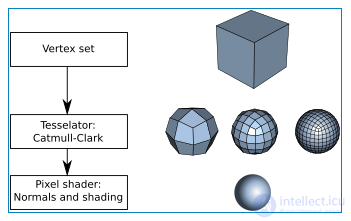
A simple tessellation pipeline rendering a smooth sphere from a coarse cubic vertex set using the subdivision method
In computer-aided design, a constructed structure is represented by a topological boundary representation model, in which analytic three-dimensional surfaces and curves, bounded by faces, edges, and vertices, form a continuous boundary of a three-dimensional solid. Arbitrary three-dimensional solids are often too complex for direct analysis. They are therefore approximated (tessellated) by a mesh of small, easily analyzed three-dimensional volume fragments — usually irregular tetrahedra or irregular hexahedra. This mesh is used for finite element analysis.
A surface mesh is usually generated for individual faces and edges (approximated to polylines), so that the original boundary vertices are included in the mesh. To ensure that the approximation of the original surface meets the requirements of further processing, three main parameters are typically defined for the surface mesh generator:
The mesh generation algorithm is usually controlled by the three parameters specified above, among others. Some types of computer analysis of a constructed structure require adaptive mesh refinement, which produces a finer mesh (using stricter parameters) in areas where the analysis requires greater detail.

Comments