
Lecture
In two-dimensional graphics, if the user has zoomed in on an image and only a small portion remains visible on the screen, the program can save processor time and memory by not rendering the remaining parts of the image that are "off-screen".
Similarly, in three-dimensional graphics a scene may consist of objects located on all sides of the virtual camera's frame, but the program only needs to compute those objects that are within the field of view. In three-dimensional graphics this is a non-trivial task.
The coordinates of the real scene are called world coordinates. An object is not always drawn in full. Computer graphics defines the concept of a window. This is an area, specified in world coordinates, within which the object is drawn. In the simplest case it is a rectangle with sides parallel to the coordinate axes. It is important to note that the window pertains to the object, not to the resulting image. The area of the screen onto which the window is mapped is called the output area (or viewport). The two-dimensional coordinates of the output area are called screen coordinates. Since the smallest addressable element is a pixel, screen coordinates always take natural (integer) values.
In the two-dimensional case, a window is specified in a two-dimensional world coordinate space, and an output area is specified on a two-dimensional view surface. In the general case, objects described in world coordinates are clipped against the boundary of the visible volume, after which they are transformed into the output area for the display. The complexity characteristic of the three-dimensional case arises because the view surface has no graphical third dimension.
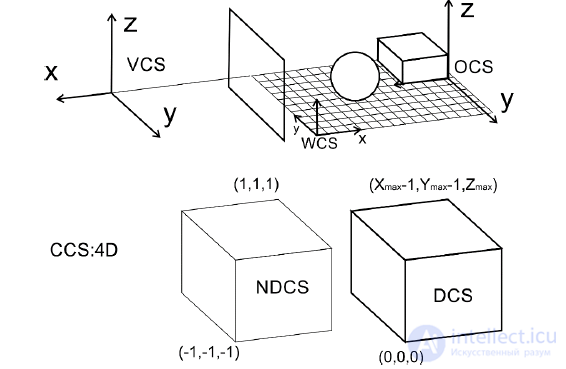
Fig. 3.1 Coordinate systems according to the OpenGL graphics pipeline
For example, in the OpenGL graphics library the following coordinates are distinguished: (Fig. 3.1)
OCS – object coordinate system, object coordinates;
WCS – world coordinate system, world coordinates;
VCS – viewing coordinate system, viewing coordinates;
CCS – clipping coordinate system, clipped coordinates;
NDCS - normalized device coordinate system, normalized screen
DCS – device coordinate system, screen coordinates;

Comments