
Lecture
The shell method has become widely used in three-dimensional computer graphics systems for both single-processor and multiprocessor machines. It gets its name from the use of simple three-dimensional convex shell figures, which enclose an object or its component parts and make it comparatively easy to identify the region of space where the object is located. Several modifications of the method are known; for example, its application at the visibility-determination stage has been demonstrated.
Polygon shells. The essence of the method, which reduces the computation time for images with shadows, is as follows. At the stage of constructing the mathematical representation of the object, each of its individual elements (a primitive or a system of primitives) is surrounded, interactively or automatically, by an imaginary shell – a convex polyhedron. The number of vertices and the orientation of the faces are chosen with a view to reliably enclosing the body of the element within the shell, achieving minimal shell volume, and minimizing the number of faces.
In automatic construction of a convex shell, a parallelepiped is most often chosen as its shape. The basic idea for determining the position and dimensions of the parallelepiped consists in calculating the maximum overall dimensions of the enclosing primitive along the axes. Since the segments defining the maximum overall dimensions may not be parallel to the axes, the constructed shell often captures excess regions of space not belonging to the object, which in turn reduces the efficiency of the method. When a shell is defined "manually" in the form of an irregular polygon, a tighter fit around the object is achieved, but this requires non-automated work by the operator. In practice, this work amounts to placing in space the smallest possible number of points that lie as close as possible to the object while also ensuring that the convex shell constructed on these points does not cut through the object with its faces.
Besides polyhedra and parallelepipeds, ellipsoids can also be used as shells. A remarkable property of the ellipsoid among all second-order surfaces is the closedness of its surface, and therefore an ellipsoid can be used as a shell enclosing an object. By varying the size and orientation of the semi-axes, one can achieve a fairly tight fit around a body of virtually any configuration.
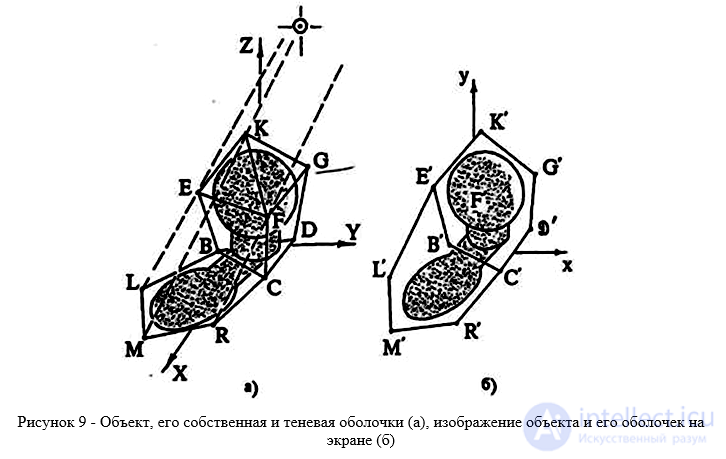
Figure 9 - Object, its own shell and shadow shell (a), image of the object and its shells on the screen (b)

Comments