
Lecture
2.5D graphics (pronounced "two and a half dimensional") refers to gameplay or movement in a video game or virtual reality environment that is restricted to a two-dimensional (2D) plane with little or no access to a third dimension, in a space that would otherwise appear three-dimensional and is often modeled and rendered in a three-dimensional digital environment.
This is similar to, but distinct from, pseudo-three-dimensional perspective (sometimes called three-quarter view, in which the environment is depicted from an angled top-down perspective), which refers to two-dimensional graphical projections and similar techniques used to make images or scenes imitate the appearance of three-dimensionality (3D), even though they are not actually three-dimensional.
By contrast, games, spaces, or perspectives that are modeled and rendered in 3D and used in 3D level design are called true 3D, while games with 2D rendering that are made to look like 2D but do not approach 3D imagery are called true 2D.
Common in video games, 2.5D projections are also useful in geographic visualization (GVIS) to help understand visual-cognitive spatial representations or 3D visualization.
The terms "three-quarter perspective" and "three-quarter view" originate from the three-quarter profile in portrait painting and facial recognition, which depicts a person's face positioned between a frontal view and a side view.

Lincity arranges two-dimensional axonometric graphical elements, forming a pseudo-three-dimensional game environment.
In axonometric projection and oblique projection, two forms of parallel projection, the viewpoint is slightly rotated to reveal other faces of the environment than those visible in a top-down or side perspective, thereby creating a three-dimensional effect. The object "is considered to be in an inclined position, resulting in foreshortening of all three axes," and the image is "a representation on a single plane (as a drawing surface) of a three-dimensional object positioned at an angle to the plane of projection." Lines perpendicular to the plane become points, lines parallel to the plane retain their true length, and lines inclined to the plane are foreshortened.
These are popular camera perspectives among 2D video games, most often released for 16-bit or earlier and handheld consoles, as well as in later strategy and role-playing video games. The advantage of these perspectives is that they combine the visibility and mobility of a top-down game with the character recognizability of a side-scrolling game. Thus, the player can be presented with a view of the game world that allows them to see it from above, more or less, with additional detail in the artwork made possible by the use of the angle: instead of showing a humanoid in top-down perspective as a head and shoulders seen from above, the entire body can be drawn using an oblique angle; turning the character will show how it looks from the sides, front, and back, whereas a top-down perspective would display the same head and shoulders regardless.
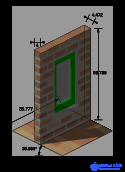
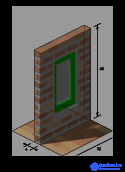
There are three main subdivisions of axonometric projection: isometric (equal measure), dimetric (symmetric and asymmetric), and trimetric (one view or only two sides). The most common of these drawing types in engineering drafting is isometric projection. This projection is tilted so that all three axes form equal angles spaced 120 degrees apart. The result is that all three axes are equally foreshortened. In video games, a form of dimetric projection with a 2:1 pixel ratio is more common due to anti-aliasing issues and the square pixels found on most computer monitors.
In oblique projection, all three axes are usually shown without foreshortening. All lines parallel to the axes are drawn to scale, while diagonals and curved lines are distorted. One clear sign of oblique projection is that the face pointing toward the camera retains its right angles relative to the image plane. [clarification needed]
Two examples of oblique projection are Ultima VII: The Black Gate and Paperboy. Examples of axonometric projection include SimCity 2000 and the role-playing games Diablo and Baldur's Gate.
In three-dimensional scenes, the term billboarding is applied to a technique in which objects are sometimes represented by two-dimensional images mapped onto a single polygon, which is usually kept perpendicular to the line of sight. The name refers to the fact that the objects appear as if drawn on a billboard. This technique was widely used in video games of the early 1990s, when consoles lacked the hardware power to render fully three-dimensional objects. It is also known as a backdrop. It can be used to good effect to significantly improve performance when geometry is far enough away that it can easily be replaced with a 2D sprite. In games, this technique is most often applied to objects such as particles (smoke, sparks, rain) and low-detail vegetation. Since then it has become mainstream and is found in many games, such as Rome: Total War, where it is used to display thousands of individual soldiers on the battlefield simultaneously. Early examples include early first-person shooters such as the Marathon Trilogy, Wolfenstein 3D, Doom, Hexen, and Duke Nukem 3D, as well as racing games such as Carmageddon and Super Mario Kart, and platformers such as Super Mario 64.
Skyboxes and skydomes are techniques used to easily create a background so that a game level appears larger than it actually is. If a level is enclosed in a cube, the sky, distant mountains, distant buildings, and other unreachable objects are rendered onto the faces of the cube using a technique called cube mapping, thereby creating the illusion of a distant three-dimensional surrounding environment. A skydome uses the same concept, but uses a sphere or hemisphere instead of a cube.
As the viewer moves through a 3D scene, the skybox or skydome typically remains stationary relative to the viewer. This technique creates the illusion that the skybox is very far away, since other objects in the scene appear to move while the skybox does not. This mimics real life, where distant objects such as clouds, stars, and even mountains appear stationary as the viewpoint shifts over relatively small distances. In fact, everything in the skybox will always appear infinitely far from the viewer. This consequence of skyboxes dictates that designers must be careful not to carelessly include images of individual objects in skybox textures, since the viewer may notice size inconsistencies of these objects while moving through the scene.
In some games, sprites are scaled larger or smaller depending on the distance to the player, creating the illusion of movement along the Z-axis (forward). Sega's 1986 video game Out Run, running on the Sega OutRun arcade system board, is a good example of this technique.
In Out Run, the player drives a Ferrari into the depth of the game window. The palm trees on the left and right of the street are the same bitmap image, but they are scaled to different sizes, creating the illusion that some of them are closer than others. The directions of movement were "left and right" and "into the depth" (although technically still possible, this game did not allow for a U-turn or reversing, so movement was "out of the depth," since that did not make sense for the high-speed gameplay and intense time limit). Note that the view is comparable to what a driver would have in reality when driving a car. The position and size of any billboard are generated using a (full 3D) perspective transformation, as are the vertices of the polyline representing the center of the street. Often, the center of the street is stored as a spline and chosen such that on straight streets, each sample point corresponds to a single scan line on the screen. Hills and curves result in multiple points on a single line, and one must be chosen. Or a line may have no point at all and must be interpolated linearly from neighboring lines. Memory-intensive billboards are used in Out Run to draw cornfields and waves on water that are wider than the screen even at the greatest viewing distance, and in Test Drive to draw trees and cliffs.
Drakkhen was notable for being one of the first role-playing video games to have a three-dimensional game field. However, it did not use a conventional 3D engine, but emulated one using character-scaling algorithms. The player's party travels overland across flat terrain composed of vectors, onto which 2D objects are scaled. Drakkhen has an animated day-night cycle and the ability to roam the game world freely, which was rare for a game of its era. This type of engine was later used in the game Eternam.
Some mobile games released on the Java ME platform, such as the mobile version of Asphalt: Urban GT and Driver: LA Undercover, used this method to render landscapes. Although this technique is similar to some Sega arcade games, such as Thunder Blade and Cool Riders, as well as the 32-bit version of Road Rash, it uses polygons instead of sprite scaling for buildings and certain objects, though it appears flat-shaded. Later mobile games (mostly from Gameloft), such as Asphalt 4: Elite Racing and the mobile version of Iron Man 2, use a mix of sprite scaling and texture mapping for some buildings and objects.

Example of parallax scrolling
Parallax refers to making a set of 2D sprites or sprite layers move independently of each other and/or of the background to create a sense of additional depth. :103 This depth cue is created by the relative motion of the layers. The technique grew out of the multiplane camera technique used in traditional animation since the 1940s. This type of graphical effect was first used in the 1982 arcade game Moon Patrol. Examples include the skies in Rise of the Triad, the arcade version of Rygar, Sonic the Hedgehog, Street Fighter II, Shadow of the Beast, and Dracula X Chronicles, as well as Super Mario World.
Mode 7 is a display system effect involving rotation and scaling, allowing a 3D effect to be created when moving in any direction without any real 3D models, and was used to simulate 3D graphics on the SNES.
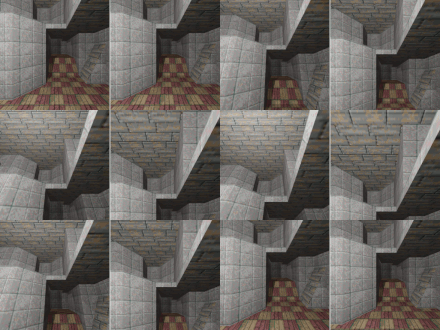
Although techniques such as camera shifting (as shown on the right) are sometimes used to create the illusion of rotation, renderers using ray casting cannot rotate the said camera vertically, as true 3D renderers can (left).
Ray casting is a pseudo-3D first-person technique in which a ray is cast from the camera position for each vertical slice of the screen. These rays are fired until they hit an object or wall, and that portion of the wall is rendered in that vertical slice of the screen. Due to the limited camera movement and the internal 2D game field, this is often considered 2.5D.
Bump mapping, normal mapping, and parallax mapping are techniques applied to textures in 3D rendering applications, such as video games, to simulate bumps and wrinkles on the surface of an object without using more polygons. For the end user, this means that textures, such as stone walls, will have greater apparent depth and, consequently, greater realism with less impact on simulation performance.
Bump mapping is achieved by perturbing an object's surface normals and using a grayscale image and the perturbed normal during lighting calculations. The result is a visibly uneven surface rather than a perfectly smooth one, although the surface of the underlying object does not actually change. Bump mapping was introduced by Blinn in 1978.
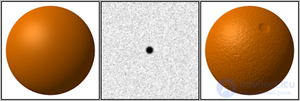
A sphere without bump mapping (left). The bump map that will be applied to the sphere (middle). The sphere with the bump map applied (right).
In normal mapping, the unit vector from the shading point to the light source is compared with the unit normal vector of that surface, and the dot product is the intensity of light on that surface. Imagine a polygonal model of a sphere — you can only approximately define the shape of the surface. By using a 3-channel bitmap image textured over the entire model, more detailed information about the normal vector can be encoded. Each channel in the bitmap corresponds to a spatial dimension (x, y, and z). These spatial dimensions relate to a fixed coordinate system for object-space normal maps, or to a smoothly varying coordinate system (based on derivatives of position with respect to texture coordinates) in the case of tangent-space normal maps. This adds much more detail to the model's surface, especially when combined with advanced lighting techniques.
Parallax mapping (also called offset mapping or virtual offset mapping) is an enhancement of bump mapping and normal mapping techniques, implemented by offsetting the texture coordinates at a point on the rendered polygon as a function of the viewing angle in tangent space (the angle relative to the surface normal) and the height map value at that point. At steeper viewing angles, the texture coordinates are offset more strongly, creating an illusion of depth due to parallax effects as the view changes.
The term is also used to describe an animation effect commonly used in music videos and, most often, in title sequences. Brought to wide attention by the film "The Kid Stays in the Picture," an adaptation of film producer Robert Evans's memoir, it involves layering and animating two-dimensional images in three-dimensional space. Earlier examples of this technique include the music videos for Liz Phair's "Down" (directed by Rodney Ascher) and "A Special Tree" (directed by musician Giorgio Moroder).
On a larger scale, the 2018 film "In Saturn's Rings" used more than 7.5 million individual two-dimensional images, captured in space or through telescopes, which were composited and animated using multiplane animation techniques.
The term also refers to a frequently used effect in icon and graphical user interface (GUI) design, where a slight illusion of 3D is created by having a virtual light source to the left (or, in some cases, to the right) and above a person's computer monitor. The light source itself is always invisible, but its effects are visible as lighter colors on the top and left side of objects, imitating a reflection, and darker colors on the right and bottom of such objects, imitating a shadow.
An extended version of this technique can be found in some specialized graphic design programs, such as ZBrush by Pixologic. The idea is that the program's canvas is an ordinary 2D drawing surface, but the data structure that holds the pixel information can also store information regarding z-index, as well as material settings, specularity, and so on. Again, using this data, lighting, shadows, and so on can be simulated.
The first video games to use pseudo-3D were mostly arcade games, with the earliest known examples dating back to the mid-1970s, when they began to use microprocessors. In 1975, Taito released Interceptor, an early first-person shooter and combat flight simulator in which players had to pilot a jet fighter, using an eight-way joystick to aim a crosshair and shoot at enemy aircraft that moved in pairs and increased/decreased in size depending on the distance to the player. In 1976, Sega released Moto-Cross, an early black-and-white motorcycle racing video game based on motocross competitions, most notable for introducing an early three-dimensional third-person perspective. Later that year, Sega-Gremlin renamed the game Fonz, as a tie-in to the popular sitcom Happy Days. Both versions of the game displayed a constantly changing, forward-scrolling road and the player's motorcycle in a third-person perspective, where objects closer to the player were larger than those closer to the horizon, and the goal was to steer the vehicle along the road, racing against time while avoiding oncoming motorcycles or running off the road. That same year also saw the release of two arcade games that expanded the driving subgenre into three dimensions with a first-person perspective: Road Race by Sega, which displayed a constantly changing, forward-scrolling S-shaped road with two racing cars as obstacles moving along the road that the player had to avoid colliding with while racing against time, and Night Driver by Atari, which featured a series of posts along the edge of the road, although there was no view of the road or the player's car. Games using vector graphics had an advantage in creating pseudo-3D effects. The 1979 film "Speed Freak" recreated the Night Driver perspective in more detail.
In 1979, Nintendo debuted Radar Scope, a shooter that introduced the genre to a three-dimensional third-person perspective, later copied by shooters such as Konami's Juno First and Activision's Beamrider. In 1980, Atari's Battlezone became a breakthrough for pseudo-3D games, recreating a three-dimensional perspective with unprecedented realism, although the gameplay itself remained flat. That same year it was followed by Red Baron, which used scalable vector graphics to create a straight-scrolling rail shooter.
Sega's arcade shooter Space Tactics, released in 1980, allowed players to aim with a sight and fire lasers at the screen at enemies approaching them, creating an early 3D effect. It was followed by other first-person arcade shooters in the early 1980s, including Taito's Space Seeker, released in 1981, and Sega's Star Trek in 1982. Sega's SubRoc-3D in 1982 also featured a first-person view and introduced the use of stereoscopic 3D through a special eyepiece. Sega's Astron Belt in 1983 was the first laserdisc video game to use full-screen video to display first-person graphics. At the same time, third-person rail shooters were also released in arcades, including Sega's Tac/Scan in 1982, Nippon's Ambush in 1983, Nichibutsu's Tube Panic in 1983, and Sega's 1982 release Buck Rogers: Planet of Zoom, notable for its fast pseudo-3D scaling and detailed sprites.
In 1981, Sega's Turbo became the first racing game to use sprite scaling with full-color graphics. Namco's Pole Position is one of the first racing games to use the chase-camera effect that is now so familiar [citation needed]. In this particular example, the effect was achieved using line scrolling — the practice of scrolling each line independently to warp the image. In this case, the warping simulated curves and steering. To make the road appear to move toward the player, line-by-line color changes were used, although many console versions instead chose palette animation.
Zaxxon, a shooter introduced by Sega in 1982, was the first game to use isometric axonometric projection, from which its name is derived. Although Zaxxon's game field is semantically three-dimensional, the game has many limitations that classify it as 2.5D: a fixed viewpoint, a scene composed of sprites, and movements, such as bullet shots, restricted to straight lines along the axes. It was also one of the first video games to display shadows. The following year, Sega released the first pseudo-3D isometric platformer, Congo Bongo. Another early pseudo-3D platform game released the same year was Konami's Antarctic Adventure, in which the player controls a penguin in a forward-scrolling third-person perspective, having to jump over pits and obstacles. It was one of the earliest pseudo-3D games available on a computer, released for the MSX in 1983. That same year, Irem's Moon Patrol was a side-scrolling platform shooter that introduced the use of multilayered parallax scrolling to create a pseudo-3D effect. In 1985, Space Harrier introduced Sega's "Super Scaler" technology, which allowed pseudo-3D scaling at a high frame rate, with the ability to scale 32,000 sprites and fill a moving landscape with them.
The first original home console game to use pseudo-3D, as well as the first to use multiple camera angles reminiscent of television sports broadcasts, was Intellivision World Series Baseball (1983) by Don Daglow and Eddie Dombrower, published by Mattel. Its television sports-style presentation was later adopted by 3D sports games and is now used in practically all major team sports games. In 1984, Sega ported several pseudo-3D arcade games to the Sega SG-1000 console, including a smooth conversion of the pseudo-3D third-person rail shooter Buck Rogers: Planet of Zoom.
By 1989, 2.5D representations consisted of surfaces drawn using depth cues and were part of graphics libraries such as GINO. 2.5D was also used in terrain modeling with software packages such as ISM from Dynamic Graphics, GEOPAK from Uniras, and the Intergraph DTM system. 2.5D surface methods gained popularity in the geographic community due to their ability to visualize the normal thickness-to-area ratio used in many geographic models; this ratio was very small and reflected the thinness of an object relative to its width, making it a realistic object within a given plane. These representations were axiomatic in the sense that the entire subsurface region was not used, or the entire region could not be reconstructed; therefore only the surface was used, and the surface is one aspect, not the full three-dimensional identity.
The specific term "two-and-a-half-D" was used as early as 1994 by Warren Spector in an interview in the North American premiere issue of PC Gamer magazine. At the time, the term was understood to refer specifically to first-person shooters such as Wolfenstein 3D and Doom, distinguishing them from the "true" 3D engine of System Shock.
With the advent of consoles and computer systems capable of processing several thousand polygons (the most basic element of 3D graphics) per second, and the use of specialized 3D graphics processors, pseudo-3D became obsolete. But even today, computer systems such as mobile phones are still being produced that are often not powerful enough to display true 3D graphics, and therefore use pseudo-3D for this purpose. Many games from the pseudo-3D arcade era of the 1980s and the 16-bit console era have been ported to these systems, giving manufacturers the opportunity to generate revenue from games that are decades old.
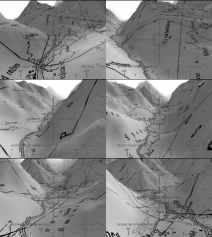
Fly over the Trent Valley
The revival of 2.5D, or visual analysis, in the natural and geological sciences increased the role of computer systems in generating spatial information for mapping. GVIS made it possible to genuinely search for unknowns, interact with spatial data in real time, and control the display of maps, and placed particular emphasis on three-dimensional representations. Efforts in GVIS were aimed at expanding higher dimensions and making them more prominent; most of the effort focused on "tricking" vision into seeing three dimensions in a 2D plane. This is much like 2.5D displays, where the surface of a three-dimensional object is represented, but locations within the solid are distorted or inaccessible.
The reason for using pseudo-3D instead of "real" 3D computer graphics is that a system meant to simulate 3D graphics is not powerful enough to handle the intensive computations of 3D computer graphics, but is capable of using 2D graphics modification techniques, such as bitmap images. One such technique is to stretch a bitmap image more and more, thereby enlarging it with each step, to create the effect of an object approaching the player.
Even simple shading and image sizing can be considered pseudo-3D, since shading makes it more realistic. If the light in a 2D game were 2D, it would only be visible on the outline, and since outlines are often dark, they would not be very clearly visible. However, any visible shading indicates the use of pseudo-3D lighting and that the image uses pseudo-3D graphics. Changing the size of an image can make it appear to approach or recede, which can be considered a simulation of the third dimension.
Dimensions are variables of data and can be mapped to specific locations in space; 2D data can be given 3D volume by adding a value to the x, y, or z plane. "Assigning a height to 2D areas of a topographic map," linking each 2D location to an elevation/height value, creates a 2.5D projection; this is not considered a "true 3D representation," but is used as a 3D visual representation to "simplify visual image processing and the resulting spatial cognition."

Comments