
Lecture
For simplicity, we will assume that in central projection the center of projection is located at the origin and the picture plane is perpendicular to the 𝑍 axis and coincides with the plane 𝑧=𝑑, while in parallel projection it coincides with the plane. Projections are considered in the observer's coordinate system, which is left-handed. The coordinate system in which the 𝑋 axis points to the right, the 𝑌 axis points up, and the 𝑍 axis points into the screen naturally agrees with the display screen. To pass from the right-handed coordinate system, in which the translation, rotation, and scaling transformations were described, to the left-handed system in which the projections are described, we can use the matrix
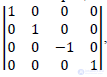
where the 𝑧 coordinate is multiplied by −1
Each of the projections can be described by a 4×4 matrix. This turns out to be convenient, since it becomes possible to combine the projection matrix with the matrix of affine transformations, thereby representing two transformation operations (geometric translation, scaling, rotation, and projection) as a single matrix.
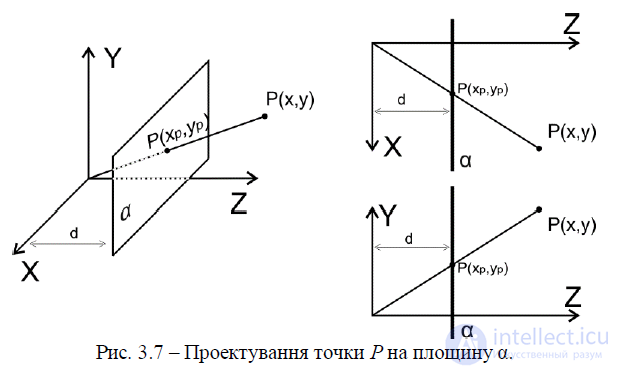
Fig. 3.7 – Projection of point P onto plane α.
Fig. 3.7 shows three images in a left-handed coordinate system, in which point P is projected onto the projection plane located at a distance 𝑑 from the origin.
To calculate the coordinates of the projection of the point (𝑥,𝑦,𝑧), let us write the relations obtained from similar triangles:

The distance 𝑑 is, in this case, a scale factor applied to the coordinates 𝑥𝑝 and 𝑦𝑝. The reason that more distant objects appear smaller than closer ones in central projection is the division by 𝑧. All values of 𝑧 are permissible except 𝑧=0. Points can be located either behind the center of projection on the negative part of the 𝑍 axis, or between the center of projection and the projection plane.
This transformation can be represented as a 4×4 matrix:
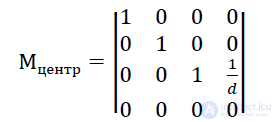
Multiplying the point 𝑃 = |𝑥 𝑦 𝑧 1| by the matrix M_center, we obtain the general expression for the point in homogeneous coordinates |𝑋 𝑌 𝑍 𝑊|:

or
 (5)
(5)
Now, dividing by 𝑊 (which equals 𝑧𝑑) to return to three dimensions, we have

This result is correct, since it contains the transformed 𝑧-coordinate, which corresponds to the position of the projection plane along the 𝑍 axis.
Orthographic projection onto the plane 𝑧 = 0 is obvious.
The direction of projection coincides with the normal to the projection plane, that is, in our case, with the 𝑍 axis.
Thus, point 𝑃 has the coordinates:

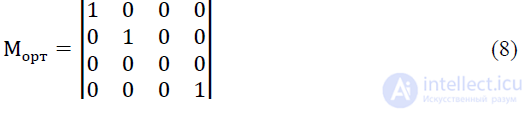
This projection is described by the matrix
In oblique projection, onto the XOY plane, the unit vector  = (0,0,1) transforms into
  = (𝑎, 𝑏, 0), i.e., the direction of projection is given by the vector
 (𝑎, 𝑏, −1)
Such a transformation in homogeneous coordinates can be specified using the matrix.
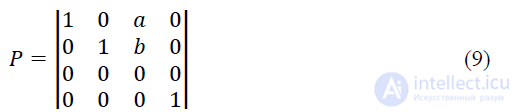
In the cavalier projection, the vector  transforms into (cos (𝜋⁄4), 𝑐𝑜𝑠 (𝜋 ⁄ 4),0),
and in the cabinet projection 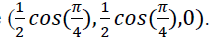

Comments