
Lecture
A digital image is an image composed of picture elements, also known as pixels, each of which has finite discrete numerical values representing its intensity or gray level, being the output of its two-dimensional functions fed as input by its spatial coordinates, denoted as x, y on the x-axis and y-axis respectively. Depending on whether the image resolution is fixed, it may be vector or raster. The term «digital image» by itself usually refers to raster images or bitmap images (as opposed to vector images).
Raster images have a finite set of digital values called picture elements or pixels. A digital image contains a fixed number of rows and columns of pixels. Pixels are the smallest single component of an image, containing quantized values that represent the brightness of a given color at any specific point.
Pixels are typically stored in computer memory as a raster image or bitmap, a two-dimensional array of small integers. These values are often transmitted or stored in a compressed form.
Raster images can be created using a variety of input devices and techniques, such as digital cameras, scanners, coordinate-measuring machines, seismographic profiling, airborne radar, and so on. They can also be synthesized from arbitrary non-image data, such as mathematical functions or three-dimensional geometric models; the latter is a major subarea of computer graphics. The field of digital image processing is the study of algorithms for their transformation.
Most users encounter raster images through digital cameras, which use one of several image file formats.
Some digital cameras provide access to nearly all of the data captured by the camera using the RAW image format. The Universal Photographic Digital Imaging Guidelines (UPDIG) recommend using these formats whenever possible, since RAW files produce the highest-quality images. These file formats give the photographer and processing agent the greatest degree of control and precision over the output. Their use is constrained by the prevalence of proprietary information (trade secrets) held by some camera manufacturers, but there have been initiatives, such as OpenRAW, to pressure manufacturers into publishing these records. An alternative may be Digital Negative (DNG), an Adobe proprietary product described as «a public archival format for digital camera RAW data». Although this format has not yet gained universal acceptance, support for the product is growing, and an increasing number of professional archivists and preservation specialists working at respected institutions variously suggest or recommend DNG for archival purposes.
Vector images are derived from mathematical geometry (vector). In mathematical terms, a vector consists of a magnitude, or length, and a direction.
Raster and vector elements are often combined within a single image, for example in the case of a billboard with text (vector) and photographs (raster).
Examples of vector file types are EPS, PDF, and AI.
Image viewing software displays images. Web browsers can display standard Internet image formats, including JPEG, GIF, and PNG. Some can display the SVG format, which is a standard W3C format. In the past, when the Internet was still slow, it was common to provide «preview» images that loaded and appeared on a website before being replaced by the main image (to give a preliminary impression). Now the Internet is fast enough that these preview images are rarely used.
Some scientific images can be very large (for example, an image of the Milky Way at 46 gigapixels, about 194 GB in size). Such images are difficult to download and are usually viewed online through more sophisticated web interfaces.
Some viewers offer a slideshow utility, allowing a sequence of images to be displayed.
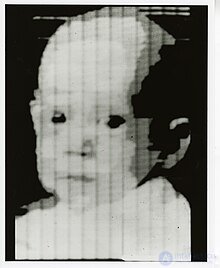
First scan performed by SEAC in 1957
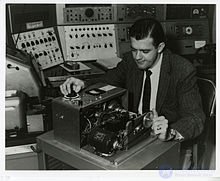
The SEAC scanner
Early digital facsimile machines, such as the Bartlane cable picture transmission system, appeared decades before digital cameras and computers. The first image to be scanned, stored, and recreated in digital pixels was displayed on the Standards Eastern Automatic Computer (SEAC) at NIST. The development of digital imaging continued in the early 1960s, alongside the development of the space program and medical research. Projects at the Jet Propulsion Laboratory, the Massachusetts Institute of Technology, Bell Labs, and the University of Maryland, among others, used digital images to improve satellite imagery, convert phototelegraphy standards, and advance medical imaging, videophone technology, character recognition, and photograph enhancement.
The rapid development of digital image processing began with the emergence of MOS integrated circuits in the 1960s and microprocessors in the early 1970s, together with the development of corresponding storage devices, display technologies, and data compression algorithms.
The invention of computed axial tomography (CAT scanning), which uses X-rays to produce a digital image of a «slice» of a three-dimensional object, was of great significance for medical diagnostics. Alongside the emergence of digital imaging, the digitization of analog images made it possible to improve and restore archaeological artifacts and began to be used in such diverse fields as nuclear medicine, astronomy, law enforcement, defense, and industry
Advances in microprocessor technology paved the way for the development and marketing of charge-coupled devices (CCDs) for use in a wide range of image capture devices and gradually displaced the use of analog film and tape in photography and videography by the end of the 20th century. The computing power required to process digital image capture also enabled computer-generated digital images to achieve a level of detail approaching photorealism.
The first semiconductor image sensor was the CCD, developed by Willard S. Boyle and George E. Smith at Bell Labs in 1969. While researching MOS technology, they realized that electric charge is analogous to a magnetic bubble and that it could be stored on a tiny MOS capacitor. Since it was fairly simple to fabricate a row of MOS capacitors, they connected a suitable voltage to them so that charge could be transferred from one to the next. The CCD is a semiconductor circuit that was later used in the first digital video cameras for television broadcasting.
Early CCD sensors suffered from shutter lag. This problem was largely resolved with the invention of the pinned photodiode (PPD). It was invented by Nobukazu Teranishi, Hiromitsu Shiraki, and Yasuo Ihara at NEC in 1980. It was a low-lag, low-noise, high-quantum-efficiency, low-dark-current photodetector structure. In 1987, the PPD began to be incorporated into most CCD devices, becoming an integral part of consumer electronic video cameras and later digital cameras. Since then, the PPD has been used in nearly all CCD sensors, and later in CMOS sensors.
The NMOS active-pixel sensor (APS) was invented by Olympus in Japan in the mid-1980s. This was made possible by advances in MOS semiconductor device fabrication, as MOSFET scaling reached micron and later sub-micron levels. The NMOS active-pixel sensor was manufactured by Tsutomu Nakamura's team at Olympus in 1985. The CMOS active-pixel sensor (CMOS sensor) was later developed by Eric Fossum's team at NASA's Jet Propulsion Laboratory in 1993. By 2007, sales of CMOS sensors had surpassed sales of CCD sensors.
An important advance in digital image compression technology was the discrete cosine transform (DCT), a lossy compression method first proposed by Nasir Ahmed in 1972. DCT compression is used in JPEG, which was introduced by the Joint Photographic Experts Group in 1992. JPEG compresses images to much smaller file sizes and has become the most widely used image file format on the Internet.
In digital image processing, a mosaic is a combination of non-overlapping images arranged in some tessellation. Gigapixel images are an example of such digital image mosaics. Satellite images are often combined into a mosaic to cover regions of the Earth.
Interactive viewing is provided through virtual reality photography.

Comments