
Lecture
The electromagnetic field is characterized by four vectors.
These vectors are:
E(x, y, z, t) — the electric field strength vector;
B(x, y, z, t) — the magnetic induction vector;
D(x, y, z, t) — the electric displacement vector;
H(x, y, z, t) — the magnetic field strength vector.
The dimensions of these vectors
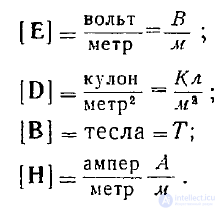
The sources of the electromagnetic field are characterized by:
— the electric current density vector J;
— the electric charge density ρ.
The dimensions of these quantities
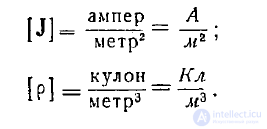
Maxwell's equations have the following form:
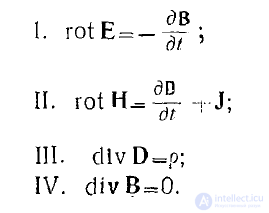
Maxwell's equations formulate, in the most general compact form, the laws of the electromagnetic field. They are laws expressing, in the most general form, the structure of the electromagnetic field, and establish the connection between the electromagnetic field and its sources, which are currents and charges. Maxwell's equations were established on the basis of an immense body of experimental facts. There is not a single experimental fact that contradicts these equations. Theoretically, these equations are not proved. What is the benefit of formulating the field's regularities in the generalized form of equations? Such a formulation makes it possible to establish particular regularities, including previously unknown ones. The Maxwell equations written above are differential equations in partial derivatives. However, Maxwell's equations can also be formulated in integral form. Such a formulation makes it possible to establish a direct connection between Maxwell's equations and the experimental laws of which they are a generalization.
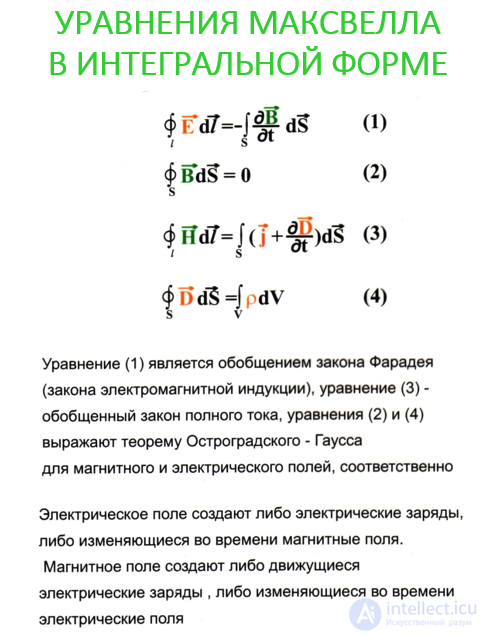
The first Maxwell equation (in some books it is considered the second) is formulated as follows:
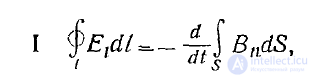
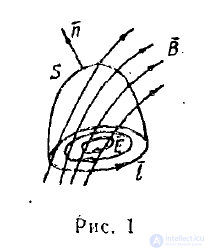
where l — is a fixed imaginary closed contour, and S — is an arbitrary surface bounded by this contour (fig. 1). The circulation of the electric field strength vector along a stationary contour equals, with the opposite sign, the time derivative of the flux of magnetic induction through the surface bounded by this contour.
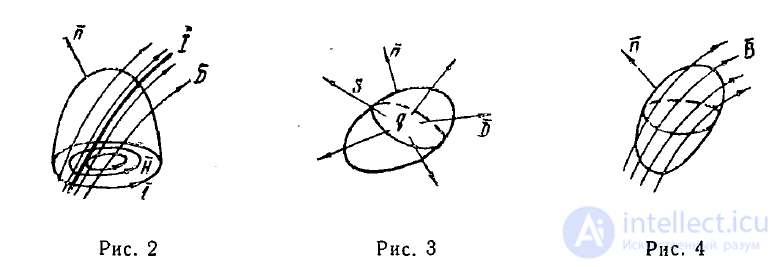
The second Maxwell equation (in some books it is considered the first) has the form
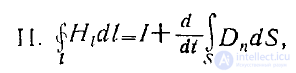
where
I — is the conduction current;
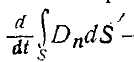 — is the displacement current;
l — is a fixed contour;
S — is an arbitrary surface bounded by this contour (fig. 2).
The circulation of the magnetic field strength vector along a stationary contour equals the total current — the sum of the conduction current and the displacement current, flowing through the surface bounded by this contour.
The third Maxwell equation
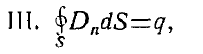
where q — is the electric charge (fig. 3).
The flux of the electric displacement vector through a closed surface equals the charge enclosed within this surface.
The fourth equation
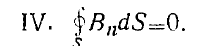
The flux of the magnetic induction vector through a closed surface equals zero (fig. 4). In other words — the magnetic induction vector
has no sources, i.e. in nature there are no magnetic charges analogous to electric ones.
The first equation is a generalization of the law of electromagnetic induction, discovered by Faraday in 1831. This law states the following: when the flux of magnetic induction changes through a surface
bounded by a closed wire, an induced current arises in the latter, the direction of which is determined by Lenz's rule, i.e. the induced current has such a direction that the magnetic field it creates tends to compensate for the change in this flux. The mathematical formulation of this law
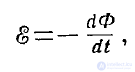
where
 — is the electromotive force of induction, arising in the wire;
Φ — is the magnetic induction flux.
The generalization consists in establishing the equalities
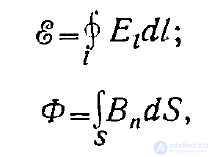
and instead of a wire there can be any imaginary contour l (fig. 5).
The second Maxwell equation is a generalization of the law of total current, which in turn is a generalization of the experimental law of interaction of two parallel currents, discovered by Ampere in 1820, following the effect of a current on a magnetic needle discovered by Oersted in that same year, 1820. Ampere's law for the force F of interaction of two parallel
currents I1 and I2 is formulated as follows:
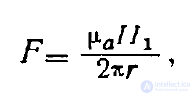
where r — is the distance between the wires (fig. 6), μa — is the magnetic permeability of the medium.
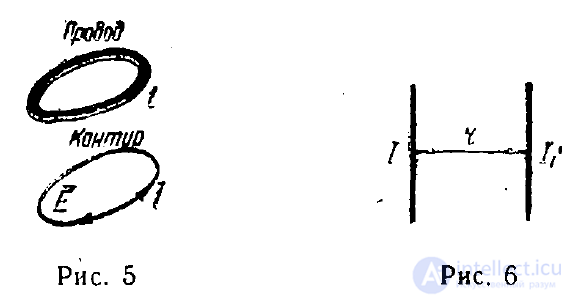
If the currents are directed the same way, then there is attraction, and if they are directed oppositely, then there is repulsion.
Let us present the considerations leading to the generalization of Ampere's law into the second Maxwell equation. The current I creates a magnetic field
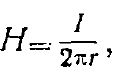 whose vector lines represent concentric circles centered at the point where the current passes (fig. 7,a). Let us draw an arbitrary closed contour l in the same plane in which the vector lines of H lie, and let us find (fig. 7,b).
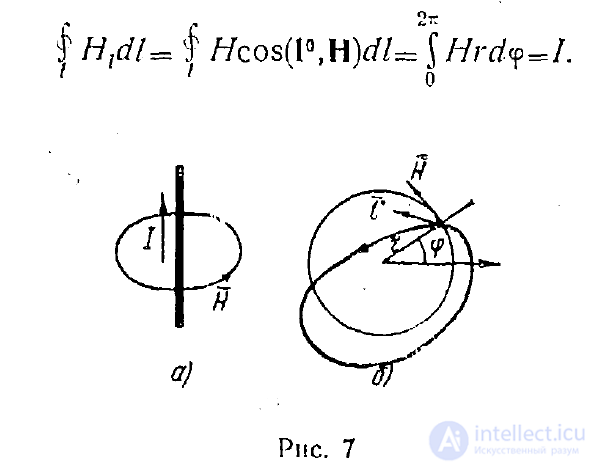
This result, obviously, can be generalized to the case when the contour l encloses not one, but many parallel currents, and then we obtain the law of total current
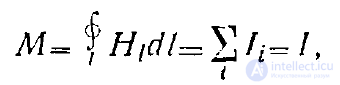
which is formulated as follows: the magnetomotive force M in a closed contour, enclosing the total current I, equals this current. A further generalization was made by Maxwell. He introduced into the law of total
current a new current — the displacement current 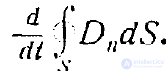
So that the magnetomotive force in a closed contour is created by the total current — the conduction current and the displacement current. The introduction of the displacement current was the most significant generalization of pre-Maxwellian electromagnetic theory. The third equation is a generalization of Coulomb's law for the force F of interaction of two charges, discovered by Coulomb in 1785
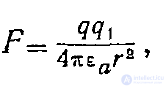
where
r — is the distance between the charges;
 — is the dielectric permittivity of the medium.
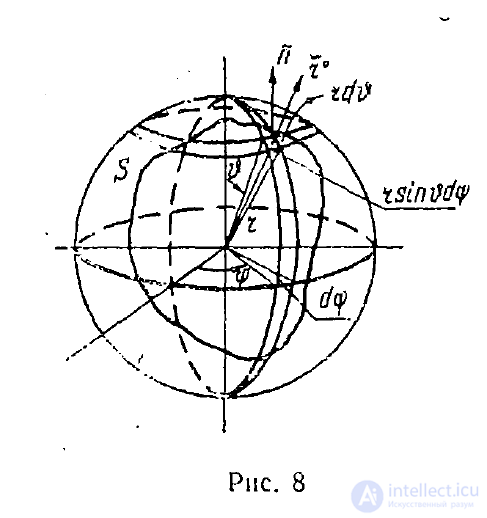
If the charges are of the same sign, then repulsion occurs, and if of different signs — attraction. Let us present the considerations leading to the generalization of Coulomb's law into the third Maxwell equation.
The charge q creates an electric field
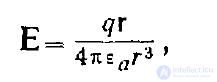
whose vector lines are straight radii, emanating from the charge q. Let us draw an arbitrary closed surface, enclosing
the charge q, and, taking into account that 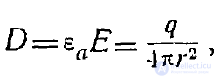 , let us find (fig. 8)

This result is easily generalized to the case when inside the closed surface there is not one charge q, but many charges, i.e.
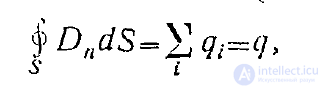
and we obtain the third Maxwell equation.
The fourth Maxwell equation is a generalization of a very long-known experimental fact, that no matter how many times we cut a magnet in half, we still get a magnet with two different poles — north and south, i.e. the south and north poles cannot exist separately. At the same time, the law of interaction of two magnetic poles is fully analogous to Coulomb's law for the interaction of electric charges. On the basis of these two experimental facts we arrive at the conclusion that the flux of the induction vector through a closed surface must equal zero. That is, the vector lines of B are always closed.

Comments