
Lecture
Coherence (from Latin cohaerens — «being in connection») — in physics, the correlation (consistency) of several oscillatory or wave processes in time, manifesting itself when they are added together. Oscillations are coherent if the difference of their phases is constant in time, and when the oscillations are added, an oscillation of the same frequency results.
A classic example of two coherent oscillations is two sinusoidal oscillations of the same frequency.
Coherence of a wave means that at different spatial points of the wave the oscillations occur synchronously, that is, the phase difference between two points does not depend on time. Absence of coherence, accordingly, is a situation in which the phase difference between two points is not constant, but changes with time. Such a situation can occur if the wave was generated not by a single radiator, but by a collection of identical but independent (that is, uncorrelated) radiators.
The study of the coherence of light waves leads to the concepts of temporal and spatial coherence. When electromagnetic waves propagate in waveguides, phase singularities can occur. In the case of waves on water, the coherence of the wave is determined by the so-called second periodicity.
Without coherence it is impossible to observe such a phenomenon as interference.
The coherence radius – is the distance, upon displacement along which along a pseudo-wave surface, the random change of phase reaches a value of the order of π.
The process of decoherence – is the disruption of coherence, caused by the interaction of particles with the surrounding medium.
The electric and magnetic dipoles considered in previous lectures are the simplest radiators of radio waves – the simplest antennas. One of the most important characteristics of wave radiators is the directivity of the radiation. An elementary vibrator radiates directionally in meridional planes. The factor characterizing the directivity of the radiation, or the so-called directivity pattern, here is  . In the equatorial plane the elementary vibrator radiates non-directionally. We see that the directivity of the radiation of a single electric or a single magnetic dipole is either quite weak or absent altogether. A visual representation of the directivity of the radiation of these elementary radiators can be given by their radiation patterns.
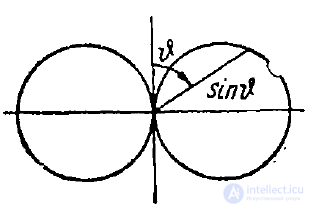
fig. 1
Figure 1 shows the radiation pattern of a dipole in the meridional plane. It represents the curve of the function  in polar coordinates. The radiation pattern in the equatorial plane is a circle. Highly directional radiation can be created only by a system of radiators, even non-directional ones, but properly arranged and phased. Let us show this using the example of two elementary vibrators.
So, let us consider the field of a system of two elementary parallel vibrators in their equatorial plane.
Let the vibrators 1, 2 be separated by a distance  (fig. 2), with the current oscillations of vibrator 2 leading in phase the current of vibrator 1 by
  .
.
The fields of the vibrators are respectively equal to
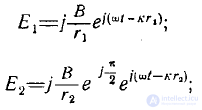
where 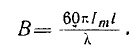
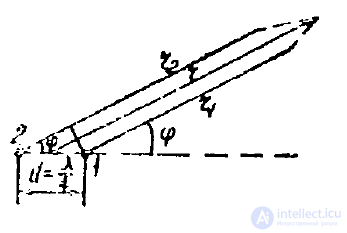
Fig. 2
For a distant observation point, i.e. at  , we can take
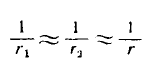
In the phase factors, however, the difference between distances r2 and r1 cannot be neglected; however, the rays from the vibrators to the observation point M can be considered parallel, and then

Adding the fields, taking into account the last equalities, we obtain

and, since

for the amplitude of the field strength we obtain
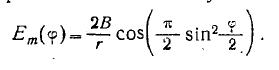
Thus, the directivity characteristic here is the function
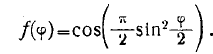 . ,
. ,
From this it can be seen that
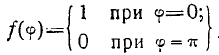
i.e. this system radiates unidirectionally.
The graph of the function, or  in other words the radiation pattern in the polar coordinate system, is shown in fig. 3.
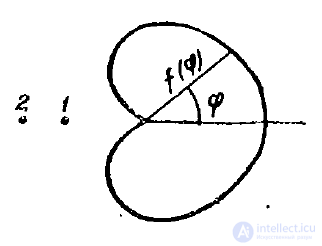
Fig. 3
From the example given, it can be concluded that with the help of a large number of elementary radiators, suitably arranged and phased, one can create an antenna of even higher directivity. It is clear that directional radiation turns out to be possible to create owing to the phenomenon of wave interference. Therefore it is necessary to establish under what conditions wave interference is possible.
Depending on the values of  , q and Ψ the radiation pattern of a system of coupled vibrators can have various shapes (fig. 3a)
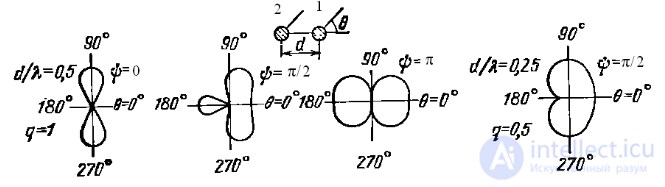
Fig. 3a Normalized radiation patterns by field strength of a system of coupled vibrators in the equatorial plane
As the distance between the vibrators increases (starting from =0.5) the radiation pattern acquires a multi-lobe character; the greater the distance, the greater the number of lobes. The case of unidirectional radiation is especially important.
Let us consider two current oscillations at the same frequency with constant amplitudes and initial phases  :
:
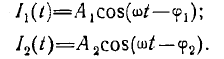
The total oscillation equals

where
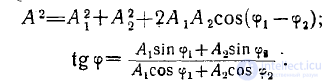 (1)
(1)
Let us note two extreme cases.
1. The difference  . In this case the oscillations are coherent.
2. The phases  — are random functions of time.
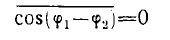
The phase as a random function of time can be imagined as follows. After each interval of time τ the phase changes abruptly, taking a random value. As a result, if we average (1) over a time interval significantly greater than τ, we obtain
 (2)
(2)
and
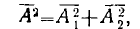
where the bar above denotes the mean value. Such two oscillations, for which (2) holds, are incoherent. Note that the phases of both oscillations can be random functions of time, but nevertheless
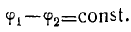
In this case the oscillations will also be coherent.
Let us consider spherical waves, created by an elementary vibrator with a current, the initial phase of oscillation of which changes, after each interval of time τ, abruptly, taking random values. The quantity  is called the coherence time. We will be interested in the question: are the field oscillations, created by this source at different points in space, coherent?
If from the source as a center we draw a sphere of radius r1, then this surface will be intersected by so-called wave trains, the duration of which is  . The quantity
  is called the coherence length.
During the time τ, the initial phases of oscillations at any point of the sphere will be the same. After this time interval elapses, the phase at all points changes by the same random quantity.
Let us draw another sphere of radius r2. Let us determine when the oscillations on these two spheres will be coherent and when they will be incoherent.
Obviously, if
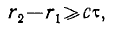
then the oscillations will be incoherent. • •
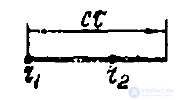
Fig. 4
If, however,
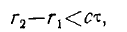
then in this case the oscillations will be coherent during the time (fig. 4)
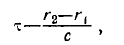
i.e. not for the entire time interval t, but only for part of it. In view of this, the oscillations are called partially coherent.
It is clear that the field oscillations at any points located on one and the same sphere will always be coherent.
Thus, as the difference  decreases, the oscillations pass from incoherent to partially coherent and then, at
  , become coherent.
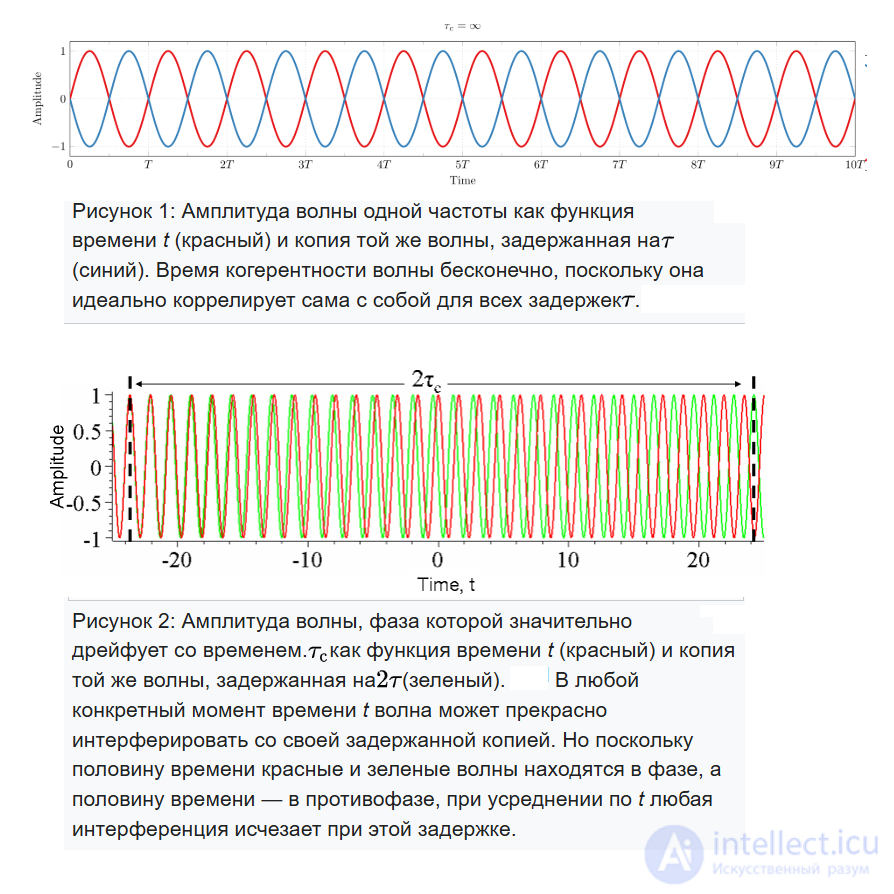
The concept of temporal coherence can be related to the contrast of the interference pattern, observed as a result of the interference of two waves, originating from the same point of the transverse cross-section of the beam (obtained by the method of amplitude division). Temporal coherence of a wave characterizes the preservation of mutual coherence upon a time delay of one of such rays relative to the other. In this case, the measure of temporal coherence is the coherence time — the maximum possible delay time of one ray relative to another at which their mutual coherence is still preserved. Temporal coherence is determined by the degree of monochromaticity.
Spatial coherence — is the coherence of oscillations, which occur at one and the same moment of time at different points of a plane, perpendicular to the direction of wave propagation.
The concept of spatial coherence was introduced to explain the phenomenon of interference (on a screen) from two different sources (from two points of an elongated source, from two points of a round source, etc.).
Thus, at a certain distance from the sources the optical path difference will be such that the phases of the two waves will differ. As a result, the waves arriving from different parts of the source at the center of the screen will reduce the power value compared to the maximum, which would occur if all the waves had the same phase. At the distance where the optical path difference leads to the phases of the two waves differing by exactly π, the sum of the two waves will be minimal
Let us now consider the superposition of waves, created by two spaced-apart elementary vibrators in the equatorial plane. Here the following cases are possible.
If the phase difference of the currents of both vibrators is a constant quantity, then the phase difference of the waves arriving at each point in space from both vibrators is preserved at all times and the waves will be coherent.
In this case, as we have seen, the phenomenon of interference takes place. If the difference of the current oscillations of both vibrators is a random quantity, then at each point in space the field oscillations, created by each vibrator, will be incoherent and the waves will be incoherent. There will be no interference.
Let the second vibrator now be a mirror image of the first vibrator, creating waves reflected from the mirror, and let the phase of the current in this vibrator change in the random manner indicated above.
Obviously, the direct and reflected waves will, in accordance with what was stated in point 3, be coherent or partially coherent if they belong to the same wave train. This kind of coherence is called temporal. A real source of waves is in fact not a point source. However, if the source has a sufficiently small spatial extent, then it, together with its mirror image, can create a clear interference pattern. A source satisfying this condition is called spatially coherent. Two spatially coherent sources of waves at arbitrary points, generally speaking, create incoherent or partially coherent oscillations. Oscillations at two points will be coherent only if the difference of distances from one source
to these points minus the difference of distances from the other source to the same two points equals a whole number of wavelengths.
Holography requires light with a long coherence time. In contrast, optical coherence tomography, in its classical version, uses light with a short coherence time.
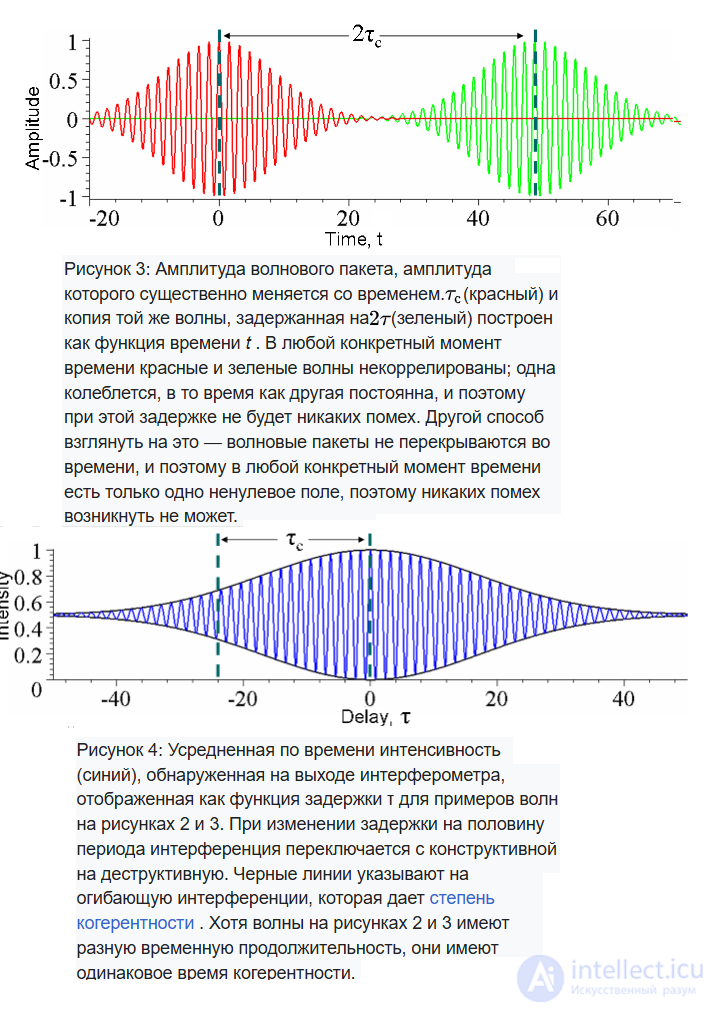
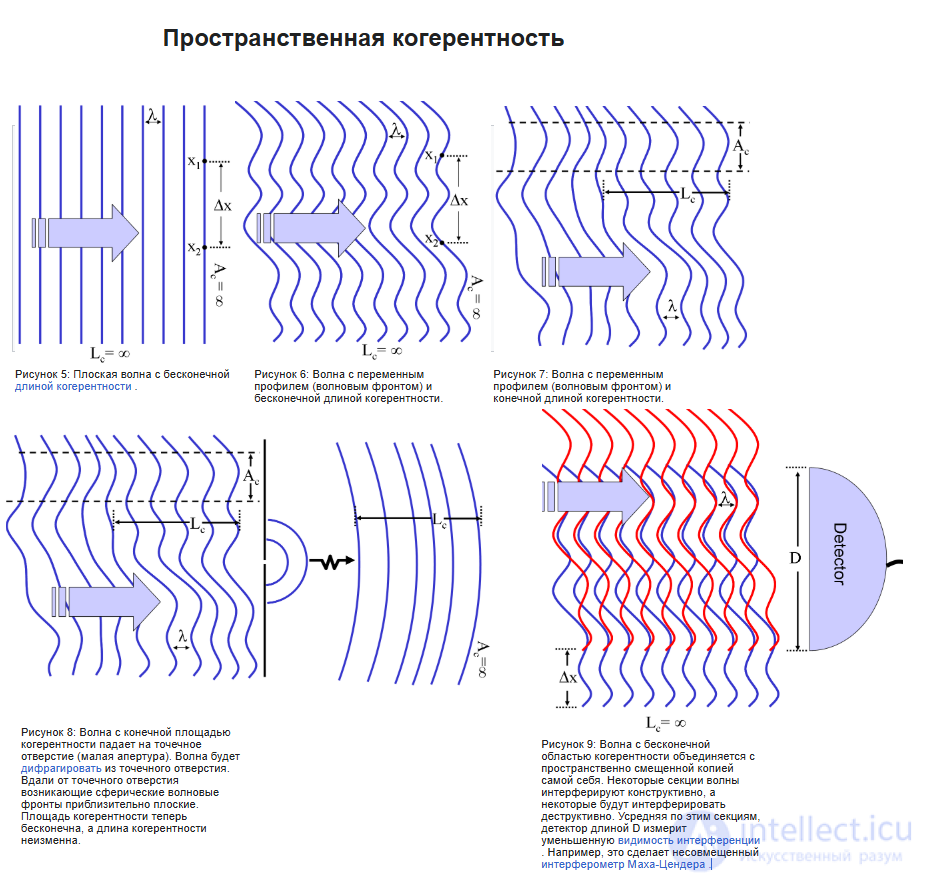
Waves of different frequencies (in light these are different colors) can interfere, forming a pulse, if they have a fixed relative phase relationship (see Fourier transform). Conversely, if waves of different frequencies are not coherent, then when combined they create a wave that is continuous in time (for example, white light or white noise). The temporal duration of the pulse  is limited by the spectral bandwidth of the light
  in accordance with:
 ,
,
which follows from the properties of the Fourier transform and leads to the Küpfmüller uncertainty principle (for quantum particles this also leads to the Heisenberg uncertainty principle).
If the phase depends linearly on the frequency (i.e.  ) then the pulse will have the minimum duration for its bandwidth (a transform-limited pulse), otherwise it will be chirped (see dispersion).
To measure the spectral coherence of light, a nonlinear optical interferometer is required, for example, an intensity optical correlator, frequency-resolved optical gating (FROG), or spectral phase interferometry for direct electric-field reconstruction (SPIDER).
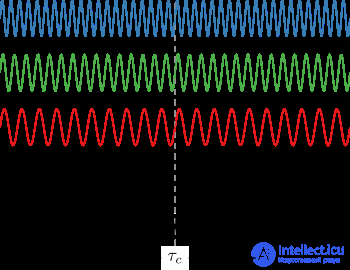
Figure 10: Waves of different frequencies interfere to form a localized pulse, if they are coherent.
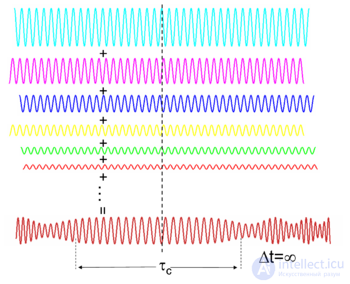
Figure 11: Spectrally incoherent light interferes to form continuous light with randomly varying phase and amplitude.

Comments