
Lecture
Magnetostatics—a branch of classical electrodynamics that studies the properties of a stationary magnetic field (the field of steady electric currents or permanent magnets), examines methods for calculating the magnetic field of steady currents, and analyzes the interaction of currents through the fields they create.
Real electromagnetic fields always change to some extent over time. Maxwell's equations exist to describe them. By the magnetostatic approximation (the magnetostatic case) one understands in practice a sufficiently slow change of the fields, so that they can be considered constant with acceptable accuracy and simpler equations can be used.
Magnetostatics, together with electrostatics, are subfields of electrodynamics; their approaches can be used both together and independently, since in this case the calculation of the electric and magnetic fields has no interdependencies.
Within the framework of magnetostatics both the vacuum case and the case of a magnetic medium—a magnetic material—are studied. In this case any medium is treated macroscopically, i.e. the fields are averaged at the atomic scale, and molecular currents and magnetic moments are considered only in aggregate.
Maxwell's equations
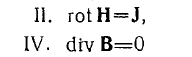
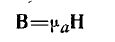
and the constitutive equation
 (1)
(1)
describe the laws of magnetostatics. The field of permanent magnets is a special case of magnetostatics, which occurs when j = 0.
Equation IV states that the vector B is solenoidal, and since
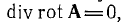 , we can set
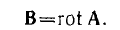 . (2)
. (2)
Assuming 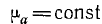 and substituting this expression for B, taking (I) into account, into equation II, we obtain
 . (3)
. (3)
Let us use the identity

and, setting
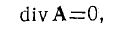 (4)
(4)
we shall find the vector A; a posteriori we shall verify that this condition is satisfied.
As a result, (3) is represented by three scalar Poisson
equations or by one vector Poisson equation
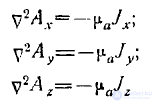
or by one vector Poisson equation
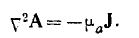
By analogy with the solution
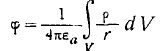
of the Poisson equation for the electric potential
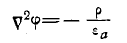
we can write
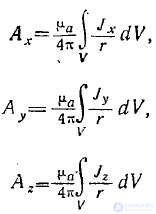
and correspondingly
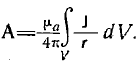
Let us show that condition (4) is indeed satisfied. Indeed, since in the differential operation divA the differentiation
is performed with respect to the coordinates of the observation point, i.e. with respect to the coordinates x, y, z, which enter only in the expression

then

Here the closed surface S must be taken large enough that all the currents are enclosed by it, without intersecting them.
Therefore the surface integral is equal to zero, and indeed,
div A = 0. '
Since  currents in magnetostatics are always closed, and therefore in practice one most often deals with closed linear currents.
For these cases let us find the vector potential (Fig. 1).
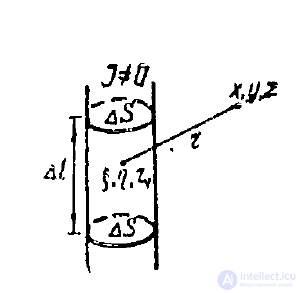
Fig. 1
We have
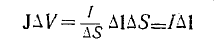
and, consequently,
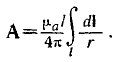 (5)
(5)
The magnetic field equals

This is the well-known Biot-Savart law.
Let us calculate the field of a circular current loop. Let the plane of the loop lie in the xy coordinate plane, and let us consider the observation point to lie in the xz plane (Fig. 2).
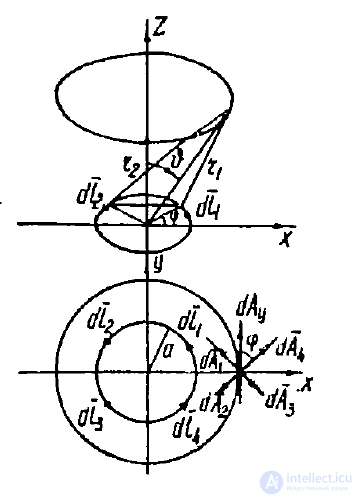
Fig. 2
As can be seen from formula (5), the vector A has no component along the oz axis.
Let us consider the expression for the vector potential created by any one of the elements of current of length dl (Fig. 2):
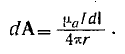
As can be seen from (Fig. 2)
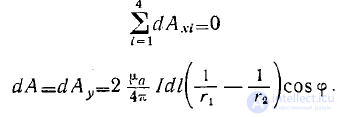
Let us calculate the vector A at large distances compared with the radius a of the circular current loop; then, as can be seen from Fig. 2,

and we obtain
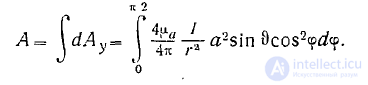
From this
 (6)
(6)
(S—the area of the loop), where
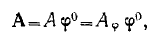
where  —the unit vector of the coordinate line φ of the spherical coordinate system r, θ, φ, (Fig. 2).
Bearing in mind that B = rot A in the same coordinate system, we obtain
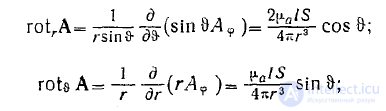
from which, denoting IS = m, we obtain
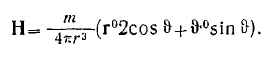 (7)
(7)
Comparing this formula with the expression for the field intensity of an electric dipole

we see that a circular loop with a current is equivalent to a dipole—a magnetic dipole with moment
 (8)
(8)
where n—the normal to the plane of the loop.
Let us consider a very long solenoid, through whose turns a current I flows, and correspondingly a current per unit length I1 = NI, where N—the number of turns per unit length.
Since outside the solenoid the field H = 0, according to the second Maxwell equation in integral form, where the integral  is taken along the contour shown in Fig. 3,
for the field inside the solenoid we obtain (Fig. 3,a)
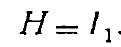 (9)
(9)
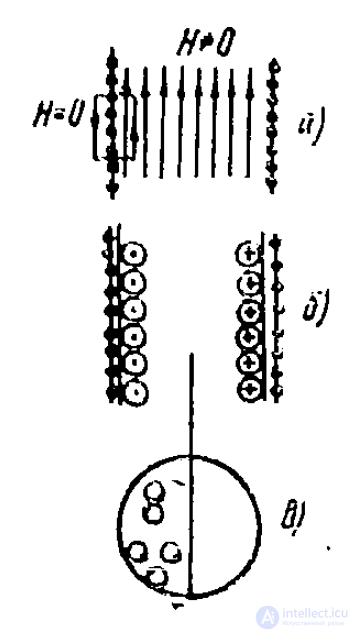
Fig. 3
Ampere first discovered that if an iron core is placed inside the solenoid, the magnetic induction vector B changes—it increases.
Ampere hypothesized that this increase occurs as a result of the appearance of an additional current on the surface of the core—a surface magnetization current  , created by molecular circular currents (Fig. 3,6).
Each molecule represents a circular current with dipole moment  (Fig. 3,c), and according to formula (8), for the total moment of the molecules contained in a volume of unit length of the core,
we can write
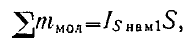
where S—the area of the core,  —the surface magnetization current per unit length of the core.
In the last formula it is taken into account that upon summing the circular molecular currents, only the peripheral, surface current remains.
We can introduce a vector of the magnetic moment per unit volume of the core, equal in magnitude to
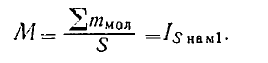 (10)
(10)
Comparing formulas (10) and (9), we conclude that  is related to M in the same way as the current I is related to H, i.e. by analogy with the relation
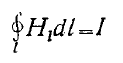
we can write
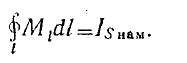
From this we conclude that there exists not only a surface magnetization current, but also a volume magnetization current, whose density 
is determined, in accordance with the last integral relation, by Stokes' formula
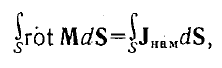
That is
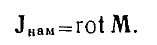
Thus, according to the second Maxwell equation, inside the substance the equality holds
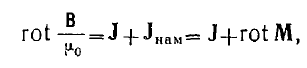
from which
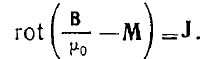
is the magnetic field intensity in the substance.
From this relation we obtain

In most substances the vector M is directly proportional to the vector H, i.e.
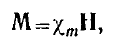
where  —the magnetic susceptibility. So that

and the relative magnetic permeability equals
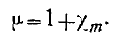
When  the substance is a paramagnet,
when  the substance is a diamagnet,
and in both cases  -
-
When  the substance is a ferromagnet.
So, inside the substance of a permanent magnet, according to the fourth Maxwell equation

we can write

The quantity—div M can formally be treated as the volume density of «magnetic charges»
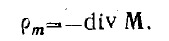
In this case Maxwell's equations take the form of the equations
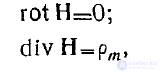
which are formally analogous to Maxwell's equations for electrostatics:'
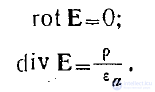
Consequently, in the magnetostatics of permanent magnets we can, as in electrostatics, introduce the concept of the magnetic potential  by the formula
