
Lecture
The macroscopic theory of the electromagnetic field, created by Maxwell, is based on the fundamental laws of nature – the laws of electromagnetism. Maxwell was able to creatively comprehend and generalize the laws
known before him and formulate them in mathematical form as a system of equations, which are called Maxwell's equations. This system
consists of four basic equations, which reflect the four fundamental laws of electrodynamics, the continuity equation, and the constitutive equations. All
these equations are summarized in Table 1, where they are given in integral and differential forms. Maxwell's basic equations have their own generally accepted numbering. The order in which they follow should be known if only because,
when references are made to these equations, this numbering is usually used, for example, "As follows from Maxwell's 1st equation…" etc.
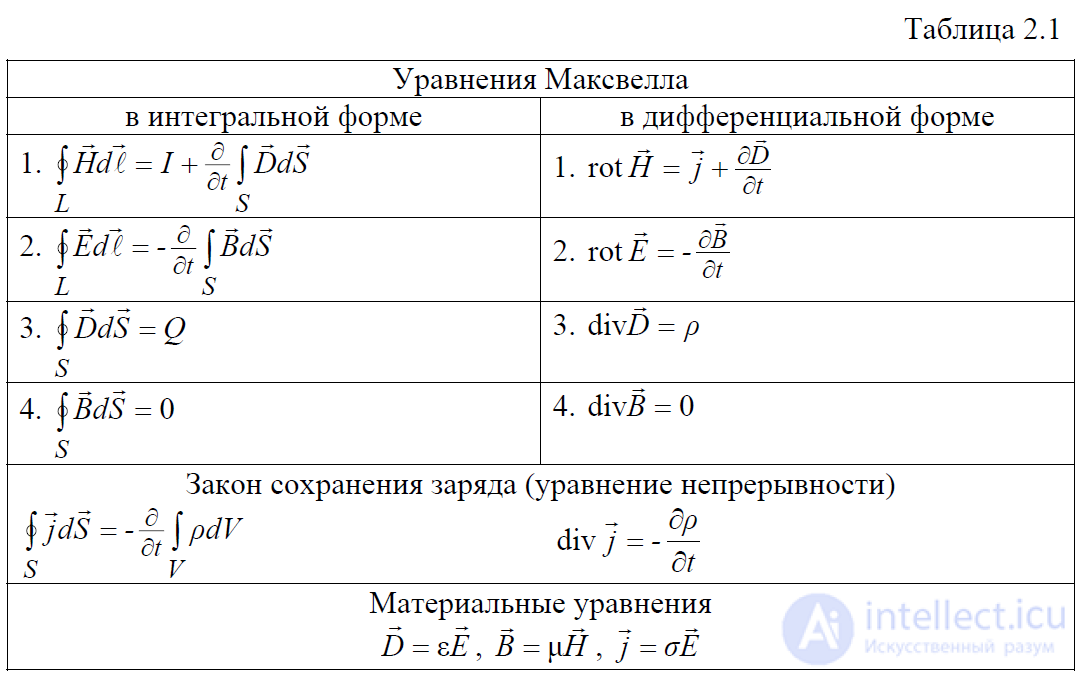
The equations given here have a deep physical meaning, which it makes sense to formulate in words, following the order of numbering of the equations.
1. The sources of the vortical magnetic field are
conduction currents and a time-varying electric field (displacement current). The circulation of the vector 
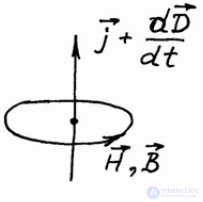
Figure 2.6
of the magnetic field strength around any closed contour equals the sum of the conduction and displacement currents enclosed by that contour. The direction of the magnetic field lines is related by the right-hand screw rule to the direction of the currents that excite it (Fig. 2.6).
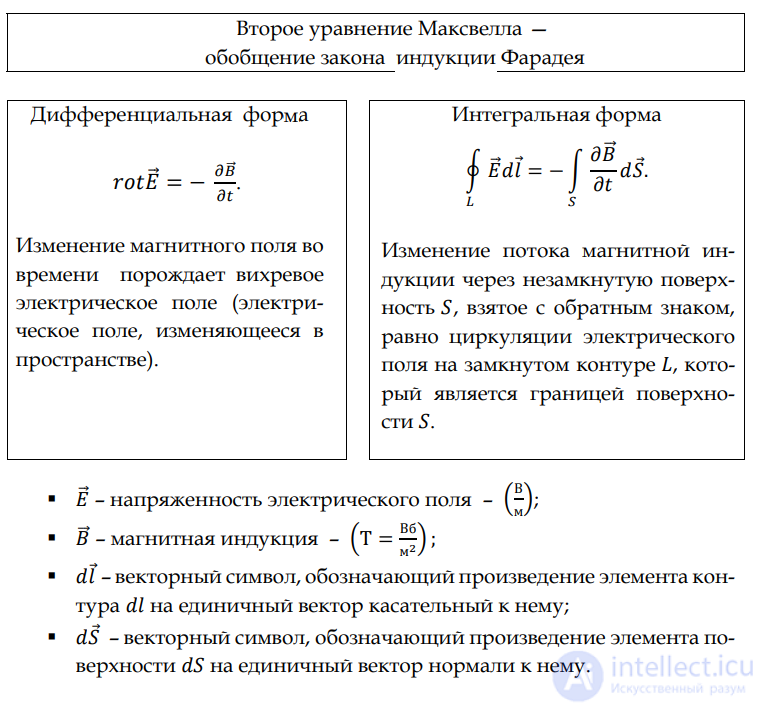
2. The source of the vortical electric field is a time-varying magnetic field. The circulation of the electric field strength 
around an arbitrary closed contour equals the rate of change of the magnetic flux
through the surface bounded by this contour. The lines of force
of the strength 
of the vortical electric field
are closed, they enclose regions of the changing magnetic field, and their direction is related by the left-hand screw rule to the rate of change of the vector 
(Fig. 2.7).
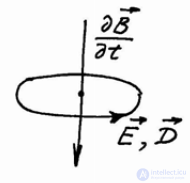
Figure 2.7
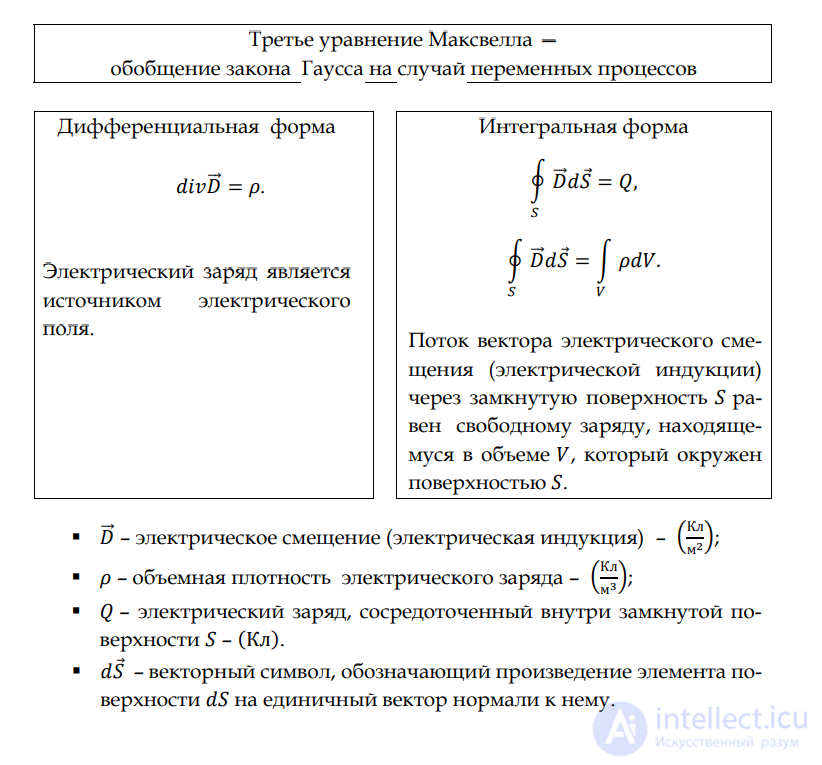
3. The sources of the electric field can be electric charges.
The total flux of the electric displacement vector D
r
through an arbitrary
closed surface at any moment of time equals the total electric charge enclosed by this surface, regardless of whether
the charges change their magnitude or position over time or not. The electric field excited by charges has a potential character, its field lines originate from positive charges and terminate on negative ones.
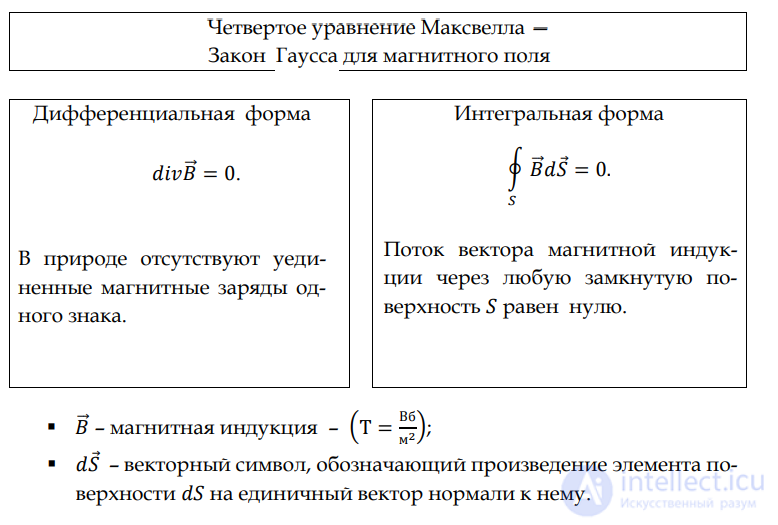
4. There are no sources of a potential magnetic field, since magnetic charges do not exist in nature. The magnetic flux through any
closed surface at any moment equals zero.
5. Considering the first and fourth Maxwell's equations together makes it possible to conclude that the magnetic field can only be vortical in character, its field lines are always closed on themselves or at infinity. Potential magnetic fields do not exist.
6. The second and third Maxwell's equations together indicate that the electric field can, in general, have a mixed character – potential and vortical at the same time. Its potential components are created by electric charges accumulated in certain regions of space, while its vortical components are created by a time-varying magnetic field. Therefore, a rapidly varying electric field in any region of space under consideration can have either closed or open field lines.
From a mathematical point of view, the differential form of Maxwell's
equations is a system of partial differential equations. Together with the constitutive equations, it is complete and, as will be shown later, has a unique solution. This system reflects the general principles of electromagnetic theory, sufficient to describe a variety of electromagnetic processes in various media.
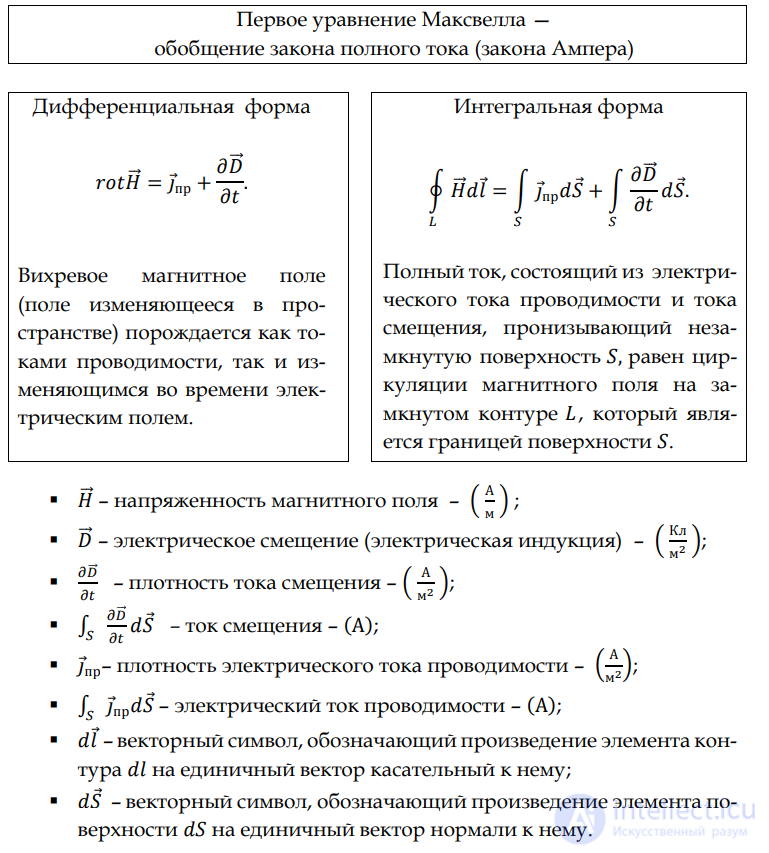
Maxwell's second equation — a generalization of Faraday's law of induction
Maxwell's third equation — a generalization of Gauss's law to the case of time-varying processes
Maxwell's fourth equation — Gauss's law for the magnetic field
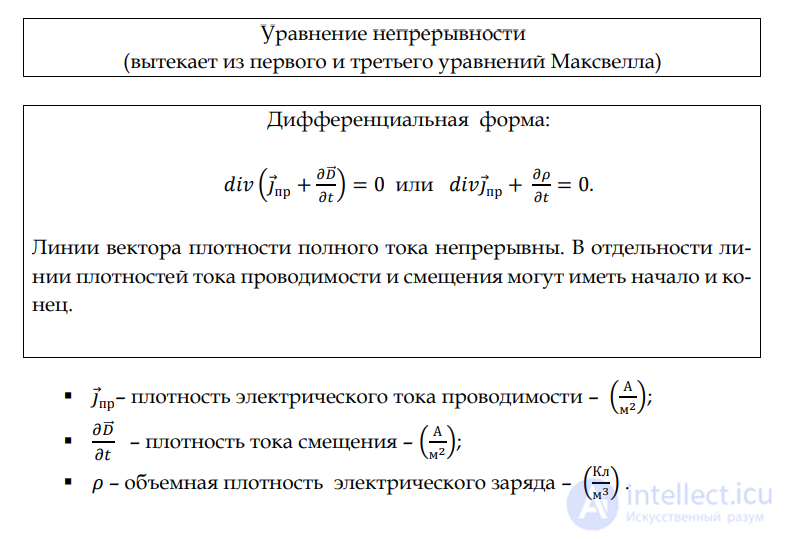
The continuity equation (follows from the first and third Maxwell's equations)
In practice, real electromagnetic fields vary in time according to quite
complex laws. However, a field that varies according to any law can always be represented as a sum of harmonic functions using a Fourier series or integral. A time-varying harmonic field of a single frequency is called monochromatic. Monochromatic oscillations are very often considered
in theoretical electrical engineering and radio engineering using the method of complex amplitudes. Let us consider this as applied to vector electromagnetic fields. In the general case, the vector of a monochromatic field can be written as:

All harmonic variables can be written similarly

Attention should be paid to the fact that each field vector is a spatial vector, but, like any complex number, it can
also be represented as a vector on the complex plane. In the latter case, the direction of the vector is merely a conventional notation for a particular
phase of a given harmonically varying quantity.
The vector  – is called the complex amplitude vector of the field.
Thus, if the vector functions


, as well as the scalar function 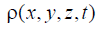
vary in time according to a harmonic law (2.24)-(2.25), then the 4 equa-
tions of Maxwell, the continuity equation, and the constitutive equations can
be written in the following form:


Here it is taken into account that the derivative of a harmonic function with respect to time t is computed as

,
and the factor  , which appears on both sides of each equality, is omitted everywhere.

Comments