
Lecture
The Umov—Poynting vector (also the Poynting vector) — a vector of the energy flux density of the electromagnetic field, whose components are part of the energy-momentum tensor of the electromagnetic field. The magnitude of the Umov—Poynting vector equals the amount of energy transferred through a unit area normal to S per unit time. Its direction determines the direction of energy transfer.
In electrodynamics, Poynting's theorem is a statement about the conservation of energy for electromagnetic fields, developed by the British physicist John Henry Poynting. It states that within a given volume, the stored energy changes at a rate determined by the work done on the charges within the volume, minus the rate at which energy leaves the volume. It is strictly true only in media that are not dispersive, but it can be extended to the dispersive case. The theorem is analogous to the work-energy theorem in classical mechanics and is mathematically similar to the continuity equation.
When speaking of the physical reality of the EMF, it is implied that energy is associated with the field.
As it changes, the field can give up its energy to some non-electromagnetic process. Therefore it is important to understand what laws govern the energy of the EMF.
Energy—a Greek word—means activity.
Philosophical definition of the concept of energy: energy is a general measure of the various forms of motion of matter.
Physical understanding: energy is a quantity that does not change quantitatively under any transformations occurring in nature.
We are well familiar with transformations of energy:
— mechanical ^ thermal;
— mechanical electrical;
— electrical ^ thermal.
In this lecture we shall be interested in the transformation of electrical energy into thermal energy. This transformation occurs in accordance with the Joule—Lenz law.

where Q—the amount of heat released per unit time in a conductor with resistance Rf, when a current / passes through it.
There is, however, another law of conservation of energy, established by Professor of Physics at Novorossiysk (Odessa)
University Umov in 1874: if energy disappears in some region of space, this happens as a result of it flowing out through the boundaries of that region.
How can this law be formulated mathematically?
Let there be energy W in a volume V. Then by analogy with the law of conservation of charge
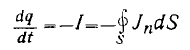 (1),
(1),
we can write (Fig. 1)
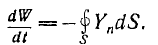 ( 2)
( 2)
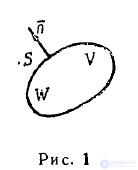
Fig. 1
Here Y—a vector analogous to the current density vector J. As is known, the vector J equals J=pv, where p•—the density and v—the velocity of the charges.
Correspondingly Y is determined by the formula  , where w—the density and v—the velocity of motion of the energy.
The vector Y has the meaning of an energy flux density.
Its dimension is

The integral conservation law (2) can be transformed into a differential law, similarly to how (1) is transformed
into the continuity equation—

and obtain

Y—the Umov vector.
Below, guided by the law of conservation of energy (2), we shall find the formulation of the law of conservation of energy in the electromagnetic field. However, first we shall generalize relation (2), taking into account that the energy of a given kind within the volume can also decrease owing to its conversion into thermal energy.
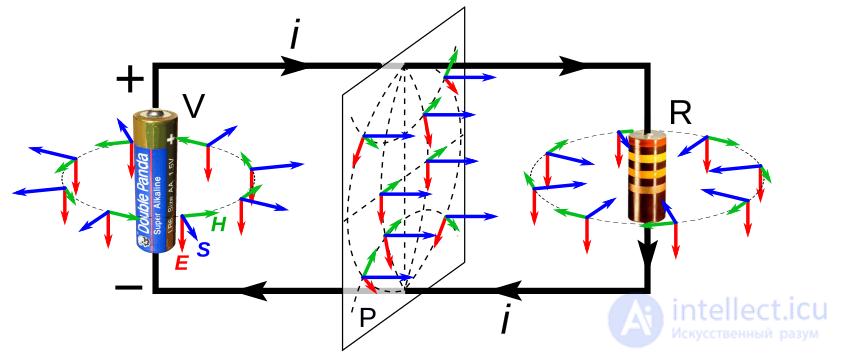
direct-current circuit i, connecting a battery V to a resistor R
the Poynting vector S in the space surrounding the circuit
electric field intensity E
magnetic field intensity H
Around the battery, the Umov—Poynting vector is directed away from the battery, indicating the transfer of energy out of the battery; around the resistor, the Umov—Poynting vector is directed toward the resistor, indicating the transfer of energy into the resistor; the flux of the Umov—Poynting vector through any plane P between the battery and the resistor is directed from the battery to the resistor
Thus, we shall use the law of conservation of energy in a more general formulation, namely:
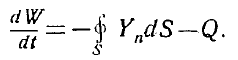 .(3)
.(3)
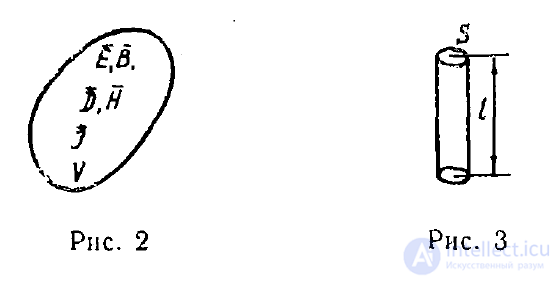
So, let us assume that an electromagnetic field exists in some volume V (Fig. 2), i.e. inside this volume 

First let us express Q in terms of quantities characterizing the electromagnetic field.
Taking into account (Fig. 3) that

i.e.
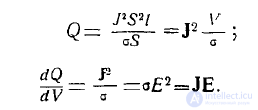
Consequently,
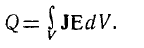
Substituting under the integral the expression for J from the second Maxwell equation, we obtain

Next, using the relation

we find

Here we substitute instead of 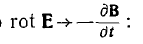
 . (4)
. (4)
Taking into account that, according to the Ostrogradsky—Gauss theorem

we have
 (5)
(5)
The relation obtained (5) is called Poynting's theorem.
Let us clarify the physical meaning of this theorem.
For this, let us set

and take into account that

Then instead of (5) we shall have
 (6)
(6)
Comparing this equality with relation (3), we conclude that
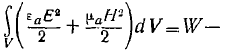
the energy of the electromagnetic field in the volume V,
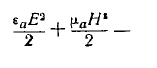
the energy density of the electromagnetic field, where:
 —the electric energy density;
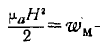 —the magnetic energy density;
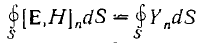 —the flux of electromagnetic energy through the surface S;
 — the energy flux density.
The vector S is called the Poynting vector.
It was introduced by Poynting in 1884.
Thus, Poynting's theorem represents a formulation of the law of conservation of energy in the electromagnetic field.
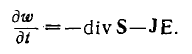
Poynting's theorem in differential form, according to (4) and (5), has the form
Let us consider the electromagnetic field in a closed volume V, where there are extraneous sources given by the current density ext jr
(Fig. 4.1). To describe this field we shall use Maxwell's equations in differential form.
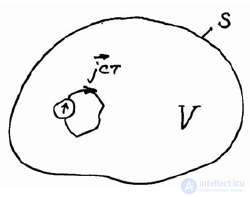
Figure 4.1
Let us write the first two of them and multiply the first equation scalarly by
E r
, and the second–by H
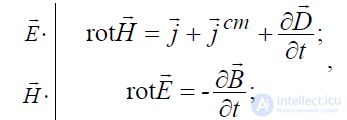
after which we subtract the 2nd from the 1st equation:

Let us replace the left-hand side of the resulting equality using the identity
(A2.20) and move the first three terms of the right-hand side here, which as a result
gives:
 . (4.1)
Now let us integrate both sides of equality (4.1) over the volume V under study (Fig. 4.1):

and, applying the Gauss-Ostrogradsky theorem (A2.24) to the first term,
we arrive at the following relation:
 . (4.2)
The resulting equality represents the mathematical formulation of the Umov-Poynting theorem in integral form, which establishes
the balance of electromagnetic energy in a closed volume at any instant of time. Let us consider what physical meaning each of the terms has here.
1. The first term.
Let us transform it, using Ohm's law in differential
form, and denote it by the symbol Pd:
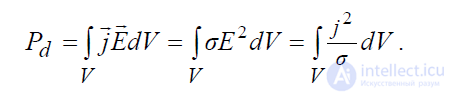 . (4.3)
Let us show that this expression is the mathematical expression of
the Joule-Lenz law, and Pd–is the power of the thermal (or Joule) losses that the electromagnetic field expends on heating the volume V.
For this, let us consider a simple example. Let the region of space V under study be occupied by a conducting medium, and let its shape be a cylinder whose axis is directed along the field lines of the electric field intensity (Fig. 4.2).
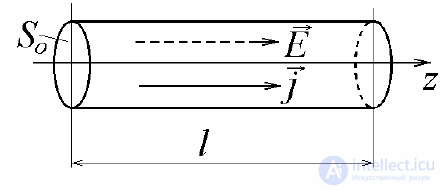
Figure 4.2
Let us assume that the dimensions of the cylinder are so
small that the vectors E
r
and j
r
are the same at all points inside
its volume. In that case they do not depend on the variables of integration and can be taken out of the integral, which is then transformed to the following form

where I = jSo–the current flowing through the base of the cylinder So, U = E ⋅ l–
the potential difference (voltage) between the bases of the cylinder. In this
form this expression describes the Joule-Lenz law, known from circuit theory, for the power Pd, dissipated by the current on a section of the circuit of length l.
It should be noted that the loss power Pd can take only positive values or zero, since the integrand function in (4.3)
is by definition non-negative. The equality Pd = 0 holds only in the absence of currents in the medium, or when σ→∞ (an ideal conductor).
2. Let us transform the second term in (4.2) as follows. Using the constitutive equations  , let us replace in it
the vectors 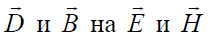
respectively. Taking into account that the operations of integration over coordinates and differentiation with respect to time are mutually independent, the second term can be transformed to the following form:

.
Taking into account that
w = εE2–the volumetric density of the electric
energy, and
wm = μH2–the volumetric density of the magnetic energy inside
the volume V, we rewrite the last expression in the form:
 . (4.4)
Here We = ∫
V
wedV–the total energy of the electric field, and Wm = ∫
V
wmdV
–the total energy of the magnetic field, stored in the volume V.
Thus, the second term Pr in (4.2)–is the rate of change of
the total energy W = We + Wm, electric and magnetic, stored in
the volume V. If Pr > 0, then the energy stored in V is growing, and if Pr < 0, then the stored energy is decreasing.
3. Let us rewrite the third term as follows:
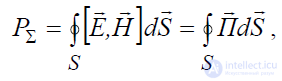 (4.5)
(4.5)
where the notation Π [E,H]
r r r
= is introduced. The vector Π
r
has the dimension [W/m2],
which is called the Poynting vector, and determines the magnitude and direction of motion of the power flux density of the electromagnetic field at each point of the region of space under consideration. Consequently, PΣ–is the power flux
passing through the surface S bounding the volume V under consideration (Fig. 4.1). If the direction of the vector Π
r
coincides with the direction of the outward normal to the surface S, then the EMF energy exits the volume V outward and PΣ > 0. If, conversely, the direction of the vector Π
r
is opposite to the direction of the outward normal to the surface S, then the EMF energy enters the volume V from outside, in which case PΣ < 0.
4. The term on the right-hand side of equality (4.2) determines the power of the extraneous sources acting in the volume V:
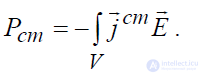 . (4.6)
Thus, equation (4.2), which describes the power balance of the electro-
magnetic field in a closed volume, can be written in the following form:
Pst = Pd + PΣ + Pr , (4.7)
from which it follows that the power of the extraneous sources in a closed volume V
can be expended on heating the material, accumulating energy in the volume,
and radiating energy out of the given volume.
If there are no extraneous EMF sources in the volume under consideration
jst = 0
r
, then Pst = 0; in this case equality (4.7) takes the form:
Pd + PΣ + Pr = 0. (4.8)
Since Pd ≥ 0 always, equality (4.8) can hold in the fol-
lowing cases:
a) Pd = PΣ = Pr = 0–a closed volume filled with a non-conducting medium
without losses, in which the stored energy remains unchanged;
b) PΣ < 0, Pr ≥ 0, Pd ≥ 0–energy enters the volume under consideration
from outside through the surface S surrounding it; this energy is here spent on
heating and (or) on accumulating energy of the medium inside the volume V;
c) Pr < 0, PΣ ≥ 0, Pd ≥ 0–the energy previously stored in the volume V decrea-
ses (for example, a capacitor discharges) and is spent on heating the medium
inside V and (or) radiating beyond the boundaries of the volume V through its surroun-
ding surface S.
Suppose that in the region of space under consideration there exists an electromagnetic field, the power flux density of which at each
point is characterized by the Poynting vector Π
r
.
Let us mentally select in this region a small volume V in the shape of a cylinder (Fig. 4.3).
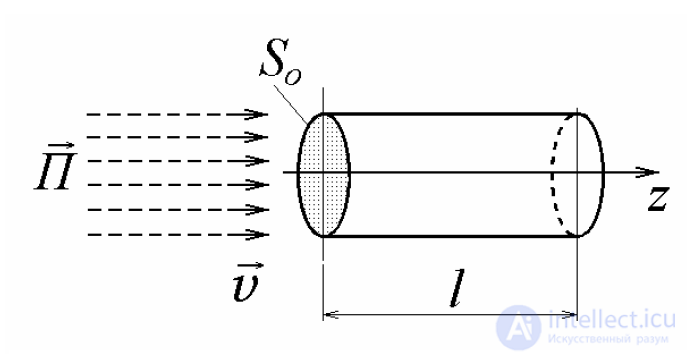
Figure 4.3
Let us choose the cross-section of the cylinder S0 and its length Δl so small that the Poynting vector can be considered the same at all points inside it. The EMF
energy, moving along the z axis with velocity ve r and passing through the base of the cylinder, will fill it in a time Δt, and the amount of energy inside the cylinder will be:
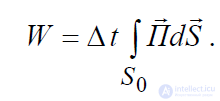 . (4.9)
On the other hand, the total EMF energy in the volume of the cylinder can be determined through its density w at all points of the region under consideration, assuming that it is known:
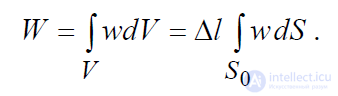 . (4.10)
Equating expressions (4.9) and (4.10), we arrive at the equality:
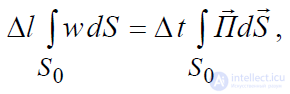
from which we find the velocity of motion of the energy, as the limit of the ratio:
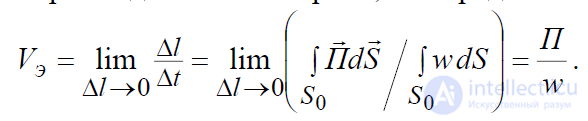 . (4.11)
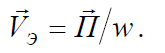
Since the direction of motion of the energy coincides with the direction of the Poy-
nting vector, this equality can be rewritten in vector form:
Let us find the expression that determines the energy balance for a monochromatic EMF. For this we write the first two Maxwell equations in complex form, the first of them for complex-conjugate fields:
 (4.13)
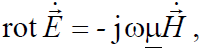 , (4.14)
where  –the complex permittivity and permeability of the medium.
Let us multiply equation (4.13) scalarly by ( E& r
− ), and equation (4.14)–by
( * H& r
), after which we add them:
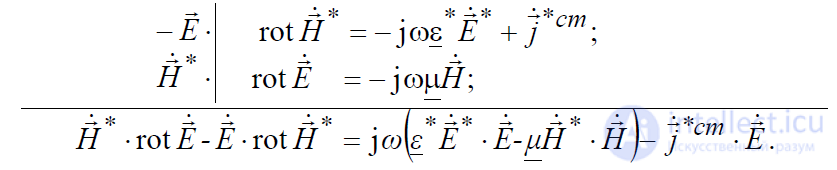
Integrating the resulting expression over the volume under consideration
and using identities (A2.20) and (A2.24), we arrive at the equality:
 , (4.15)
which is the mathematical expression of the Umov-Poynting theorem in com-
plex form, describing the balance of electromagnetic energy of a monochro-
matic EMF in the selected volume V.
Let us consider the physical meaning of all the terms entering equality
(4.15):
a) 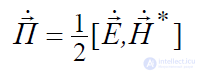 =–the complex Poynting vector, the real part of which represents the power flux density, averaged over a period of oscillation;
b) 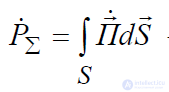 –the complex power radiated from the volume V, and its real part Re{P&Σ}–is the power radiated from the volume V, averaged over a period of oscillation;
c) 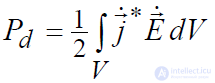 –the average loss power (active) over a period;
d) 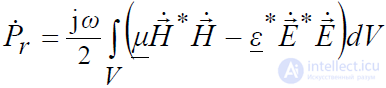
j–the imaginary power in the volume V, which can be transformed to the following form:
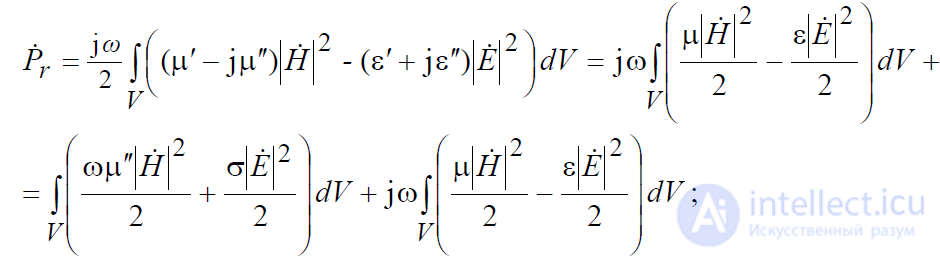
1–the complex power of the extraneous sources.
Let us separate from equation (4.15) the equalities for the real and imaginary
parts:
 (4.16)
 (4.17)
The first of these equalities (4.16) characterizes the balance of active powers, which represent the real powers averaged over a period of oscillation. The left-hand side of this equality describes the power, averaged over a period of oscillation, entering the volume V from an extraneous source. This power is expended here on heating the medium and radiating from the given volume through the surface bounding it. The second equation
(4.17) describes the balance of reactive (oscillatory) powers, which for one half of the period pass from the field source into the volume under consideration, and for the other half–return back to the source.
Let the electromagnetic field vectors vary in time
according to a harmonic law, i.e.
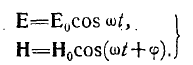
Then the average value of the vector S over the period T equals
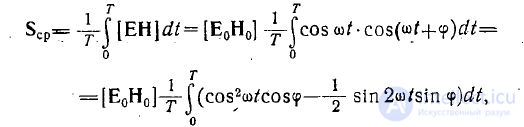
i.e.
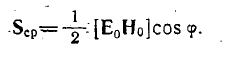 . (9)
. (9)
On the other hand, writing (8) in complex form
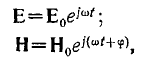
we see that

Comparing the last equalities with (9), we find that
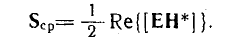
The simplest way to introduce sources of the electromagnetic field into Poynting's theorem
is to represent them as extraneous e.m.f.'s. In circuit theory, an extraneous e.m.f. is concentrated in one place. But in order to introduce an extraneous e.m.f. into the equations of the electromagnetic
field, we must assume that it can be distributed in space and, instead of €ext, operate with the field intensity
of the extraneous e.m.f. E ext.
Ohm's law in differential form, taking into account the extraneous e.m.f.,
will be represented in the form
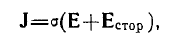
from here
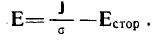
Substituting this expression for E into equation (4) on the left, after
some transformations we obtain
 (7)
(7)
since
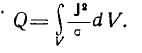
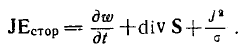
Relation (7) is the formulation of the law of conservation of energy of the electromagnetic field in the presence of sources. It can be seen that the energy of the source is spent on increasing the electromagnetic energy in the volume V, on the energy flux out of the volume, and on Joule heat.
In differential form (7) is written as follows:
The energy of the electromagnetic field, Poynting's theorem and the Poynting vector have important applications in physics and engineering. Here are the main examples of their application:
Poynting's theorem and the associated vector describe the flow of electromagnetic field energy. This is applied in the analysis of:
Energy losses in transmission lines.
The efficiency of energy transmission in waveguides and antennas.
The distribution of energy in electrical machines (for example, generators).
The Poynting vector helps to model and understand the processes of radiation and propagation of radio waves, which are used:
In radio communication and television broadcasting.
In modern communication technologies (Wi-Fi, 5G).
The energy characteristics of radiating antenna elements, such as radiated power and the radiation pattern, are determined using the Poynting vector.
The energy of the electromagnetic field plays a key role in the research and development of:
Laser systems, where control of energy density is important.
Optical systems, where the transmission of light is analyzed using Maxwell's equations.
Poynting's theorem is used to calculate the thermal effect of the electromagnetic field on conductors or biological tissues, for example:
In the microwave processing of materials.
In assessing the safety of electromagnetic radiation.
It is applied in devices such as electromagnetic motors, where the circulation of energy is calculated to optimize the operation of the system.

Comments