
Lecture
The resulting system of Maxwell's equations (2.26) describes monochromatic fields and their sources.
Let us consider some of these equations in more detail. Let us begin with the 1st Maxwell equation, in which we express the vectors 
through  , using the corresponding constitutive equations:

where it is denoted 
Here ε – is the complex permittivity of the medium, whose real part is ε′ = ε , the imaginary part is  , and the quantity
  is called
the loss tangent of the dielectric.
Let us clarify the physical meaning of tgδ . For this we perform the following transformations:
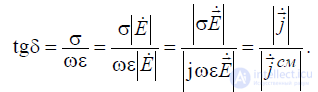
Thus, tgδ represents the ratio of the magnitudes of the conduction and displacement currents. The greater the conduction current in the medium, the more
electromagnetic field energy is dissipated as heat. In other words, the thermal losses of electromagnetic energy in a given medium are proportional to its tgδ .
Consequently, the imaginary part of the complex permittivity is directly proportional to the specific conductivity of the medium and describes the thermal losses in it. In general, ε′′ also includes losses associated with dielectric polarization and the phenomenon of dielectric hysteresis, so

Similarly, one can introduce the complex
magnetic permeability of the medium 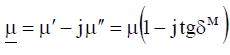 where
where
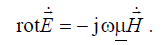
tgδ accounts for the presence of magnetic losses in the substance, then the 2nd Maxwell equation
can be written as
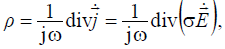
To transform the third Maxwell equation, we proceed as follows. We move the charge density ρ from the right-hand side to the left-hand side and express it through the current density, using the continuity equation
 ,
,
which as a result gives:

.
Thus, introducing the complex permittivities of the medium
(dielectric and magnetic) makes it possible to write the entire system
of equations for the monochromatic field in the following form:
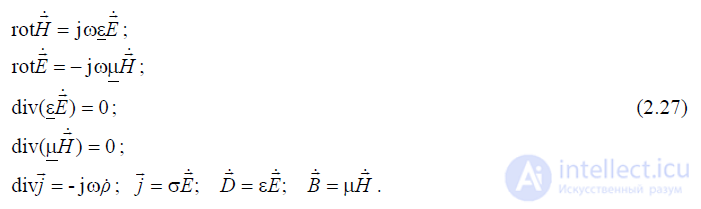
Systems of equations (2.26) and (2.27) are identical and can be used interchangeably.
In different material media, the relationship between ωε and δ of the substance can differ.
If in the medium  , then it is called a conductor, and if
  – then a dielectric.
Typical conductors are metals, for which 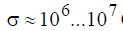 S/m, and ε ≥ 1.
For typical dielectrics  S/m (porcelain, mica, polystyrene, ebonite…).
There are media that cannot be unambiguously called either a conductor or a dielectric. Moreover, tg δ – depends on frequency. For each medium
one can find a certain boundary frequency f = f_gr , below which ( f < f_gr ) it is a conductor, and above ( f > f_gr ) – a dielectric.
For example, for polystyrene 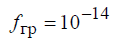 Hz, for ice
 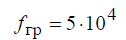 Hz, and for metals –
  Hz.
Hz.

Comments