
Lecture
In physics and the theory of the electromagnetic field, conservation of charge — is a principle of an experimental nature, according to which the total electric charge in an isolated system never changes. The net amount of electric charge, the amount of positive charge minus the amount of negative charge in the Universe, is always conserved . Conservation of charge, regarded as a physical conservation law , implies that the change in the amount of electric charge in any volume of space is exactly equal to the amount of charge flowing into the volume, minus the amount of charge flowing out of the volume. In essence, conservation of charge — is an accounting relation between the amount of charge in a region and the flux of charge into and out of that region, given by the continuity equation between the charge density ρ(x) and the current density  .
.
This does not mean that individual positive and negative charges cannot be created or destroyed. Electric charge is carried by subatomic particles , such as electrons and protons . Charged particles can be created and destroyed in elementary particle reactions. In particle physics, conservation of charge means that in reactions that create charged particles, an equal amount of positive and negative particles is always created, keeping the net amount of charge unchanged. Similarly, when particles are destroyed, an equal amount of positive and negative charges is destroyed. This property is confirmed without exception by all empirical observations so far.
Although conservation of charge requires the total amount of charge in the Universe to be constant, it leaves open the question of what that amount is. Most evidence indicates that the net charge in the Universe is zero; that is, there exist equal amounts of positive and negative charge.
Conservation of charge was first proposed by the British scientist William Watson in 1746 and the American statesman and scientist Benjamin Franklin in 1747, although the first convincing proof was given by Michael Faraday in 1843.
It is now discovered and demonstrated, both here and in Europe, that the Electrical Fire is a real Element, or Species of Matter, not created by Friction, but only collected .
— Benjamin Franklin, Letter to Cadwallader Colden, June 5, 1747.
Consider a body of volume V (Fig. 2.1) containing electric charges whose total amount is equal to Q. Let these charges gradually leave the body, passing through the surface S bounding the body.
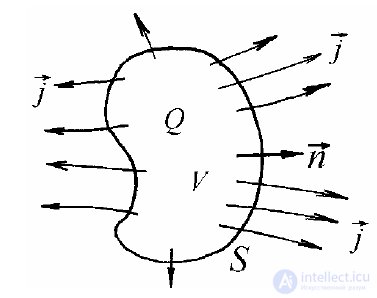
Figure 2.1
In this case one can say that a current flows through the surface S
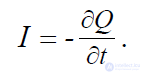 . (2.1)
If the left and right sides of this equation are expressed in terms of the volume densities of current and charge, it is not difficult to arrive at the following equality:
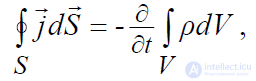 (2.2)
(2.2)
which represents the law of conservation of charge in integral form.
Let us apply the Gauss–Ostrogradsky theorem to the left side of the obtained equation:
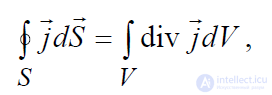 ,
,
which allows it to be written in the form
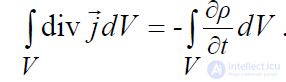 .
.
Now let us move all terms of the equation to its left side and combine them under the sign of a single integral, which gives the following expression:
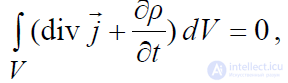
from which the equality follows:
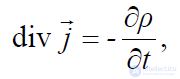 (2.3)
(2.3)
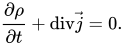
which is the mathematical expression of the law of conservation of charge in differential form, better known as the continuity equation.
In words, the law of conservation of charge is formulated as follows:
Every change in the amount of charge contained within some region of space corresponds to an electric current flowing out of or into that region.
The law of conservation of charge can be regarded as a consequence of Maxwell's equations. Indeed, if in the second Maxwell equation the contour / is shrunk to a point, we obtain that the contour integral will be equal to zero, and the surface S will turn out to be closed
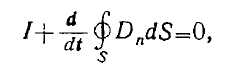
Using the third equation, we find that
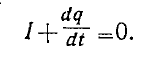
This relation formulates the law of conservation of charge. The change of charges within some volume bounded by a closed surface is equal to the current flowing through that surface.
If in the first Maxwell equation the contour is shrunk to a point, then the contour integral will be equal to zero, the surface S will turn out to be
closed and we obtain
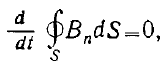
that is
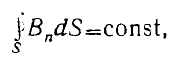
and according to the fourth equation
const = 0.
Thus, from the second and third Maxwell equations follows the law of conservation of electric charges, and from the first and fourth equations follows the conservation of a kind of
«magnetic charges», i.e. the total «magnetic charge» is always zero.
In other words, in nature there are no magnetic charges analogous to electric ones.
Recall that the flux density of electric charge is simply the current density. The fact that the change of charge in a volume is equal to the total current through the surface can be written in mathematical form:
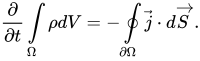
Here Ω — is some arbitrary region in three-dimensional space, ∂Ω — is the boundary of this region, ρ — is the charge density,  — is the current density (the flux density of electric charge) through the boundary.
Passing to an infinitesimal volume and using the Ostrogradsky–Gauss theorem as needed, the law of conservation of charge can be rewritten in local differential form (the continuity equation):
Kirchhoff's rules for currents follow directly from the law of conservation of charge. A combination of conductors and radio-electronic components is represented as an open system. The total influx of charges into this system is equal to the total outflow of charges from the system. Kirchhoff's rules assume that an electronic system cannot significantly change its total charge.

Comments