
Lecture
The simplest medium in terms of its electrical properties is free space — vacuum. For this «medium» the following relationship between field
vectors holds:
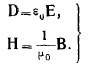 . (I )
 — the permittivity and permeability of free space, where
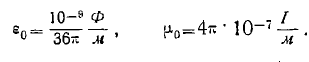
Free space is also characterized by one more derived parameter:
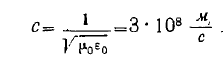 — the propagation velocity of electromagnetic waves in free
space.
The parameters  — are all the characteristics of free space as a medium.
As for other media, here we have a great variety of relationships between the field vectors, analogous to (1) but significantly more complex.
These relationships are called constitutive equations.
Constitutive equations represent any relationship between the field vectors themselves. In this they differ from Maxwell's equations, which are differential equations.
The simplest constitutive equations for real media have, as already noted, the same form as in the case of free
space, i.e.
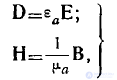 (2)
(2)
where
 —absolute permittivity and permeability,
where

 — relative permittivity and permeability.
It is essential that the current density J in Maxwell's equations can
play a dual role. The current can be a source of the field — that
is, the cause of the field's appearance, but it can also be generated by the field,
i.e. it can be a consequence.
In the latter case there is one more constitutive equation
I, , Siemens Ohm\ „
where a—the conductivity of the medium I [a] = — — = — I . This relationship
represents a formulation of Ohm's law in differential
form. The parameters s, u-, a are found either experimentally,
or theoretically on the basis of model concepts of the structure of
the substance.
Constitutive equations (2) relate to each other the «force
» vectors E and B and the «quantity» field vectors D and H. Vectors
E and B are called force vectors because, as seen from the
expression for the Lorentz force \
. F=<7(E+VXB),
they determine the force acting on a charge in the electromagnetic
field.
Vectors D and H are called quantity vectors because, as
seen from the second and third Maxwell equations in integral
form, they are determined directly by the magnitudes of the charges and
currents, i.e. by the quantities characterizing the sources of the electromagnetic
field.
Having become acquainted with the simplest constitutive equations and
their meaning, below we will consider the classification of media according to their electrical
properties.
Vectors Er and Br fully determine the electromagnetic field in vacuum.
In the case of an arbitrary medium, however, these vectors are insufficient, since they do not account for the properties of the medium itself.
Therefore two more vector quantities are introduced:  , calling them the magnetic field
strength and the electric induction (or electric displacement), respectively.
Let us establish how the vectors Hr and Dr are related to Er and Br.
First, let us consider the action of an electric field on a substance. In the absence of an external field
the substance is electrically neutral, i.e. the negative and positive charges there are balanced.
The molecules that make up the substance can be polar and nonpolar.
In nonpolar molecules the center of mass of the negative charges coincides with the center of mass of the positive charges, while in polar molecules these centers do not coincide, so that the molecule can be regarded as a dipole with dipole moment  , where lr is the vector connecting the charges –q and +q.
When an external field Er is applied to the substance, polar molecules orient themselves along its field lines.
Nonpolar molecules under the action of an electric field first become polarized, and then behave the same way as polar ones.
This process is called polarization of the substance, and to characterize it the polarization vector P is introduced
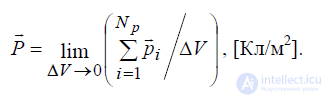 (1.17)
where N p – is the number of ordered electric dipoles in the volume
ΔV .
The magnitude of the polarization Pr can be considered proportional to the strength of the applied field Er
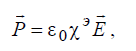 (1.18)
where χe – is the dielectric susceptibility of the medium, ε = 10−9 36π 0 [F/m] – the universal electric constant.
The electric induction vector is defined as
 , (1.19)
where . 
The quantity ε [F/m] is called the absolute permittivity of the medium, and  is called its relative permittivity.
The electric induction vector is often called the electric displacement vector, since it accounts for the displacement of molecules in the substance during its polarization.
Substances behave in a similar way in an external magnetic field as well.
The atoms and molecules of many of them can be likened to current loops with current I, which possess a magnetic moment m ISn0 r r = .
In the normal state the loops are oriented chaotically, however under the action of an external magnetic field Br they become ordered, which leads to magnetization of the material.
The magnetization of the medium is characterized by the vector
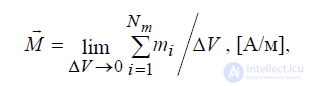 (1.20)
where Nm – is the number of ordered magnetic dipoles in the volume ΔV .
To account for the influence of the medium's magnetization, the magnetic field
strength vector is introduced:
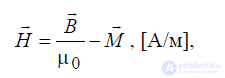 , (1.21)
where 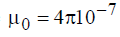 − [H/m] – the universal magnetic constant.
The vectors Mr and H r
are considered proportional to each other (for a linear
medium):
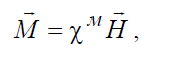
(1.22)
where χm – is the magnetic susceptibility.
From the last two equalities it follows
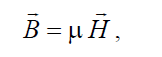 , (1.23)
where (1 m )
μ = μ0 + χ – is the absolute magnetic permeability of the medium, and m
μr = μ μ0 = 1+ χ – the relative magnetic permeability.
It should be noted that the vectors D
r
and H
r
under identical external
field sources do not depend on the medium, i.e. do not depend on the intramolecular charges and currents of the substance.
The parameters εa , μa , χe and χm characterize properties of the substance caused by bound charges. However, in addition to bound charges, there can be free charges inside the substance, which begin ordered
motion under the action of an external electric field, forming a conduction current. The conduction current density j
r
is proportional to the voltage
of the electric field:
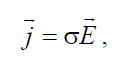
, (1.24)
where σ [1 (Ohm⋅m) ] – is the specific conductivity of the medium.
This last equality expresses the differential form of the well-known Ohm's law for a circuit section.
All media are characterized by three parameters: ε, μ and σ. Depending
on the properties of the parameters ε, μ and σ, media are divided into:
1) linear and nonlinear: if at least one of the medium parameters ε, μ or σ depends on the magnitude of the applied field E r or Hr , then the medium is considered nonlinear; if no such dependence is observed, then the media are called linear;
2) homogeneous and inhomogeneous: if at least one of the medium parameters ε, μ or σ depends on the coordinates, then the medium is considered inhomogeneous; if no such dependence is observed, then the media are called homogeneous;
3) isotropic and anisotropic: if the properties of the medium are the same along three orthogonal directions, then the medium is isotropic; if not – then it is anisotropic. In isotropic media ε, μ and σ – are scalar quantities, while for
describing anisotropic media they are tensors. Tensors are written in the form of a matrix. For example, in a Cartesian coordinate system they have the form:
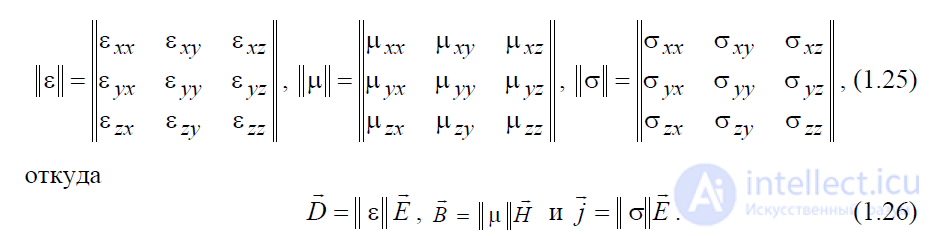
In this case the vectors  are in general found to be non-parallel.
Media in which the electrical properties are the same in all directions are called isotropic.
In this case, in an arbitrarily chosen rectangular coordinate system, for an arbitrarily directed vector E, the following equalities hold
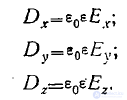
Consequently, here no matter how the vector E is directed, we will have
D=eneE
and similarly
J = o £ ,
that is, in an isotropic medium the vector D is collinear with E, the vector B is col-
linear with H, the vector J is collinear with E.
Media in which the electrical
properties differ in different directions are called anisotropic. In this case, in some
rectangular coordinate system it may turn out that with the
vector E directed along the ox axis, we obtain
 ; (3a)
with direction along the oy axis
 ; (3 b)
with direction along the oz axis
 (3c)
(3c)
Suppose that the vector E lies in the coordinate plane
xoy of the same coordinate system and is directed at an arbitrary angle
to the ox axis. In this case, decomposing the vector B into components'
1 along the coordinate axes, we obtain

And since  , the vector

will no longer be collinear with the vector E (fig. 1).
However, relations (3) and those that follow are valid only in a special
coordinate system. In an arbitrary rectangular coordinate system the relations between the components of the vectors D and E for anisotropic media are more complex:
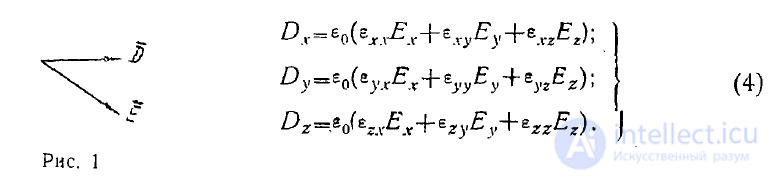
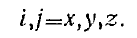
The set of nine numbers in the form of a matrix •tj is called a tensor.
The tensor is written as
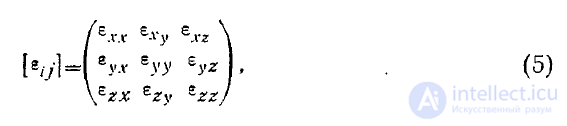
where
A tensor is a generalization of a scalar and a vector.
A scalar — is a quantity characterized by a single number, and its description requires no indices.
A vector — is a quantity characterized by three numbers (three coordinate components), and its description requires one index (x or y or z).
A tensor — is a quantity characterized by nine numbers, and its description requires two indices (xx or xy or yz, etc.).
Correspondingly, a scalar is a tensor of rank zero, a vector is a tensor of rank one, and the permittivity tensor is a tensor of rank two.
The magnetic permeability μ and the conductivity σ can also be tensors.
If at least one of the electric parameters  is a tensor, then the medium is anisotropic.
Examples of anisotropic media are crystals and the ionosphere. The permittivity tensor, like the tensors μ and σ, is, as will be shown, a symmetric tensor, i.e.
This means that the permittivity tensor is in fact characterized not by 9, but only by 6 distinct numbers.
A medium in which the electric parameters do not depend on the coordinates is called homogeneous.
Thus, in the case of an isotropic medium  .
.
In the case of a homogeneous anisotropic medium, all components of the electric parameter tensors must not depend on the coordinates.
A medium in which the electric parameters depend on the coordinates, or at least one of the parameters depends on at least one coordinate, is called inhomogeneous.
An example of an inhomogeneous medium is the atmosphere. Media can be linear or nonlinear. A medium is called linear if its electric parameters do not depend on the magnitudes of the electromagnetic field vectors. A medium is called nonlinear if its electric parameters depend on the magnitudes of the electromagnetic field vectors. An example of such a medium is a ferromagnet, whose magnetic permeability depends on the magnitude of the magnetic field strength. In principle all media are nonlinear, however this nonlinearity manifests itself only at very large magnitudes of the field vectors.
Media possessing conductivity are characterized by one more derived parameter — the relaxation time. Let us derive this parameter:
J=oE (assuming a—const);
div J + 1 = 0 ;
d l v E = — (assuming e=const).
From these three relations we find
Solving this equation for a fixed point, we find •
t
where
Po — the initial charge density;
t = —the relaxation time; it shows how quickly
an accumulation of charges of density p0 dissipates in the medium.
For example, for:
— copper o ~ 1 0 7 — , e=1,
t ~ 1 0 - 1 8 < : ;
— seawater a=4 ^ , s=80,
x=2 - 1 0 - 1 0 s;
— glass o = 1 0 ~ 1 2 ^ < e=2;
t=20 s;
—quartz b = 1 0 - p Sch-, e=2,
x=2- 106 s ≈ 25 days.
As can be seen from this data, in a metal an accumulation of charges
dissipates almost instantly and ends up on the surface of the conductor.
We further conclude that the better the insulator, the greater the relaxation time.
In this lecture course we will study the theory of the electromagnetic
field only for linear media. In this
case Maxwell's equations are linear. Therefore the time
dependence is conveniently represented here by means of the time factor
e^(iωt). Thus any quantity characterizing the electromagnetic
field is represented as a product of a function of the coordinates
and the indicated time factor. In this case the function
depending on the coordinates can also be complex. This means
functions depending on the coordinates in electromagnetic field theory
can be simultaneously vector-valued and complex. For example,

i.e. here 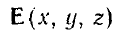 —is a complex vector function of the coordinates:

where 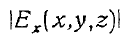 . — is the modulus, and
 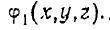 ..—is the argument or phase of the complex number
 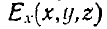 and so on.
Considering that
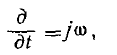
i.e. the time derivative is the operator of multiplication by  , let us write Maxwell's equations in the form
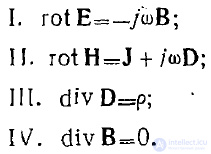
Setting in the second equation

we can represent it in the form
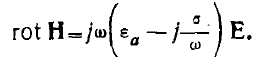
Comparing this equation with the equation for the case of a dielectric (a=0)
i.e. with the equation
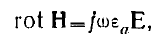 , (7)
, (7)
we see that it is expedient to introduce the complex permittivity
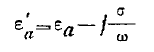
and write
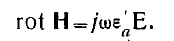 (8)
(8)
Comparing equation (8) with equation (7), we see that formally the equations in the cases  do not differ from each other.
This circumstance, as we shall see later, often leads to significant simplifications.
So, the permittivity, like the permeability, can be a complex quantity. In connection
with this we note that the permittivity tensor in the general case satisfies the condition
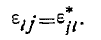 (9)
(9)
(The asterisk denotes the complex conjugate number).
A tensor possessing this property is called Hermitian (after the scientist Hermite). Consequently, the symmetry of the tensor
(equality (6)) follows from condition (9).
In radio engineering the parameters  of many media are practically independent of frequency.
Such a dependence begins to show up only in the shortest-wavelength part of the radio-wave spectrum.
In the optical wave range  depend on frequency, i.e. dispersion takes place.

Comments