
Lecture
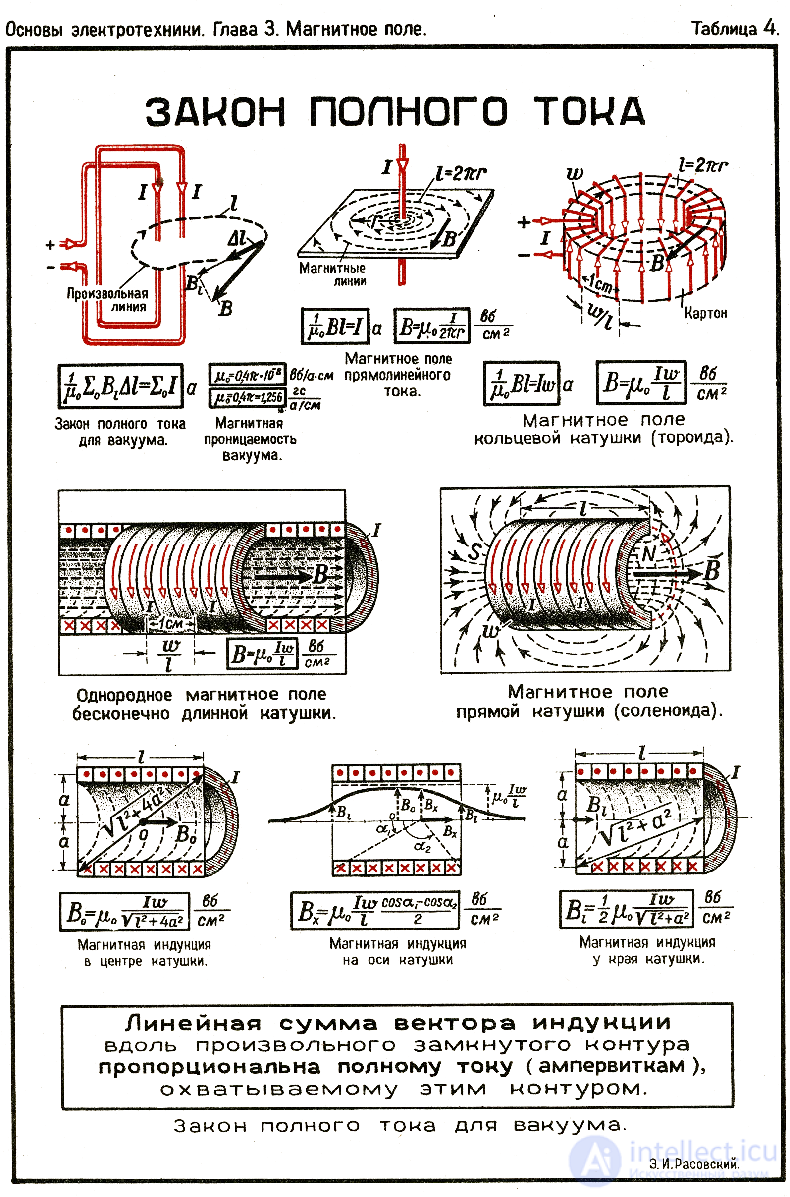
The law of total current was discovered by Ampère and bears his name.
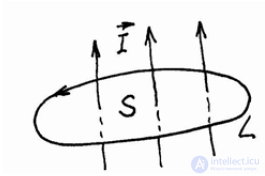
Figure 2.4
Mathematically it can be written in the following form:
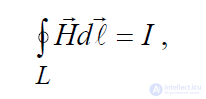 (2.11)
and its verbal formulation states:
The circulation of the magnetic field strength H r
around a closed contour
L (Fig. 2.4) is numerically equal to the conduction current I crossing the surface S bounded by this contour.
Expression (2.11) is the integral form of the law under consideration. Let us find its differential analogue, assuming that the current I on the right-hand side of the equality is a volume current. In this case, the current I flowing through the surface S can be expressed through its volume density
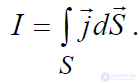
. Let us transform the left-hand side of (2.11) using Stokes' theorem
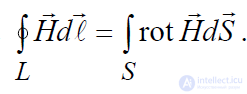
As a result of these operations we obtain 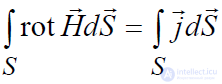
, from which the equality follows:
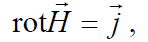 , (2.12)
which represents the differential form of the law of total current. It should be noted that this law was obtained by Ampère for direct currents.
Analyzing it, Maxwell came to the conclusion that the law in this form is not suitable for describing alternating currents. To clarify the reason for this conclusion, let us consider an alternating-current electrical circuit containing a capacitor (Fig. 2.5) and try to find the circulation C of the magnetic field around a contour L enclosing the wire. Equality (2.11) gives an ambiguous solution to this problem.
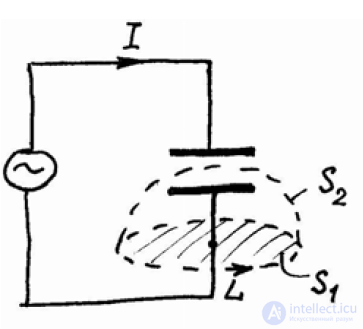
Figure 2.5
Indeed, if the surface of integration S, resting on the contour L, is chosen so that it crosses the current-carrying wire, i.e., S = S1, then the circulation of the vector Hr
around the chosen contour turns out to be equal to the current in the wire: C1 = I. If, however, the surface S, resting on the same contour L, is drawn in a different way, so that it does not cross the wire but passes
between the plates of the capacitor, where there is no conduction current, then C2 = 0.
Thus the circulation C1 of the vector Hr around the contour L turns out not to be equal to the circulation C2 around the same contour, which is a nonsense.
Moreover, it can be shown that the law of total current (2.12) contradicts the law of conservation of charge. Indeed, if we apply the div operation to both sides of equality (2.12):
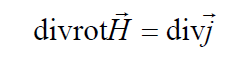
and take into account that 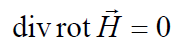 r
r
(B.21), then we obtain that 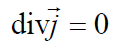
r
instead of the law of conservation of charge being satisfied, which requires:
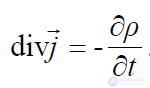
. Let us try to correct this discrepancy by substituting into the last equality, in place of the charge density ρ
its expression in terms of the electric displacement 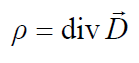 Gauss's law).
As a result we obtain: 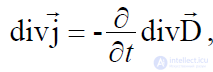
from which
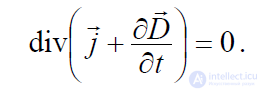
.
Maxwell assumed that the expression in brackets, i.e., 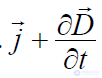
, must, in the general case, appear on the right-hand side of the law of total current, whose differential form in this case takes on a new form:
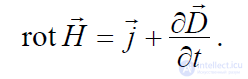 (2.13)
Let us proceed to the integral form of the generalized law of total current, for which we integrate the left- and right-hand sides of the last equality over the surface S
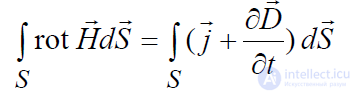
and, applying Stokes' theorem to the left-hand side, we finally find
disp

, (2.14)
where disp
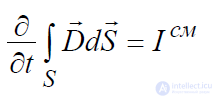
– is the displacement current, and j disp
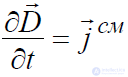 – is the displacement current density.
The generalized law of total current in the form (2.13)-(2.14) no longer contradicts
the law of conservation of charge and explains the paradox found when considering the circuit (Fig. 2.5). The circulation 
around the chosen contour L cannot depend on the choice of the shape of the surface S over which the integration on the right-hand side of equality (2.14) is carried out, therefore the relation must hold
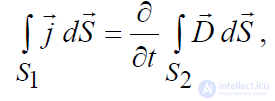 , (2.15)
establishing the equality of the conduction current in the conductor and the displacement current between the plates of the capacitor. Thus, despite the apparent break in the circuit between the plates of the capacitor, it turns out to be closed by displacement currents, and continuity of current is observed in the circuit, as described in circuit theory by Kirchhoff's first law.

Comments