
Lecture
Magnetic flux — the flux of the magnetic induction vector B through a certain surface. For an infinitesimally small element it equals the product of the modulus |B| and the area of the element dS and the cosine of the angle α between B and the normal n to the plane of the element. For a surface of finite size it is found as the sum (integral) over its small fragments. The standard notation is Φ.
In other words, Gauss's law for magnetism is the statement:
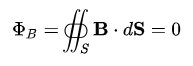
for any closed surface S.
The most important physical formula involving magnetic flux is the expression for Faraday's law of electromagnetic induction.
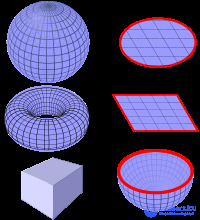
Some examples of closed surfaces (left) and open surfaces (right). Left: the surface of a sphere, the surface of a torus, the surface of a cube. Right: the surface of a disk, a square surface, the surface of a hemisphere. (The surface is blue, the boundary is red.)
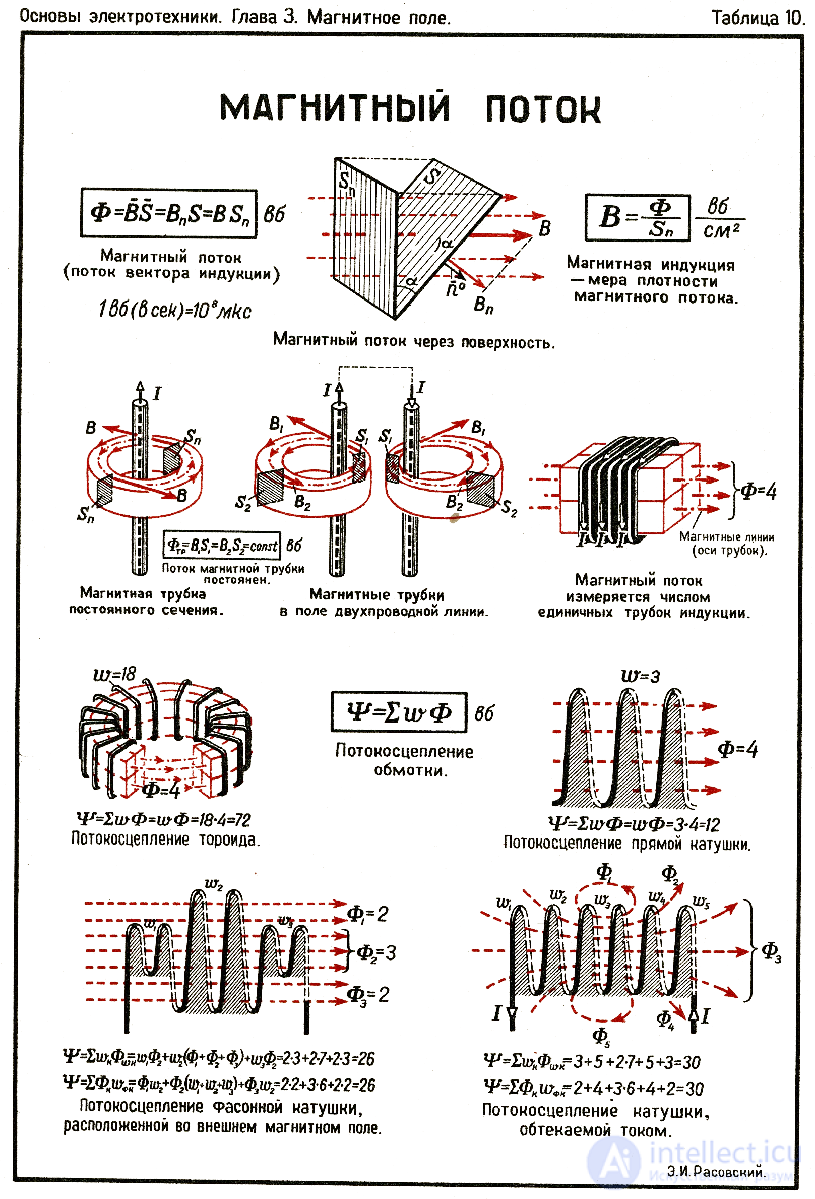
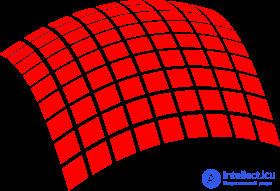
Division of the surface into small elements dS
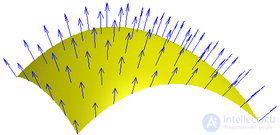
Change of the normal vector to the surface
The magnetic flux through an infinitesimally small element of a surface dS is called the product
 ,
,
where α — is the angle between the magnetic induction vector B and the unit normal vector n to the surface element, and the vector element dS of the surface area S is defined as
 .
.
The magnetic flux through a surface of finite area is called the integral of dΦ over the surface:
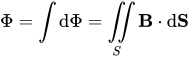 .
.
The direction of the vector n is in the general case not constant (see fig.), the magnetic field can also change along the surface. The dot in the products denotes the scalar (dot) product of vectors. The integral is understood as the limit of the sum over small elements as their sizes tend to zero. The surface can be open (as in the figure) or closed.
In the case of a uniform field and a flat surface, the magnetic flux is calculated as Φ=BScosα .
.
In SI, the unit of magnetic flux is the weber (Wb, dimension — Wb = V·s = kg·m²·s-2·A-1), in the CGS system — the maxwell (Mx, 1 Wb = 108 Mx).
An instrument for measuring magnetic flux is called a fluxmeter (from Latin fluxus — «flow» and Greek metron — measure) or webermeter.
In accordance with Gauss's theorem for magnetic induction, the flux of the magnetic induction vector B through any closed surface S equals zero:
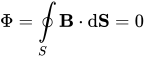 .
.
This means that in classical electrodynamics the existence of magnetic charges, which would create a magnetic field similarly to how electric charges create an electric field, is impossible.
In accordance with Stokes' theorem, the magnetic flux Φ through a surface «stretched» over a certain contour L can be expressed through the circulation of the vector potential A of the magnetic field along this contour:
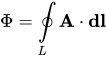 ,
,
since the relation B=rotA holds. This flux does not depend on the configuration of the stretched surface.
According to Faraday's law of electromagnetic induction, if the magnetic flux through a certain surface changes with time, an electromotive force is created
E=−dΦdt
in the contour over which this surface is stretched. If an electrical wire is «laid» along such a contour, an induced current will arise in it. The change of the flux with time can be caused by a change of the magnetic induction vector B and/or the geometry of the contour.
When considering a number of quantum phenomena, such as the Aharonov—Bohm effect or the quantum Hall effect, the quantum of magnetic flux is used:
 ,
,
where h — is Planck's constant, e — is the elementary charge.
Experiments with a multiply connected superconductor (for example, with a superconducting ring) show that the magnetic flux through the ring is always a multiple of half the quantum of magnetic flux, from which it follows that the current carriers in the superconductor are pairs of bound elementary charges. This is direct confirmation of BCS theory, according to which superconductivity is caused by electron pairs (Cooper pairs):
 Wb (in SI);
 Gauss·cm2 (in CGS), c — is the speed of light.
The quantization of magnetic flux was experimentally discovered in 1961.

Comments