
Lecture
Experience shows that under certain influences (for example, friction) bodies can acquire special properties – they become able to electrify and interact with one another. The measure of electrification in physics is
the electric charge q. The charge q – is a scalar quantity, which in the SI
system is measured in Coulombs (C). The name of the unit of charge immortalized the name
of the French scientist Coulomb, who discovered the law of electrical interaction of charged bodies.
In space, charges can be distributed in various ways: discretely or continuously. A typical example
of an indivisible discrete charge is the charge of the electron e= -1.6*10-19 C.
Sometimes, in theoretical treatment of charges, it is convenient to use the notion of a
point charge, by which one usually means a charge of arbitrary magnitude, ascribed to a body of negligibly small dimensions (compared to the distances at which the field it produces is considered).
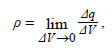
For a continuous distribution of charge in a volumetric body, it is convenient to use the notion of volume charge density, which is nothing other than
the charge per unit volume of the charged body. The volume charge density is a differential quantity and, in the general case, is defined as the limit:
 , (1.1)
where ΔV – is the volume of the selected portion of the charged body, Δq – is the charge of that portion.
If the volume charge density is known as a function of coordinates
ρ(x,y,z), then the total charge of the current can always be found as the integral
 . (1.2)
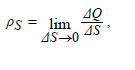
Sometimes charge is distributed not throughout the entire volume of the body, but only on its surface. In this case, the concept of surface density
of charge is introduced (charge per unit surface area):
 , (1.3)
where ΔS – is the area of the selected portion of the charged surface, Δq – is the charge
of that portion. Knowing the distribution ρs, one can determine the total charge
of the surface, as
 (1.4)
(1.4)
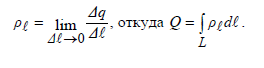
If dealing with charged extended objects, for example,
a charged thin filament, then the notion of linear (or per-unit-length) charge density is introduced (charge per unit length):
 (1.5)
(1.5)
Consider some body of volume V, having
a positive electric charge Q. Suppose electric charges, for some reason, flow out of this body through its surface S (fig.1.1).
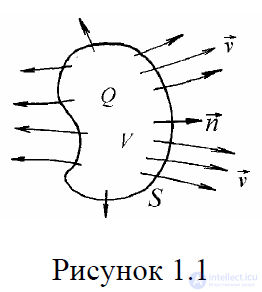
In this
case, one says that a conduction electric current (or simply electric
current) flows through the surface S. In the general case, conduction electric current is called the process of ordered motion of charges.
The magnitude (or strength) of the current I, flowing through the surface S, numerically
equals the rate of change of the charge in the volume V:
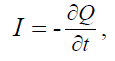 , (1.6)
the "minus" sign here indicates that the positive direction of the current is
taken to be the direction of motion of positive charges. Thus, the
strength of the current – is the amount of charge that passes through a given cross-section
of the wire per 1 unit of time. The unit of measurement of current strength in the SI system
is 1 Ampere: A = C/sec.
It is graphically convenient to depict the motion of charges by means of current
lines. Current lines – are directed lines, the tangents to which coincide
in direction with the velocity vector υ r of the charges at a given point and at a given
moment in time. One can imagine that neighboring current lines form the walls of a certain tube,
inside which the current flows. This imaginary tube
is called a current tube (fig.1.2).
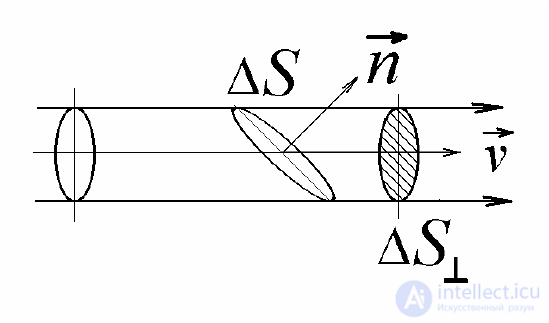
Figure 1.2
If we take the current
tube sufficiently thin, then we can find an important
differential characteristic of the current, which is called the volume current density and is defined as
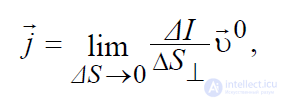 , (1.7)
where ΔI – is the current flowing through the selected current tube, ΔS⊥ – is its cross-section, 0 υ r – is the unit vector of the charge velocity, giving the direction of
current flow at that point. In the general case, if the cross-section ΔS is oriented
at an arbitrary angle to the current lines, then the cross-section ΔS⊥ can
be determined as the scalar product:
 (1.8)
(1.8)
The current we have considered flows within the entire volume of the body, so it can
be called a volume current. The entire current I flows through the cross-section S, and the current
per unit surface area is called
If the value of j
r
is the same at all points of the cross-section through which it flows, then the current is called uniform (or a current uniformly distributed
over the cross-section). If j
r
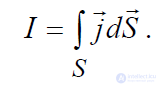
is nonuniform over the cross-section, then the current strength can be determined as the flux of the vector j
r
through the surface S:
 (1.9)
(1.9)
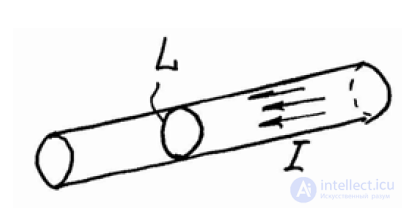
Figure 1.3
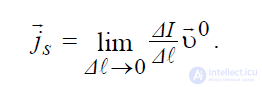
Sometimes there are cases when the current flows not through the entire volume of the body, but only over its surface (fig.1.3),
then one speaks of a surface current and introduces the notion of
surface current density
 . (1.10)
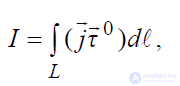
The total current is expressed through its surface density by the line
integral:
 , (1.11)
where L – is the perimeter of the wire, 0 τ r – is the perpendicular to L on the surface of the wire.
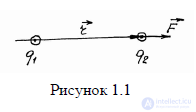
It has been experimentally established that electric charges exert
a force effect on one another. Let us consider the following example. Suppose
there is some large point charge q1, located at a given point
in space. Let us call this charge the primary charge, and bring to it another point charge, of negligibly small magnitude, the so-called test
charge qpr. On this second charge, wherever in space it is placed, a force F1r will act, "originating" from the first charge. This force
becomes larger as the test charge approaches the primary one, and smaller as the distance r between the charges increases. Consequently, we can
assert that at each point of the space under consideration there exists
"something" that transmits the force originating from the primary charge to the test charge. This "something" is present even if we remove the test charge from consideration, and this objectively existing "something" is commonly called the electric field. As is known, the interaction force of two stationary point charges, according to Coulomb's law, is proportional to the magnitudes of both charges:
 , (1.12)
where ε – is the coefficient called the dielectric permittivity
of the medium,  a unit vector, indicating the direction of action of the force. In the example under consideration, the test charge essentially served as a kind
of indicator, allowing one to detect the electric field of the primary
charge. To obtain a characteristic of this field that does not depend on the magnitude of the test charge, the force F1
r
in (1.12) is divided by qpr and the resulting quantity is called the electric field strength produced by the primary
charge q1:
 (1.13)
Experience shows that magnetized bodies also possess a similar property of force interaction, so it can be asserted that this interaction is also transmitted by means of a certain objectively existing
substance, which is called the magnetic field. In addition, it has been established
that the presence of a magnetic field can also be detected by its force
effect on a moving electric charge qpr. If the velocity υ r with which the charge qpr moves is known, then this effect can be described
by the Lorentz force
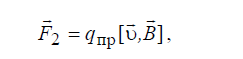 (1.14)
which allows us to introduce a certain vector quantity B
r
, characterizing
the magnetic field itself:
 (1.15)
The vector B
r
is called the magnetic induction vector. The magnitude of B r
is
equal to the force acting on a unit electric test charge,
moving with unit velocity, and its direction is perpendicular
to this force and to the direction of motion.
Since the vectors Er
and Br
, characterizing the electric and magnetic
fields, depend on the point of application and can change with time, they in the
general case are functions of coordinates and time. These functions
can be denoted as E(x, y, z, t)r
and B(x, y, z, t)r
. If in some region
of space both fields, electric and magnetic, are present, then one can speak of the presence of an electromagnetic field, which acts on
the test charge with a force
 (1.16)
From the very way in which the concept of electric field strength is introduced
it follows that this is a differential characteristic of the field, since it characterizes it at each specific point. Along with the differential characteristics of the field, the force properties of the field can also be described by an integral characteristic, closely related to the concept of work. Let us find the work A, performed by the electric forces F
r
of the field when moving a point
charge q from point P1 to point P2:
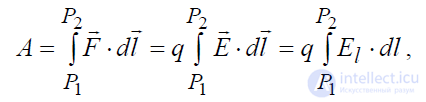 (1.27)
where dl – is the path element along which the charge moves from point P1 to point
P2.
If we relate A to the magnitude of the charge being moved, we obtain an integral characteristic of the field that does not depend on the magnitude of the charge:
, 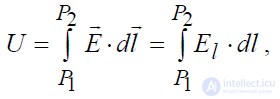 (1.28)
which is called the voltage between points P1 and P2. From the definition it follows that the voltage between these points is nothing other than the work done by electric forces in moving a unit charge from one point to another. If the charge moves along a closed contour L, then the voltage U is called the electromotive force acting in this closed contour:
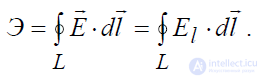 (1.29)
As can be seen from the last relation, the electromotive force (or simply EMF) is the circulation of the vector E
r
along the contour L. This integral characteristic is very often used in describing electromagnetic fields.

Comments