
Lecture
A perfectly conducting sphere or a sphere made of a perfect dielectric is placed into a uniform electric field Eo. It is required to find the perturbed field. It is clear that at large distances from the sphere the field will be unperturbed and equal to Eo (Fig. 1). Obviously, to find the perturbed field it is convenient to use a spherical coordinate system 
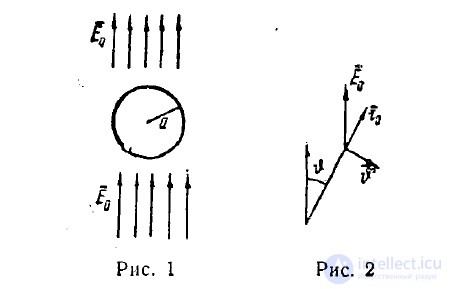
Fig. 1 Fig. 2
The uniform field in this coordinate system is represented by the formulas (Fig. 2).
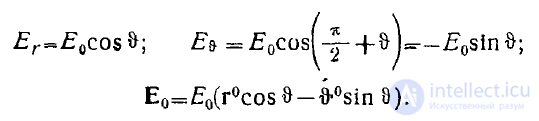
The potential  of the uniform field in the same coordinate system, as is easy to verify from the formula
  , is equal to
 (1)
(1)
Finding the perturbed field, as is generally the case in electromagnetic field theory, is carried out in two stages:
a) a solution satisfying Maxwell's equations is found;
b) the unknown constants entering the solution are chosen so that the boundary conditions at the interface between the media are satisfied.
However, it often turns out to be possible to use a ready-made solution and thus reduce the solution of the problem to carrying out only the second stage. Below we will solve the stated problem
precisely in this way.
A well-known method exists for solving the following simple problem:
there is a point charge above a perfectly conducting plane, and it is required to find the field above this plane. This problem is solved by the method of image charges. This method consists in
representing the field above the plane as the sum of the fields of the real charge and its mirror image, which has the opposite sign. As we can see, the essence of this method is that a
ready-made solution of Maxwell's equations is used — this is the field of an imaginary charge, with the position of this charge chosen so that the total field satisfies the boundary condition
on the perfectly conducting plane  .
.
The method of image charges suggests the possibility of choosing such an imaginary system of charges inside the sphere
that the field of these charges, together with the uniform field E0, satisfies
the boundary condition on the surface of the sphere
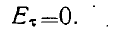 . (2)
. (2)
The boundary condition for the potential  that follows from this condition is as follows:
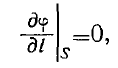
where l — is any curve on the surface S of the sphere. It follows that 
So,
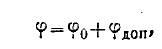
where  — is the potential of the sought system of charges inside the sphere.
From formula (1) it follows that the additional potential must contain the factor  (the boundary condition must hold for any ô), and such
a factor is contained in the expression for the potential of a dipole.
Therefore, let us set 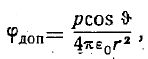
where p —• is the sought dipole moment. Consequently,
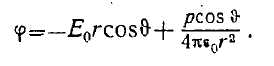
On the surface of the sphere, i.e. at r —a, the following condition must hold

Since this equality must hold for any  , it
, it
is possible only when
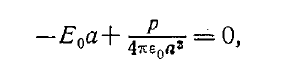
from which we obtain
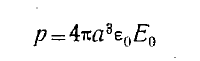 (3)
(3)
and the problem is solved. Fig. 3 shows the vector field lines of E.
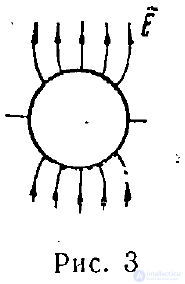
fig. 3
In this case, unlike the previous one, two boundary conditions must hold:
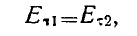 (4)
(4)
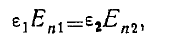 (5)
(5)
where  ,— are the dielectric permittivities inside and outside the sphere (Fig. 4).
Boundary condition (4) corresponds to the condition for the potential
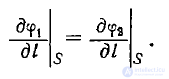
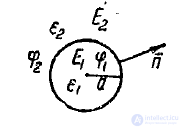
Fig. 4
This boundary condition reduces to the following:
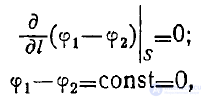
since at infinity the potential  must equal zero.
Thus, on the surface of the sphere the condition must hold
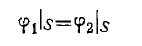 (6)
(6)
and the condition corresponding to (5),
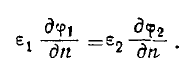 (7)
(7)
In the case of a perfectly conducting sphere the field inside it is zero. In the case of a dielectric, however, the field inside the sphere is nonzero.
Therefore there must be two unknown quantities corresponding to the two boundary conditions. If one tries to solve the problem by choosing a dipole field, this gives one unknown—the dipole
moment p. Obviously the second unknown must be the field E inside the sphere. So, assuming the field Eh parallel to the field E0 is uniform inside the sphere, we have
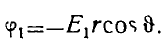
Outside the sphere

Substituting these expressions into the boundary conditions (6) and (7), we obtain a system of equations
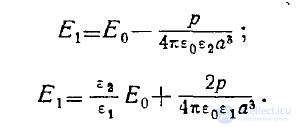
Solving it, we find
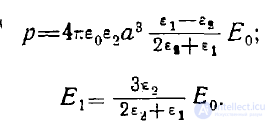 (8)
(8)
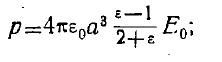
In particular, for 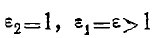
(9) 
(10) 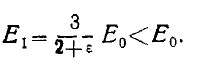
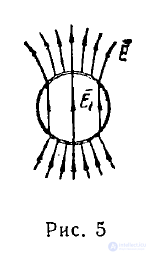
Fig. 5
The configuration of the vector field lines of E for this case is shown in Fig. 5. In connection with inequality (10), the concept of depolarization factor is introduced, which is defined by the formula
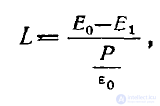
where P — is the polarization vector inside the dielectric sphere.
Taking into account that  we find
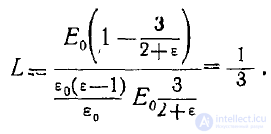
The solution considered for the sphere problem is used in the study of the scattering of electromagnetic waves in the atmosphere and in other media.

Comments