
Lecture
The average Poynting vector, or the average energy flux density, radiated by an elementary vibrator, according to lecture 20 equals
 (1)
(1)
In order to determine the energy radiated by the vibrator per unit time, i.e., the radiated power, it is necessary to calculate the flux of the Poynting vector Scp through a closed surface enclosing the vibrator.
This surface can be drawn in any zone of the vibrator.
However, the sought result is obtained most simply if this surface is a sphere, passing through the far zone and centered at the location of the vibrator.
In a spherical coordinate system in which the surface element is equal to
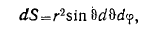
the radiated power of the vibrator is calculated by the formula
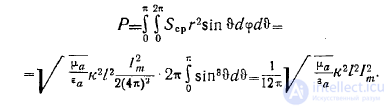 (2)
(2)
Introducing the effective (rms) value of the current  we can write
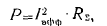 (3)
(3)
where , . 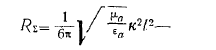
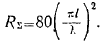
the so-called radiation resistance of the elementary vibrator.
The radiation resistance is called such an active resistance of a two-terminal element in which, at the same current  , the same power is dissipated as the radiated power of the vibrator.
For free space
 . (5)
. (5)
In lecture 20 we obtained formulas for the components of the electromagnetic field vectors created by an electric dipole. Here the task is to obtain analogous formulas for the electromagnetic field of a magnetic dipole. A magnetic dipole, as was established in lecture 11, is a circular loop with current. We will solve the stated problem without repeating the long path that was traversed in the two preceding lectures to determine the electromagnetic field of the electric dipole. To do this we will make use of the property of permutational duality of Maxwell's equations. However, beforehand, with the aim of accounting for the field sources, using formula (3) of lecture 8 and formula (11) of lecture 11, let us represent Maxwell's equations in the form
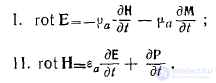
Now let us formulate the stated property. Let the electromagnetic field vectors E and H be found as the solution of Maxwell's equations. The vectors E and H will be functions of the coordinates, time, electrical parameters  and the electric and magnetic dipole moments p, m
Suppose that in the solution the mutual substitutions are made
 (6)
(6)
 . (7)
. (7)
Then the resulting vectors will also be electromagnetic field vectors, i.e., will also be solutions of Maxwell's equations I and II.
This follows from the fact that if, in equations I and II, we make the substitutions (6) and, according to (7), the substitution  , we arrive at the same Maxwell equations I and II.
Using the property of permutational duality, we obtain, from the expressions for the components of the electromagnetic field vectors of the electric dipole, the expressions for the components of the field
of the magnetic dipole. To do this, let us first note that, according to what was set out in lecture 11, the maximum value of the dipole moment of the magnetic dipole  , equals
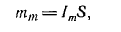
where S— is the area, and Im— is the current amplitude in the circular loop.
Then in formulas 8 of lecture 20 let us make the substitution (6) and (7).
As a result we obtain
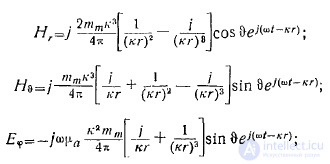
that is, the vector E has only one «equatorial» component, while the vector H — has radial and «meridional» components.
In the far zone
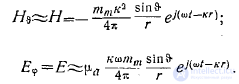 (8)
(8)
In free space these formulas are as follows:
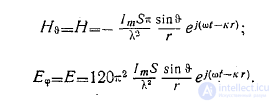
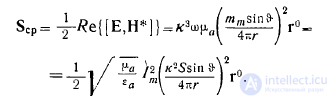
The time-averaged Poynting vector, according to formulas (8), equals
The radiated power equals

Introducing the effective (rms) value of the current  we can write
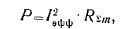
where
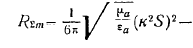
the radiation resistance of the magnetic dipole.
For the ratio of the radiation resistance of the magnetic dipole to the radiation resistance of the electric dipole of the same size l (formula (4)), taking into account that the area of the circular current loop
equals , where l — is the diameter of the loop, we obtain
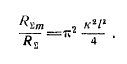
Consequently, the radiation resistance of the magnetic dipole, since  is considerably smaller than the radiation resistance
of the electric dipole, i.e., systems with closed alternating currents radiate considerably worse than systems with open (unclosed) currents.

Comments