
Lecture
Up to now we have studied the field of electromagnetic waves without concerning ourselves with the sources of the electromagnetic field. Now, however, we must consider the question of how the electromagnetic field is related to its sources, i.e. how electromagnetic waves are radiated.
In this case the complete system of Maxwell's equations must be solved without any approximations, with the sources, i.e. the currents and charges, being taken as known.
So, we need to solve the system of equations
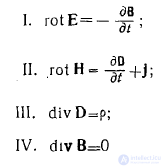
for given current density j and charge density ρ.
Equation IV is immediately satisfied by introducing the vector potential
 . (1)
. (1)
Substituting this expression for B into equation (1), we obtain
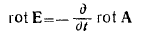
or
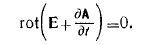
From this it follows that
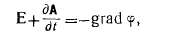 , (2)
, (2)
i.e.
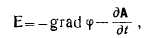 ,
,
where  is the scalar potential.
We shall assume that the medium is a homogeneous dielectric, i.e.

Taking into account the relations  , we substitute (1) and (2) into Maxwell's equation II and obtain
