
Lecture
Electromagnetic interaction, or electromagnetism, is one of the four fundamental interactions. It exists between particles possessing electric charge. From the modern point of view, the electromagnetic interaction between charged particles is not carried out directly, but only by means of the electromagnetic field. From the point of view of quantum field theory, the electromagnetic interaction is mediated by a massless boson — the photon (a particle that can be thought of as a quantum excitation of the electromagnetic field). The photon itself does not carry electric charge, but it can interact with other photons by exchanging virtual electron-positron pairs.
The theory of the electromagnetic field, or electrodynamics, is a theory of electromagnetic processes in various media, covering a large set of physical phenomena in which the main role is played by interactions between charged particles by means of the electromagnetic field
(EMF).
The electromagnetic field is a special kind of matter, qualitatively different from substance. It is characterized by its ability to propagate
in space and to carry electromagnetic energy. The EMF manifests itself through its action on charged particles.
The theory of the electromagnetic field plays an important role in modern views on the structure of matter. According to modern concepts, matter is built from elementary particles, atoms and molecules. The theory of the structure of matter at the micro level belongs to the domain of quantum physics, one of whose branches is quantum, or microscopic, electrodynamics. At the same time, in many practical cases, especially in engineering when designing machines and devices, it is convenient to consider substances as continuous rather than divided into atoms. In this case, the parameters of a substance are characterized
by certain averaged quantities, such as, for example, specific density, permittivity and permeability. The electromagnetic field in this case is also considered to be continuously distributed in space. This approach is called macroscopic, and the theory of the electromagnetic field built within its framework is called macroscopic electrodynamics. The accepted assumptions are justified when all distances from the field sources to the point under consideration are significantly greater than the size of the molecules, and the characteristic time of change of the EMF (for example, the period of oscillation) is large compared with the period of intramolecular processes.
We will study macroscopic electrodynamics, since it is precisely this that is convenient to apply when considering the physical phenomena occurring in radio engineering devices and equipment. Macroscopic electrodynamics is also often called classical electrodynamics, since it was with its construction that the understanding of the nature of electromagnetic phenomena began.
The first mentions of electrical and magnetic phenomena are found as early as the works of ancient Greek scholars of the 6th–3rd centuries BC. Thus, Thales of Miletus in the 6th century BC noticed the ability of rubbed amber to attract light objects. He associated this phenomenon with a special "electric spirit" contained in amber. In the 5th century BC, Democritus suggested that the particles making up a magnet have a certain orientation that allows them to attract one another. Aristotle, in the 4th century BC, described the ability of a magnet to attract iron objects and proposed that magnetism be considered a special "quality" of matter.
Despite these initial observations, in antiquity electrical and magnetic phenomena were regarded merely as curious properties of certain natural materials. The systematic study of electricity and magnetism began much later.
Atmospheric electricity. Electrical and magnetic phenomena have accompanied humanity throughout its entire existence. The first of these to be observed were most likely manifestations of atmospheric electricity — lightning and thunder; the various discharges could not fail to attract people's attention. The destruction and fires that resulted from them caused great damage, and ancient people attributed them to the wrath of the gods. As a rule, the chief god of pagan peoples was a thunderer — Zeus, Jupiter, Perun, and so on. However, even in those times people noted special properties of lightning. Thus, Aristotle himself, in his “Meteorology”, noted lightning's peculiar "affinity" for metals: “It has happened that the bronze of a shield melted while the wood covering it remained unharmed”. Seneca, tutor to the emperor Nero, wrote: “The silver will melt, while the purse that held it will remain unharmed”. Amber and the lodestone. In addition to the manifestations of atmospheric electricity, several thousand years ago people also noticed the special properties of amber and the lodestone. The first of these, when rubbed, had the ability to attract dust particles and threads. The Greek name for amber is elektron. The lodestone had the ability to attract iron objects. Both of these substances are repeatedly described in the legends and myths of ancient Greece and Rome, and they are often mentioned in the works of writers of that time — Plato, Pliny, and others. Both substances were credited with miraculous and healing properties. The first important practical use of the magnet was the compass. The philosophers of that time attempted to explain the essence of the observed phenomena, but their attempts were naive. The first surviving study of the magnet was written by the Frenchman Pierre Pelerin de Maricourt, who, during a forced idleness while besieging the small Italian town of Lucera in 1269, wrote a booklet titled "Letter on the Magnet", which gathered a great many observations on the properties of the magnet. Here he was the first to speak of the poles of magnets, of the attraction of unlike poles and the repulsion of like poles, of the penetration of magnetic forces through glass and water, and of the compass.
Substantial progress in the study of electrical phenomena was achieved in the 17th–18th centuries. In 1600, the English scholar William Gilbert published the treatise "On the Magnet", in which he was the first to introduce the term "electric" to describe the attractive properties of rubbed amber. He also established that the Earth itself is a giant magnet.
In 1729, the English physicist Stephen Gray carried out a series of experiments showing that electric charge could be transmitted over considerable distances along conductors. His experiments marked the beginning of the science of electrostatics. In 1733, the German scholar Georg Wilhelm Richmann proposed a scale for measuring the magnitude of electric charge.
In 1745, the German physicist Ewald Georg von Kleist and the Dutch scholar Pieter van Musschenbroek independently invented the "Leyden jar" – the first capacitor capable of accumulating and storing electric charge. This device made it possible to carry out more precise studies of electrical phenomena.
In parallel with the development of electrostatics, the 18th century also saw the emergence of galvanism – the study of electrochemical processes. In 1786, the Italian physician Luigi Galvani discovered that the contraction of a frog's muscles could be induced by contact with different metals. These experiments formed the basis of the notion of "animal electricity". In 1800, Volta built the world's first galvanic cell – the prototype of the modern electric battery.
A major breakthrough in understanding the relationship between electrical and magnetic phenomena occurred in the 1820s. In 1820, the Danish physicist Hans Christian Ørsted discovered that an electric current flowing through a conductor causes a deflection of a magnetic needle. This was the first experimental proof of the connection between electricity and magnetism.
Ørsted's discovery inspired other scientists to pursue further research. In 1825, the French physicist André-Marie Ampère formulated the laws governing the interaction of current-carrying conductors, proving that electric currents create magnetic fields around themselves. Ampère also put forward the hypothesis that magnetism is caused by the motion of electric charges within matter.
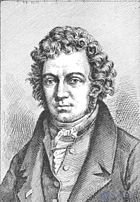
André-Marie Ampère
A key event was the discovery of electromagnetic induction by the English physicist Michael Faraday in 1831. Faraday established that a change in a magnetic field causes an electric current to arise in a conductor placed within that field. This phenomenon underlies the operating principle of generators, transformers, and many other electrical devices.
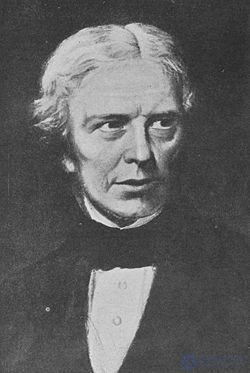
Michael Faraday
And yet the first researcher who approached the study of electrical and magnetic phenomena from a scientific point of view should be considered William Gilbert. A contemporary of Shakespeare and court physician to Queen Elizabeth, over the course of 18 years he conducted, at his own expense, countless experiments, which he then described in the book “On the Magnet, Magnetic Bodies, and the Great Magnet, the Earth…”, published in 1600. This was the first truly scientific work devoted to electricity and magnetism. Scientific – because he was the first of the researchers to proclaim experiment the criterion of truth. He made a sphere out of magnetite – a “terrella” – and noticed that the sphere strongly resembled the Earth in its magnetic properties and likewise had north and south poles. He discovered many properties of magnetic materials (the Curie point, the shielding properties of iron, and so on). In his work the word “electricity” appeared for the first time. He understood that the attractive forces of a magnet and of amber have a different nature, and thus he divided electrical and magnetic phenomena into two classes, which have since been studied separately. William Gilbert made the brilliant assumption that the action of a magnet propagates in a manner similar to light. He did and discovered a great deal, but was unable to explain any of it, and died of the plague three years after the publication of his work. Otto von Guericke (1602-1681) – an inquisitive, portly burgomaster of the German city of Magdeburg – built a curious machine – a sphere of sulfur set into rotation.
If the sphere was held with the palms of the hands, electric charges accumulated on it. With its help one could perform many amusing experiments with electrified objects. In his experiments Guericke observed faint glows during electrical discharges and heard crackling sounds. He wrote a book about his experiments (1672). Guericke's book and spheres spread throughout Europe, and other researchers were able to observe electrical phenomena. One of the most striking experiments took place in 1745 in the city of Leiden (Holland). Professor Musschenbroek of Leiden and his student attempted to charge water in a jar with electricity. The charging was carried out by means of a chain connected to a machine. When trying to remove the chain from the jar after charging, the student received a terrible electric shock, from which he nearly died. It turned out that vessels of this type could accumulate electricity. This is how the later-famous “Leyden jar” – the simplest capacitor – was discovered. After these experiments Musschenbroek became a very well-known figure. Among others, the Russian tsar Peter I made his acquaintance while working at the shipyards in Holland. News of the Leyden jar quickly spread throughout Europe. Everywhere people began setting up experiments. Here are a few of them. In Paris, 700 monks, holding hands, carried out the Leyden experiment. At the moment when the first of them grasped the head of the jar, all 700 monks, seized by a single convulsion, cried out in horror. In Versailles, a similar experiment was performed before the king by the court “electrician”, Abbé Nollet, who was specially in charge of various electrical entertainments. This time the test subjects were 180 royal musketeers. Electrical experiments became popular and turned into one of the entertainments of the day. Despite the unpleasant sensations, thousands of people wanted to undergo the experiment. However, someone had to appear who would see in the Leyden jar more than mere entertainment. That person was Benjamin Franklin (1706-1790). It would be hard to imagine a more outstanding and popular figure of that time. 91
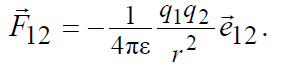
He was born in 1706 in Boston, was the 15th child in the family of a minor tradesman, lived 84 years, and was engaged in physics for only 7 years, from 1747 to 1753. After chancing to hear a lecture, he decided to systematize everything he had learned from others and understood himself. He proved the electrical nature of lightning, invented the lightning rod, and developed a fairly simple, yet coherent and, as it later turned out, correct theory of static electricity and its transfer from one body to another – the very theory that is now taught in school. He introduced such familiar concepts to us as charge, conductor, capacitor, battery, winding, discharge; he divided charges into positive and negative (1749). Benjamin Franklin was an educated and versatile man. He was a writer, published a literary magazine, was a public and statesman, and stood at the origins of the founding of the United States (1776). He founded the first public library in the North American colonies, in Philadelphia, as well as the University of Pennsylvania and the American Philosophical Society. At the congress of representatives of the North American colonies, he proposed a plan for their union, which later formed the basis for the creation of the United States. B. Franklin is one of the authors of the Declaration of Independence and the Constitution of the United States. The next step in the understanding of electricity was the discovery made by Luigi Galvani (1737-98) in 1780. An Italian anatomist and physiologist studying the nervous system of frogs, he discovered a contact potential difference upon touching an electrolyte with two different metals. In Galvani's case, the electrolyte was a frog's leg, which also served as the indicator, since when touched with two different metals it twitched. In 1800, Alessandro Volta (1745-1827) decided to repeat Galvani's experiment. Only instead of a frog's leg he used his own tongue. He took 2 coins made of different metals and placed them in his mouth – one on the tongue and the other under the tongue. He then connected the coins with a wire and felt a taste familiar to anyone who has ever touched their tongue to the contacts of an electric battery. From earlier experiments carried out with Guericke's machine, Volta knew that this was the taste of electricity. He then stacked more than 100 metal discs (zinc and silver) on top of one another, separated them with paper soaked in salt water, and obtained a fairly powerful source of electricity – the voltaic pile. He assembled his next battery from alternating zinc and copper plates connected in series and immersed in pairs in vessels of dilute sulfuric acid. For its time this was a powerful source of electrical energy, which allowed his followers to discover many laws of physics. At the beginning of the 19th century, the torch of research into electromagnetic phenomena passed to the French, where at that time Napoleon had helped create a scientific organization – an academy – which brought together a rare constellation of talents: Gay-Lussac, Humboldt, Arago, Laplace, Biot, Savart, Ampère, Coulomb. These academicians made an invaluable contribution to the study of electromagnetism. Their undeniable merit lies in the fact that they brought a quantitative character to the study of electrical and magnetic phenomena. The first to introduce quantitative criteria into the theory of electricity was the Frenchman Charles-Augustin de Coulomb (1710-1806). Among his inventions was the torsion balance (1784), which allowed the measurement of extremely small forces. Using it, in 1785 he discovered the law, later named after him, which governs the force of interaction between two point charges:
During this time, research into magnetic phenomena also continued. Since the time of Gilbert it had been believed that electrical and magnetic phenomena were in no way connected to one another. However, some observations showed that these phenomena were often interrelated. The Frenchman Arago collected numerous accounts of the remagnetization of ships' compasses during thunderstorms. One well-known case occurred in 1775, when two English ships were sailing on parallel courses from London to Barbados. At the latitude of the Bermuda Islands the ships were scattered by a storm, and one of them was struck by lightning while the other was unharmed. After the storm each ship continued on its course, but, as it turned out, they ended up going in opposite directions. Noticing this, the captains decided to find out why the other one had turned back. After heated debate they decided to check their compasses against the stars. It turned out that the compass of the stricken ship was pointing in the opposite direction. Researchers sought the reason why electrical lightning affects a magnetic compass. The answer came from Copenhagen, where the Danish professor Hans Christian Ørsted (1777-1851) discovered the magnetic action of electric current in 1820, that is, he experimentally discovered the connection between electrical and magnetic phenomena. In his experiment he passed a current through a straight wire and found that the needle of a nearby compass deflected. The effect was stronger the stronger the current in the wire. It was also noted, as an odd phenomenon, that the compass needle came to rest perpendicular to the wire. In the same year the Frenchmen Biot, Savart and Laplace established a quantitative law, named after them, determining the relationship between the current in a wire and the vector of magnetic field strength. The Biot–Savart–Laplace law states:
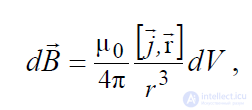
where B – the magnetic field induction, j – the current density in the volume dV, r – the distance to the observation point, 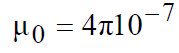 H/m.
H/m.
At the same time, André Ampère (1775-1867) came up with the idea that if a current has a magnetic action, then wires carrying current should interact with each other, just as magnets do, i.e., attract or repel one another. Having learned of Ørsted's experiments, in the span of two weeks, from September 11 to 25, 1820, he established the laws of the force action of a magnetic field on a current-carrying conductor, which now bear his name:
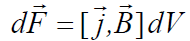 ,
,
dF – the Ampère force.
Ampère is considered the founder of the science of “electrodynamics”, as distinct from the electrostatics that existed before him. The experiments of Ørsted and the great Frenchmen convincingly proved that electric currents create a magnetic field. The question naturally arose whether the reverse relationship also existed, i.e., whether it was possible to create an electric current with the help of magnets. Many expected an affirmative answer to this question, but numerous experiments by physicists produced no positive result. Ampère himself carried out such an experiment. He connected the ends of a wire coil to the terminals of a galvanometer and inserted a magnetic core into it, hoping to detect a current at the terminals of the instrument. However, to avoid errors caused by vibration of the instrument, he placed the instrument and the coil in different rooms. During the experiment he would insert the core into the coil, go into the other room, and look at the instrument. The needle showed zero – the discovery did not take place. This state of affairs in physics continued until 1831, when the Englishman Michael Faraday decided to repeat Ampère's experiment. And he repeated it in every detail, including placing the coil and the instrument in different rooms. The only thing that distinguished Faraday's experiment was the presence of an assistant during the experiment. It was precisely the assistant, watching the behavior of the instrument in the other room, who saw that its needle sharply deflected when Faraday inserted the magnet into the coil, and then quickly returned to its original zero position when the motion of the magnet stopped. This effect, of course, was not noticed by Ampère when conducting his experiments alone, since he could not insert the magnet into the coil and simultaneously watch the instrument's needle in another room. Thus was discovered the law of electromagnetic induction, which can be written in the following form: E = − ∂Φ , E – the EMF induced in the ∂t circuit by the magnetic field, Φ – the magnetic flux through the circuit. The law of electromagnetic induction is not Faraday's only discovery. In addition, he established the laws of electrolysis, discovered the rotation of the plane of polarization of light, proved the identity of all types of electricity (static and galvanic), introduced the concepts of electric and magnetic field, and put forward the idea of the existence of a unified electromagnetic field. It is probably no coincidence that in that same year, 1831, when M. Faraday discovered the law of electromagnetic induction, a son named James was born into the family of the Scottish landlord John Maxwell – a son who would creatively develop Faraday's ideas and create a coherent theory of the electromagnetic field (1864).
The theoretical generalization of electrical, magnetic and induction phenomena was made by the British physicist James Clerk Maxwell in the 1860s. He carefully studied the works of his predecessors – Faraday, Ampère, Coulomb and other pioneers of electromagnetism – and formulated the fundamental equations of electromagnetism describing the relationship between electric and magnetic fields. In 1865, Maxwell published his famous paper "A Dynamical Theory of the Electromagnetic Field", in which he made the first attempt at a unified theoretical description of electrical, magnetic and optical phenomena. He presented electromagnetism as a unified whole, based on the concept of the electromagnetic field. In 1873, Maxwell completed his fundamental work "A Treatise on Electricity and Magnetism". In this book he formulated a system of equations describing the relationship between electric and magnetic fields. These equations, now known as Maxwell's equations, form the mathematical foundation of classical electrodynamics. Maxwell also predicted, in 1864, the existence of electromagnetic waves propagating at a finite speed. After a careful analysis of his equations, he derived that the speed of propagation of these waves is equal to the speed of light, which allowed him to conclude that light is a type of electromagnetic wave.
James Maxwell cast Faraday's research results into mathematical form and reduced the description of all electrical and magnetic phenomena to a single new system of equations. From this system it followed that an electromagnetic disturbance propagates in space at a finite speed, that the electromagnetic field has a wave nature, and that its speed of propagation is equal to the speed of light in a given medium. This allowed him to put forward the hypothesis of the electromagnetic nature of light. Maxwell died in 1879 at the age of 48. The results of Maxwell's theory were brilliantly confirmed by the experiments of Heinrich Hertz, who experimentally produced electromagnetic waves, and of Pyotr Nikolaevich Lebedev (1866-1912), who discovered and measured the pressure of light on solid bodies (1899) and gases (1907), thereby quantitatively confirming the electromagnetic nature of light. The triumph of the EMF theory was most vividly demonstrated by the invention of radio by Alexander Stepanovich Popov (1895) and Guglielmo Marconi (1897), which led to the widespread practical use of the EMF. Further development of the science of electromagnetism and the creation by Albert Einstein of the special theory of relativity led to the understanding that the electromagnetic field is a special kind of matter, qualitatively different from substance.
Experimental confirmation of the existence of electromagnetic waves was obtained in 1888 by the German physicist Heinrich Hertz. He was able to generate, radiate and receive electromagnetic waves under laboratory conditions, thereby opening a new chapter in the history of physics.
Hertz's discovery became the starting point for the creation of radio engineering. In 1895, the Russian physicist Alexander Popov demonstrated the world's first radio communication system. Soon afterward, the Italian engineer Guglielmo Marconi invented the first commercial radiotelegraph.
The development of the classical Maxwell-Hertz electrodynamics at the end of the 19th century completed the formation of electromagnetism as a fundamental physical theory, unifying electrical, magnetic and optical phenomena.
At the beginning of the 20th century, the achievements of classical electrodynamics were supplemented by revolutionary discoveries in the field of quantum mechanics. In 1905, Albert Einstein explained the photoelectric effect by postulating the existence of quanta of light – photons. This marked the beginning of the formation of quantum electrodynamics.
In 1927, the Soviet physicist Pyotr Kapitsa discovered the phenomenon of superfluidity in liquid helium, opening up a new quantum state of matter. In 1947, the American physicists John Bardeen, Walter Brattain and William Shockley invented the first semiconductor transistor, laying the foundations of modern microelectronics.
The further development of quantum electrodynamics in the 1940s-1950s is associated with the work of Richard Feynman, Julian Schwinger and Sin-Itiro Tomonaga. They created a consistent theory of the interaction of the electromagnetic field with charged particles, taking quantum effects into account.
Modern quantum electrodynamics is one of the most precise physical theories. It makes it possible to predict and describe, with high accuracy, a wide range of electromagnetic phenomena – from elementary interactions at the subatomic level to complex processes on cosmic scales.
Knowledge in the field of electromagnetism finds application in the most diverse areas – from electronics and radio engineering to astrophysics and space exploration. Further development of electromagnetic theory opens up new possibilities for creating high-tech devices, improving modern technologies and gaining a deeper understanding of the world around us.
Today electromagnetism underlies the technologies of wireless communication, electronics, lasers and quantum computing. Modern scientists study it at the fundamental level, including its interaction with gravity and cosmological phenomena.
In most cases, macroscopic electromagnetic processes can be described with the necessary degree of accuracy within the framework of classical electrodynamics. In this case, the interacting objects are treated as a collection of material points characterized, in addition to mass, by electric charge as well. It is assumed here that the interaction is carried out by means of the electromagnetic field — a separate kind of matter that permeates all of space.
Electrostatics deals with the interaction of stationary charged bodies. The basic law of electrostatics is Coulomb's law, which establishes the relationship between the force of attraction/repulsion of two charged material points, the magnitude of their charge, and the distance between them.
Magnetostatics studies the interaction of electric currents that are constant in magnitude and stationary in space, representing in essence a flow of charged particles. Magnetostatics is based on the Biot—Savart—Laplace law and Ampère's law. The Biot—Savart—Laplace law makes it possible to find the magnitude of the magnetic field created by a small current element.
Maxwell's equations — a system of equations in differential or integral form describing the electromagnetic field and its relationship to electric charges and currents in vacuum and in continuous media. Together with the expression for the Lorentz force, which specifies the measure of the action of the electromagnetic field on charged particles, these equations form the complete system of equations of classical electrodynamics, sometimes called the Maxwell—Lorentz equations. The equations, formulated by James Clerk Maxwell on the basis of the experimental results accumulated by the mid-19th century, played a key role in the development of the concepts of theoretical physics and had a strong, often decisive, influence not only on all areas of physics directly related to electromagnetism, but also on many fundamental theories that arose afterward, the subject of which was not reducible to electromagnetism (one of the most striking examples here is the special theory of relativity).
Quantum electrodynamics (QED) — a quantum field theory of electromagnetic interactions; the most thoroughly developed part of quantum field theory. Classical electrodynamics accounts only for the continuous properties of the electromagnetic field, whereas quantum electrodynamics is based on the notion that the electromagnetic field also possesses discontinuous (discrete) properties, whose carriers are the quanta of the field — photons. The interaction of electromagnetic radiation with charged particles is treated in quantum electrodynamics as the absorption and emission of photons by particles.
Quantum electrodynamics quantitatively explains the effects of the interaction of radiation with matter (emission, absorption and scattering), and also consistently describes the electromagnetic interactions between charged particles. Among the most important problems that found no explanation in classical electrodynamics but are successfully resolved by quantum electrodynamics are the thermal radiation of bodies, the scattering of X-rays by free (more precisely, weakly bound) electrons (the Compton effect), the emission and absorption of photons by atoms and more complex systems, the emission of photons in the scattering of fast electrons in external fields (bremsstrahlung), and other processes of interaction of electrons, positrons and photons. The lesser success of the theory when considering processes involving other particles is due to the fact that, in these processes, in addition to electromagnetic interactions, other fundamental interactions (strong and weak) also play an important role.
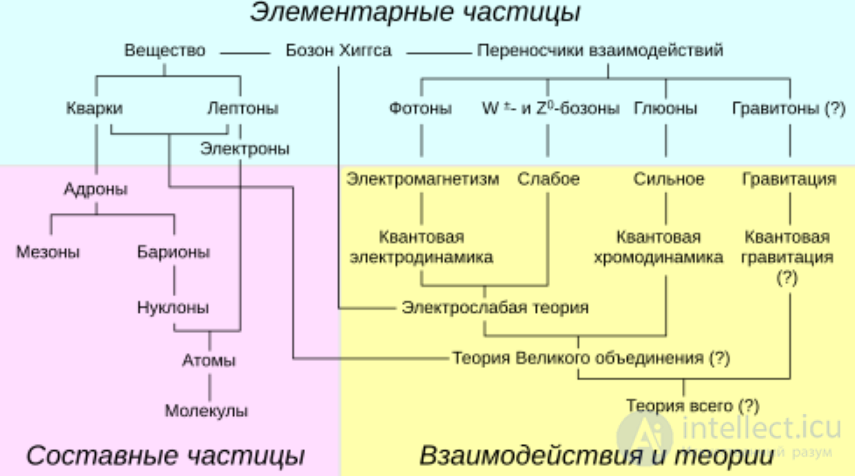
A brief overview of the various families of elementary and composite particles and the theories describing their interactions. The elementary particles on the left are fermions, on the right are bosons. (The terms are hyperlinks to Wikipedia articles)
From a mathematical point of view, QED can be described as a perturbation theory of the electromagnetic vacuum. Richard Feynman called it the «jewel of physics» for its extremely accurate predictions of quantities such as the anomalous magnetic moment of the electron and the Lamb shift of the energy levels of the hydrogen atom
An electric field always exists around an electric charge, in any reference frame,
a magnetic field – in a frame relative to which the electric charges are moving,
an electromagnetic field – in a reference frame relative to which the electric charges are moving with acceleration.
The study of electromagnetism provides information about the design of electric circuits, magnetic circuits and semiconductor devices. It also makes it possible to design and create new means of communication, metamaterials, methods of storing, transmitting and generating energy, new electronic devices or components, as well as to improve existing ones.
The development of the science of electromagnetism has come a long way from simple observations to complex mathematical models and technologies. The unification of electrical and magnetic phenomena within the framework of Maxwell's equations was a revolution in physics, and modern research continues to deepen our understanding of the nature of electromagnetic interactions. Advances in this field have become the foundation for numerous technological breakthroughs that define the modern world.

Comments