
Lecture
In physics, dispersion refers to the dependence of the refractive index of a medium or the speed of propagation of electromagnetic waves on frequency. The phenomenon of dispersion leads to the signal propagation speed in a medium being different from the phase velocity. This consequence of dispersion is almost obvious. Indeed, any signal can be regarded as the result of the superposition of an infinite number of monochromatic waves, each of which propagates with its own phase velocity. It is therefore clear that there must exist some average speed with which the signal as a whole is carried. Obviously, if there is no dispersion and the phase velocities of all the monochromatic waves are the same, then this average speed must coincide with the phase velocity. The question of the speed of signal propagation in a dispersive medium will be considered a little later. Here we shall only note that the study of the phenomenon of dispersion makes it possible to learn some important
aspects of the atomic structure of matter. The bridge connecting the macroscopic theory of the electromagnetic field with the theory of the atomic structure of matter is the Lorentz—Lorenz formula.
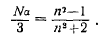 (1)
(1)
This relation is obtained from the Clausius—Mossotti formula if in the latter we substitute  (see lecture 8). It may seem strange that almost identical formulas are given
different names. However, it should be noted that formula (1) was obtained in 1880, shortly after the discovery of Maxwell's equations, when the equality ε=n2 was still considered a not entirely proven hypothesis.
According to formula (1), the polarizability of a molecule in the presence of dispersion must depend on frequency. The theory of dispersion must explain this dependence.
Each molecule consists of several heavy positively charged particles (the nuclei of the atoms forming the molecule), around which light particles — electrons — «revolve».
The centers of gravity of the light and heavy particles may not coincide. In this case the molecules possess an electric dipole moment even in the absence of an external electric field. Such molecules are called polar. However, such molecules will not be considered here. We shall consider substances whose molecules are polarized under the influence of the electric field
of the propagating wave.
Under the influence of this field, in step with the change of the electric field, all the charged particles of the molecule begin to move. But the masses of the nuclei are thousands of times greater than the mass of the electrons, and therefore the motion of the
nuclei can be neglected.
To a good approximation it can be assumed that the electrons behave as if they were displaced from their equilibrium position under the influence of a quasi-elastic force —  .
.
So the equation of motion of the electron is as follows:
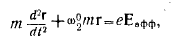 , (2)
, (2)
where
 kg — the mass of the electron;
 C — the charge of the electron.
We emphasize that on the right-hand side of (2) it is not the field strength of the wave E, but, in accordance with what was set out in lecture 8, the effective field.
We seek the solution of equation (2) in the form

and obtain
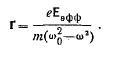 (3)
(3)
From this it is evident that  — has the meaning of the resonant frequency of the electron's motion. Each electron contributes to the dipole moment of the molecule an amount

Let us first assume that the molecule contains only one electron; then the dipole moment of the molecule will equal

Comparing this relation with (3), we obtain
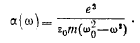 (4)
(4)
From this, according to formula (1), we find
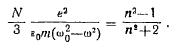 (5)
(5)
This relation makes it possible to determine, by measuring the static dielectric permittivity  , the resonant frequency
  from the formula
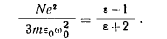
The curve  is shown in fig. 1. We see that at the resonant frequency
  the polarizability of the molecule α undergoes a discontinuity, which is not actually observed.
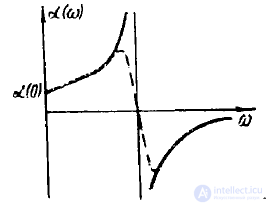
Fig. 1
This is explained by the fact that in the equation of motion of the electron we neglected the dissipative forces, which are due to the radiation of the accelerating electron and collisions of the electron with other particles. The presence of these forces means that  turns out to be finite at all frequencies. The actual course of the curve
  in the neighborhood of the resonant
  is shown in fig. 1 by the dotted line.
From the formula
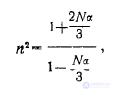
(6)
obtained from (1), it is evident that as the frequency increases at ω < ω0, when the quantity α grows, the refractive index also grows, that is, in these regions of frequency change normal
dispersion takes place. Comparing formula (6) with the actual curve α(ω) in fig. 1, it follows that in the neighborhood of the resonant frequency the refractive index must decrease with increasing frequency, that is,
in this region of frequencies the dispersion is anomalous.
When the propagation of electromagnetic waves in dispersive media is studied, one usually has in mind regions of normal dispersion, in which the attenuation is small. Absorption of electromagnetic waves by a medium under anomalous dispersion is very large.
Up to now we have assumed that the molecule has only one electron. However, in reality it contains many electrons, and a given resonant frequency ω0 may correspond to.