
Lecture
Consider a system of n conductors, on which n charges qi are distributed (over the surface) (Fig. 1).
The energy stored in the electrostatic field within a volume V is equal to
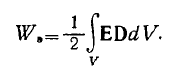
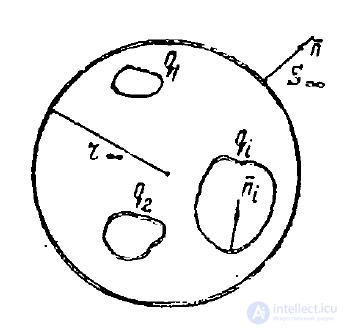
Fig. 1
V
Substituting under the integral 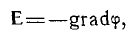 we have
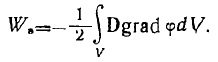
Taking into account the equality

— and bearing in mind that outside the conductors 
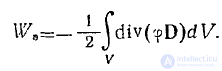
Using the Ostrogradsky—Gauss theorem and the fact that the potential of each conductor is constant, we find
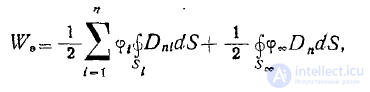
where S is the surface of a sphere of very large radius, enclosing all the conductors.
In the last formula we take the normals to the surfaces of the conductors as outward with respect to the conductors. Recall that in the Ostrogradsky—Gauss theorem the normals must be outward with respect to the region in which the theorem is applied.
The integral over the surface of the sphere  must tend to zero as the radius of the sphere
  increases, since
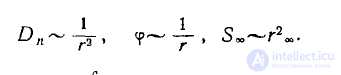
Taking further into account that 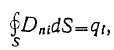 we finally find
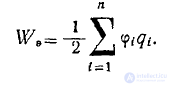 (1),
(1),
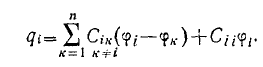
Expression (1), using the so-called coefficients of electrostatic induction  defined by the formula
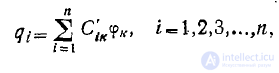
can be represented in the form
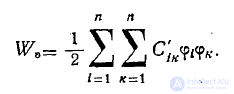
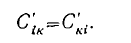
These coefficients, as follows from the equality
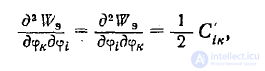
are symmetric, i.e.
Note that the coefficients of electrostatic induction differ from the so-called coefficients of mutual capacitance
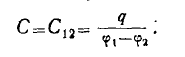
 , since the latter are defined by the formula
The coefficients of mutual capacitance are a generalization of the ordinary concept of the capacitance of a capacitor
Between the coefficients of mutual capacitance and the coefficients of electrostatic induction, as is easily established from the formulas given, there is a relation:
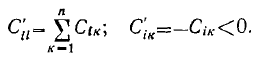
 — is called the self-capacitance;
 — are the capacitance coefficients.
It is clear that formula (1) is also applicable to the case of a system of point charges. In this case <p,- is the potential at the point where the charge qi is located, created by all the other charges.
In particular, for the interaction energy of two charges
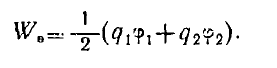 . (2)
. (2)
Here a question may arise: where does the factor 1/2 come from?
According to elementary considerations, the interaction energy of two charges qt and q2 is equal to  , i.e., the work done against the field forces to bring the charge qx from infinity to the point where the potential is equal, or this work is equal to the fact that in formula (2) the quantity in parentheses equals twice the interaction energy.
Using formula (2), we calculate the energy of interaction of a dipole with an external field. This energy is equal to (Fig. 2).
 (3)
(3)
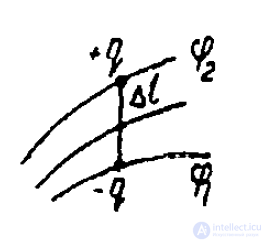
Fig. 2
The "—" sign means that the interaction energy, or in other words the potential energy of the dipole, is greatest when the dipole moment p is directed opposite to the vector E, and conversely, when the vector p coincides in direction with the vector E, the potential energy of the dipole in the electric field is smallest.
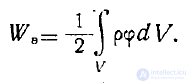
The energy of the electrostatic field for a continuous charge distribution with density p, as follows from formula (1), is equal to
Symmetry of the permittivity tensor. According to formula (3), the work expended by the field to polarize a unit volume of dielectric when creating the polarization vector
dP is equal to
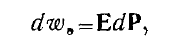 , (4)
, (4)
with, in the case of an anisotropic medium
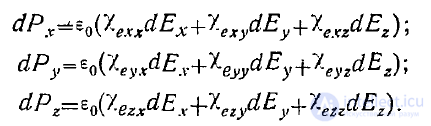
In other words, expression (4) represents the work expended to change the field components from 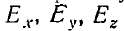 respectively to
  .
.
If the field components return to their original values Ex, Ey, E2, then according to the law of conservation of energy the change in field energy must be equal to that same quantity (4). Consequently, the quantity  from (4) must be a total differential of the function
  .
.
From this it follows that we must have
 (5)
(5)
that is, the mixed partial derivatives with respect to any two arguments of the function Wa must not depend on the order of differentiation.
A consequence of this requirement is the symmetry of the electric susceptibility tensor and, correspondingly, the symmetry of the permittivity tensor.
Let us illustrate this conclusion, for simplicity assuming that 
We have:
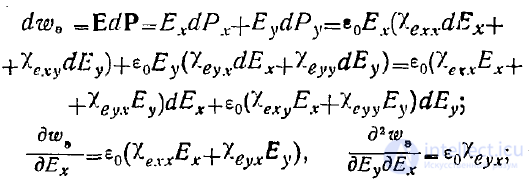

From this it can be seen that indeed the fulfillment of conditions (5) requires the fulfillment of the equalities

The symmetry of the electric susceptibility tensor entails the symmetry of the permittivity tensor, since

The energy of the electrostatic field in an anisotropic medium per unit volume, taking into account the symmetry of the permittivity tensor, can be represented in the form
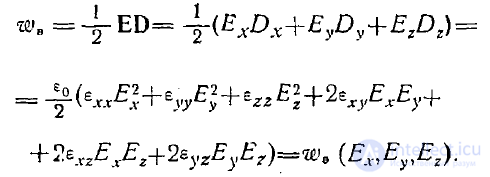 (6)
(6)
From this expression it can be seen that the equation

represents the equation of an ellipsoidal surface in a space whose point coordinates are the components of the field
intensity vector E r , Ev, E'z (Fig. 3). This ellipsoid is called the ellipsoid of the permittivity tensor, or the Fresnel ellipsoid.
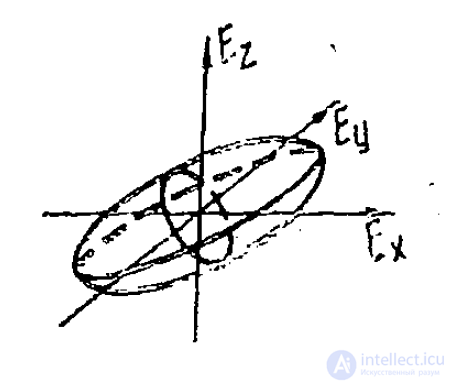
Fig. 3
It is known from analytic geometry that the equation of an ellipsoid takes its simplest form in a rectangular coordinate system whose axes coincide with the axes of the ellipsoid.
In exactly the same way, by analogy it is easy to see that there exists a rectangular coordinate system in the space Ev, Ey, Ez in which the equation of the ellipsoid takes the form (Fig. 4),
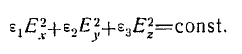 (7)
(7)
The quantities  are called the principal values of the permittivity tensor, and the axis directions are called the principal directions of the permittivity tensor.
The physical meaning of the principal values and principal directions of the permittivity tensor is that if the vector E is directed along any of the principal directions, with the coordinate axes coinciding with these, then the vector D turns out to be collinear with E, i.e.
 (8)
(8)
The principal directions of an anisotropic medium, for example a crystal, are determined by the structure of the crystal. According to what has been stated, a crystal has three principal directions and these directions are mutually perpendicular.
If at some fixed point of the crystal the direction and magnitude of the vector E are varied so that its tip, in accordance with formula (7), traces the surface of the ellipsoid, then the energy of the electrostatic field remains constant. Of course, as the field components Ex, Ey, Ez one must take the projections of the vector E onto the directions of the crystal's principal axes.
The principal values of the permittivity tensor can be determined based on the following considerations.
In the mathematical sense, the permittivity tensor transforms the vector E into the vector D, changing, generally speaking, its components differently.
However, as already stated, there exist directions such that the permittivity tensor changes only the magnitude of the vector E, without changing its direction, so that the vector
D turns out to be collinear with the vector E.
' Therefore, if the vector E is directed along one of the principal directions and its components in some coordinate system are Ex, Ey, Ez, then we will have:
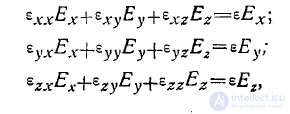
where s indicates by what factor the magnitude of the vector E changes when it is directed along one of the principal directions of the tensor.
This system of homogeneous equations in Ex, Ey, Ez has a nontrivial solution only when its determinant equals zero, i.e.
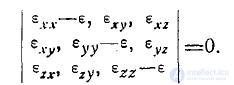
This determinant represents a cubic equation in e. Since the tensor  is symmetric, all three roots turn out to be real.
These roots are precisely the principal values of the permittivity tensor 

Comments