
Lecture
One of the fundamental experimental laws underlying modern electrodynamics is the law of interaction between point charges (Coulomb's law), which can be written as:
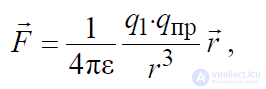
where q1 – is the primary charge, which creates the electric field, qpr – is the test
charge.
The field strength and induction of the electric field, created by the point
charge q1, can be found as follows:

Let us generalize Coulomb's law to the case of N point charges, concentrated in some volume V (fig.2.2).
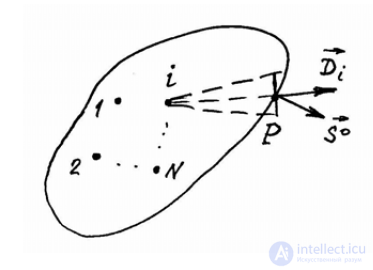
Fig.2.2
According to the superposition principle, the induction vector D
r
of the resultant field will
equal the geometric sum of the induction vectors
i D
r of the individual charges' fields:
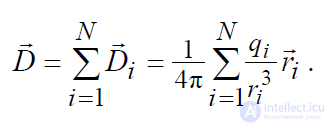
.
Let us find the flux of the resultant vector D
r
through the surface S bounding the region under consideration

where 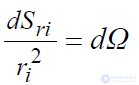 - is the element of solid angle.
As a result of the operations performed, we can obtain Gauss's law for electric field induction:
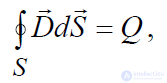 (2.4)
(2.4)
which is formulated as follows:
The flux of the electric field induction vector through a closed surface
S equals the total charge, concentrated in the volume V, bounded
by this surface.
Let us find the differential analog of Gauss's law for charges, continuously
distributed in the volume V with a given volume density ρ(x,y,z).
Ostrogradsky-Gauss:
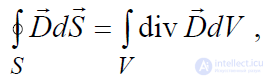 ,
,
and let us express the charge on the right-hand side through its volume density:
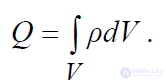 .
.
Substituting these quantities into equality (2.4) we arrive at the following expression:
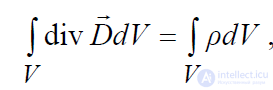 ,
,
from which follows the sought expression:
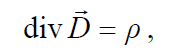 (2.5)
(2.5)
which is sometimes called Gauss's law in differential
form.
Both forms of Gauss's law indicate
that the sources of the electric field D
r
are electric
charges Q. If electric charges are present inside the region under consideration V, then the flux of the vector
D r
comes out of V through S. Graphically this can be depicted as follows: the field lines of D
r
begin inside
the volume V, and if Q<0, then the flux enters V from outside,
where the field lines then terminate. Thus, the field lines of the electric field (fig.2.3), created by electric charges, begin and end on charges (or go off to
∞ ). Electric fields of this structure are called potential fields.
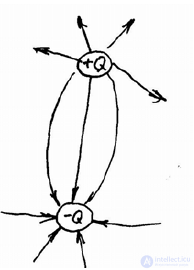
Figure 2.3

Comments