
Lecture
In the theory of the electromagnetic field, Maxwell's equations are usually used in differential form because of their significant advantages over Maxwell's equations in integral form.
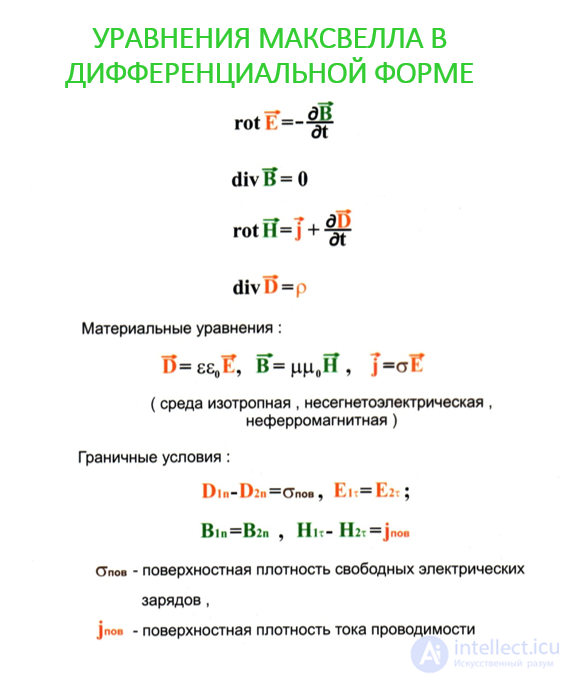
These advantages are as follows:
a) differential equations represent the most adequate description of the field, since they define physical quantities at every point in space;
b) differential equations are more convenient for solving the enormous number of particular problems.
Let us transform Maxwell's equations from integral form into Maxwell's equations in differential form. In doing so we shall use Stokes' formula and the Ostrogradsky—
Gauss theorem. In the first and second Maxwell equations we carry out the transformation using Stokes' formula.
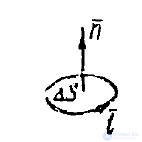
Fig. 1
According to this formula we have:
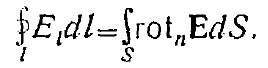
Let us consider the surface S to be a flat area bounded by a contour, and so small (Fig. 1) that instead of
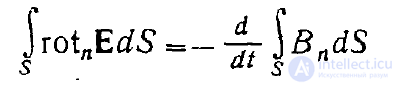
we can write:
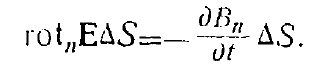
Here the total time derivative has been replaced by a partial derivative, because 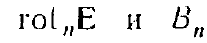 in the last equality are the average values of these quantities over a very small area AS, i.e.
they are almost their values at the point. Consequently, 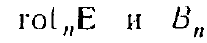 here are functions not only of time, but also of the coordinates.
Since the last equality must hold for an arbitrarily
oriented area 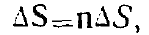 ', it can hold only when the equality
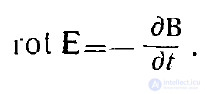
The meaning of this equation is that the curl of the electric field intensity vector at any point equals the rate of change of the magnetic induction vector with the opposite sign at the same point. The second Maxwell equation is similarly represented as
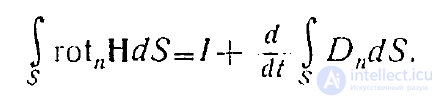
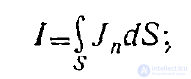
Let us introduce the current density J by the formula
we take an arbitrary sufficiently small area Δ5 and obtain

Since this equality must hold for an arbitrarily oriented area 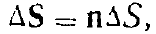 , it will hold only when the equality
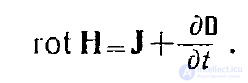
The meaning of this equation: the curl of the magnetic field intensity vector at any point equals the sum of the current densities—the conduction current and the displacement current.
In the third and fourth Maxwell equations we carry out the transformations using the Ostrogradsky—Gauss theorem.
At the same time we introduce the charge density by the formula
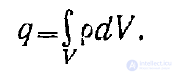
Then instead of the third and fourth Maxwell equations we obtain
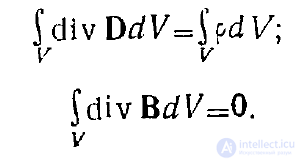
These relations must hold for arbitrary volumes, including a sufficiently small ΔV, and we can write
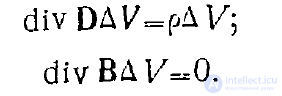
From this we obtain the second pair of Maxwell equations
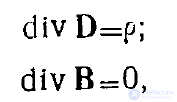
that is, the divergence of the electric displacement vector at any point equals the electric charge density at the same point, while the divergence of the magnetic induction vector is everywhere equal to zero.
Thus, the system of Maxwell equations is as follows:
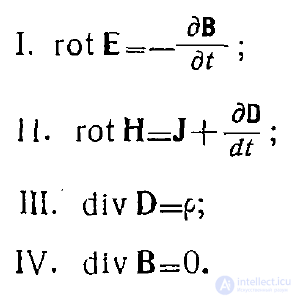
This system of equations is the most fundamental system of equations in modern physics. A quite reasonable question is: why are the most fundamental laws of nature—the laws of electromagnetic phenomena—described by equations of precisely this form? Unfortunately, modern physics is unable to answer this question.
As we have seen, the law of conservation of charge follows as a consequence of Maxwell's equations. The formulation of this law in differential form is obtained accordingly from Maxwell's equations
in differential form.
Owing to the fact that 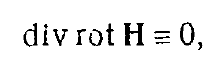
from equation I I we find
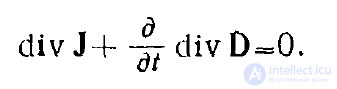
Taking equation I I I into account, we obtain
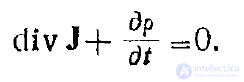
This is the continuity equation—and it is the stated formulation of the law of conservation of charge in differential form.
Let us find the formulation for the force acting in the electromagnetic field in differential form. From Coulomb's law it follows that a force acts on a charge Δq
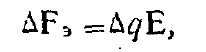
and from Ampere's law for the force acting on a current-carrying element of length
dl from the side of the magnetic field with induction vector B, we have
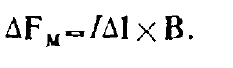
As is known, the direction of this force is established by the right-hand rule—the direction of the current along the thumb, the direction of the magnetic field (vector B) along the remaining fingers, then the direction of the force AF_M will be perpendicular to the palm.
The current I is determined by the formula
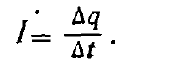
Therefore

The total force acting on the moving charge Δq equals

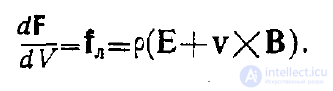
From this we obtain the expression for the Lorentz force acting per unit volume (the Lorentz force density):

Comments