
Lecture
It was found experimentally that the field lines of the vector field

are always closed in space, regardless of whether the field is created by permanent magnets or by currents.
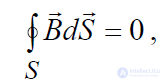
Mathematically this is expressed by the equality
 (2.6)
(2.6)
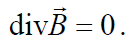
which, using the Gauss–Ostrogradsky theorem, is easily transformed
into the differential form
 . (2.7)
Indeed, if the field lines are closed, then for any volume the flux of the vector  , flowing into it, equals the outflowing flux. A vector field without sources, i.e. with zero divergence, is called a vortex or
solenoidal field. The field of the vector  – is a striking example of this.
It was found experimentally that the field lines of the magnetic induction vector B, regardless of whether the field is created by permanent magnets or by current-carrying coils, form closed lines in space (fig. ).
For a mathematical description of this fact it is convenient, as is done in vector analysis, to use a representation of the magnetic field lines in the form of
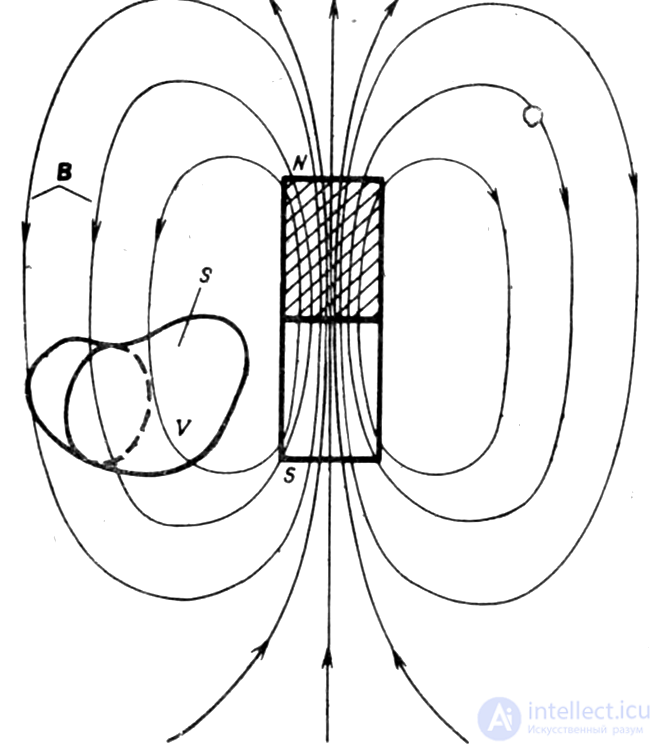
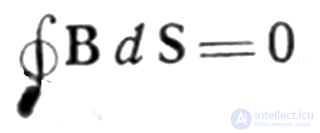
imaginary streamlines of an incompressible fluid. Let us place, inside the region where the magnetic field exists, an arbitrary volume bounded by the surface S. From the closedness of the streamlines it follows that the flux of fluid flowing in is exactly equal to the flux flowing out of the volume. Thus,
Carrying out operations analogous to those set out in the preceding section, we obtain a relation valid for an infinitesimal neighborhood of a chosen point in space:
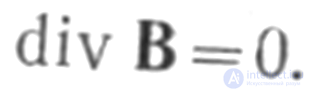
These formulas serve as the mathematical expressions of the law of continuity of magnetic field lines in integral and differential form, respectively.
An equivalent formulation of the law under consideration is that the vector field B nowhere has sources.
In other words, no magnetic charges actually exist in nature, and consequently magnetic currents have no direct physical meaning.

Comments