
Lecture
Crystal structure — is such an assemblage of atoms in which a certain group of atoms, called a motif unit, is associated with every point of the crystal lattice, and all such groups are identical in composition, arrangement, and orientation relative to the lattice. The structure can be considered to arise from the synthesis of the lattice and the motif unit, as a result of the propagation of the motif unit by the translation group.
Crystal lattice — is an auxiliary geometric construct introduced to analyze the structure of a crystal. The lattice resembles canvas or a mesh, which is the reason its points are called nodes. A lattice is the assemblage of points that arise from a single, arbitrarily chosen point of a crystal under the action of the translation group. This arrangement is remarkable in that, relative to every point, all the other points are arranged in exactly the same way. Applying to the lattice as a whole any of the translations inherent to it translations results in its parallel displacement and self-coincidence. For convenience of analysis, the lattice points are usually made to coincide with the centers of certain atoms among those making up the crystal, or with elements of symmetry.
Depending on their spatial symmetry, all crystal lattices are subdivided into seven crystal systems. By the shape of the unit cell, they can be divided into six crystal families (syngonies). All possible combinations of the rotational symmetry axes and mirror symmetry planes present in the crystal lattice lead to the division of crystals into 32 symmetry classes, and, taking into account screw symmetry axes and glide symmetry planes, into 230 space groups.
In addition to the basic translations on which the unit cell is built, additional translations, called Bravais lattices, may be present in the crystal lattice.
In the simplest case, the motif unit consists of a single atom, for example in crystals of copper or iron. The structure arising on the basis of such a motif unit is geometrically very similar to the lattice, yet it differs in that it is made up of atoms rather than points. This circumstance is often disregarded, and the terms «crystal lattice» and «crystal structure» are used as synonyms for such crystals, which is not strictly correct. In cases where the motif unit is more complex in composition — consisting of two or more atoms — there is no geometric resemblance between the lattice and the structure, and conflating these concepts leads to errors. For example, the structure of magnesium or diamond does not coincide geometrically with the lattice: in these structures the motif units consist of two atoms.
The main parameters characterizing a crystal structure, some of which are interrelated, are the following:
In crystallography, a crystal structure represents a description of the ordered arrangement of atoms, ions, or molecules in a crystalline material. Ordered structures arise from the internal nature of the constituent particles and form symmetric patterns that repeat along the principal directions of three-dimensional space within the matter.
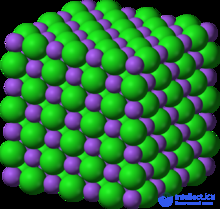
The smallest group of particles in the material that makes up this repeating pattern is the unit cell of the structure. The unit cell fully reflects the symmetry and structure of the entire crystal, which is built up by repeated translation of the unit cell along its principal axes. The translation vectors define the nodes of the Bravais lattice.
The lengths of the principal axes or edges of the unit cell, and the angles between them, are the lattice constants, also called the lattice parameters or cell parameters. In terms of symmetry, a crystal's property is described by the concept of space groups. All possible symmetric arrangements of particles in three-dimensional space can be described by 230 space groups.
Crystal structure and symmetry play a decisive role in determining many physical properties, such as cleavage, electronic band structure, and optical transparency.
Crystal structure is described in terms of the geometry of the arrangement of particles within the unit cell. The unit cell is defined as the smallest repeating unit that possesses the full symmetry of the crystal structure. The geometry of the unit cell is defined as a parallelepiped, giving six lattice parameters taken as the cell edge lengths ( a , b , c ) and the angles between them (α, β, γ). The positions of particles within the unit cell are described by fractional coordinates ( x i , y i , z i) along the edges of the cell, measured from a reference point. Only the coordinates of the smallest asymmetric subset of particles need be specified. This group of particles may be chosen so as to occupy the smallest physical space, meaning that not all particles need to be physically located within the boundaries set by the lattice parameters. All the remaining particles of the unit cell are generated by symmetry operations, which characterize the symmetry of the unit cell. The set of symmetry operations of the unit cell is formally expressed as the space group of the crystal structure.
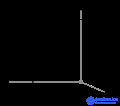
Simple cubic (P)
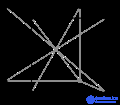
Body-centered cubic (I)
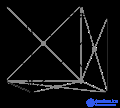
Face-centered cubic (F)
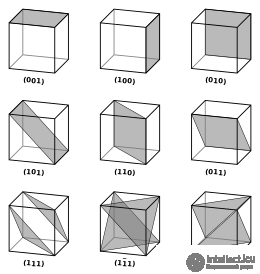
Vectors and planes in a crystal lattice are described by a three-value Miller index. This syntax uses the indices ℓ , m , and n as direction parameters.
By definition, the syntax ( ℓmn ) denotes a plane that intersects the three points a 1 / ℓ , a 2 / m , and a 3 / n, or several of their multiples. That is, the Miller indices are proportional to the inverse of the intercepts of the plane with the unit cell (in the basis of the lattice vectors). If one or more indices are equal to zero, this means that the plane does not intersect that axis (i.e., the intercept is «at infinity»). A plane containing a coordinate axis is shifted so that it no longer contains that axis before its Miller indices are determined. The Miller indices of a plane are integers with no common factors. Negative indices are denoted by horizontal bars, as in (1 2 3). In an orthogonal coordinate system for a cubic cell, the Miller indices of a plane are the Cartesian components of the vector normal to the plane.
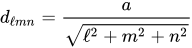
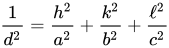
If we consider only ( ℓmn ) planes that intersect one or more lattice points ( lattice planes ), the distance d between neighboring lattice planes is related to the (shortest) reciprocal lattice vector orthogonal to the planes by the formula

Crystallographic directions are geometric lines connecting nodes ( atoms , ions , or molecules ) of a crystal. Similarly, crystallographic planes are geometric planes connecting nodes. Certain directions and planes have a higher density of nodes. These high-density planes affect the behavior of the crystal in the following ways:
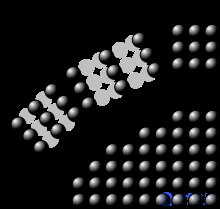
Certain directions and planes are determined by the symmetry of the crystal system. In the monoclinic, rhombohedral, tetragonal, and trigonal-hexagonal systems there is one unique axis (sometimes called the principal axis ), which has higher rotational symmetry than the other two axes. The basal plane is the plane perpendicular to the principal axis in these crystal systems. For triclinic, orthorhombic, and cubic crystal systems, the labeling of axes is arbitrary, and there is no principal axis.
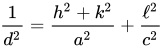
In the special case of simple cubic crystals, the lattice vectors are orthogonal and of equal length (usually denoted a ); similarly for the reciprocal lattice. Thus, in this common case, the Miller indices ( ℓmn ) and [ ℓmn ] simply denote normals/directions in Cartesian coordinates . For cubic crystals with lattice constant a , the distance d between neighboring (ℓmn) lattice planes is (above):
Because of the symmetry of cubic crystals, it is possible to permute the position and sign of the integers and obtain equivalent directions and planes:
For face-centered cubic (FCC) and body-centered cubic (BCC) lattices, the primitive lattice vectors are not orthogonal. However, in these cases the Miller indices are usually defined relative to the lattice vectors of the cubic superlattice, and are thus again simply Cartesian directions.
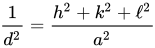
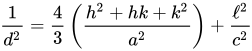
The distance d between neighboring ( hkℓ ) lattice planes is given by the expression



The defining property of a crystal is its inherent symmetry. Performing certain symmetry operations on a crystal lattice does not change it. All crystals possess translational symmetry in three directions, but some have other symmetry elements as well. For example, rotating a crystal by 180 ° around a certain axis can result in an atomic configuration identical to the original configuration; the crystal has two-fold rotational symmetry about that axis. In addition to rotational symmetry, a crystal may have symmetry in the form of mirror planes, as well as so-called compound symmetries, which are a combination of translational and rotational or mirror symmetry. Complete classification of a crystal is achieved when all the symmetries inherent to the crystal have been identified.
Lattice systems represent a grouping of crystal structures according to the axial system used to describe their lattice. Each lattice system consists of three axes with a particular geometric arrangement. All crystals fall into one of seven lattice systems. They are similar to, but not exactly the same as, the seven crystal systems.
| Crystal family | Lattice system | Point group ( Schoenflies notation ) |
14 Bravais lattices | |||
|---|---|---|---|---|---|---|
| Primitive (P) | Base-centered (S) | Body-centered (I) | Face-centered (F) | |||
| Triclinic (a) | C i | 
aP |
||||
| Monoclinic (m) | C 2 h | 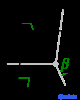
mP |
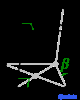
mS |
|||
| Orthorhombic (o) | D 2h | 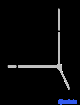
oP |
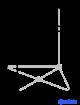
oS |
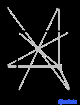
oI |

oF |
|
| Tetragonal (t) | D 4h | 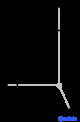
tP |
tI |
|||
| Hexagonal (h) | Rhombohedral | D 3d | 
hR |
|||
| Hexagonal | D 6h | 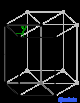
hP |
||||
| Cubic (c) | O h | 
cP |

cI |

cF |
The simplest and most symmetric, cubic or isometric system, has the symmetry of a cube, that is, it has four three-fold rotation axes, oriented at an angle of 109.5 ° ( the tetrahedral angle ) relative to one another. These three-fold axes lie along the body diagonals of the cube. The remaining six lattice systems are hexagonal , tetragonal , rhombohedral (often confused with the trigonal crystal system ), orthorhombic , monoclinic , and triclinic .
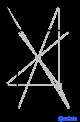
Bravais lattices , also called space lattices , describe the geometric arrangement of lattice nodes and, hence, the translational symmetry of a crystal. Three dimensions of space give 14 distinct Bravais lattices describing translational symmetry. All crystalline materials known today, with the exception of quasicrystals , fit into one of these schemes. The fourteen three-dimensional lattices, classified by lattice system, are shown above.
A crystal structure consists of the same group of atoms, the basis , arranged around every lattice point. Thus, this group of atoms is repeated infinitely in three dimensions according to the arrangement of one of the Bravais lattices. The characteristic rotational and mirror symmetry of the unit cell is described by its crystallographic point group .
A crystal system is a set of point groups in which the point groups themselves, and the corresponding space groups, are assigned to a lattice system. Of the 32 point groups that exist in three dimensions, most belong to only one lattice system, in which case the crystal system and the lattice system have the same name. However, five point groups are assigned to two lattice systems, the rhombohedral and the hexagonal, since both lattice systems possess three-fold rotational symmetry. These point groups belong to the trigonal crystal system.
| Crystal family | Crystal system | Point group / crystal class | Schönflies | Point symmetry | Order | Abstract group |
|---|---|---|---|---|---|---|
| triclinic | pedial | C 1 | enantiomorphic polar | 1 | trivial  |
|
| pinacoidal | C i (S 2 ) | centrosymmetric | 2 | cyclic  |
||
| monoclinic | sphenoidal | C 2 | enantiomorphic polar | 2 | cyclic |
|
| domatic | C s (C 1h ) | polar | 2 | cyclic |
||
| prismatic | C 2 h | centrosymmetric | 4 | Klein four  |
||
| orthorhombic | rhombic-disphenoidal | D 2 (V) | enantiomorphic | 4 | Klein four |
|
| rhombic-pyramidal | C 2v | polar | 4 | Klein four |
||
| rhombic-dipyramidal | D 2 h (V h ) | centrosymmetric | 8 |  |
||
| tetragonal | tetragonal-pyramidal | C 4 | enantiomorphic polar | 4 | cyclic  |
|
| tetragonal-disphenoidal | S 4 | non-centrosymmetric | 4 | cyclic |
||
| tetragonal-dipyramidal | C 4h | centrosymmetric | 8 |  |
||
| tetragonal-trapezohedral | D 4 | enantiomorphic | 8 | dihedral  |
||
| ditetragonal-pyramidal | C 4v | polar | 8 | dihedral |
||
| tetragonal-scalenohedral | D 2d (V d ) | non-centrosymmetric | 8 | dihedral |
||
| ditetragonal-dipyramidal | D 4h | centrosymmetric | 16 |  |
||
| hexagonal | trigonal | trigonal-pyramidal | C 3 | enantiomorphic polar | 3 | cyclic  |
| rhombohedral | C 3i (S 6 ) | centrosymmetric | 6 | cyclic  |
||
| trigonal-trapezohedral | D 3 | enantiomorphic | 6 | dihedral  |
||
| ditrigonal-pyramidal | C 3v | polar | 6 | dihedral |
||
| ditrigonal-scalenohedral | D 3d | centrosymmetric | 12 | dihedral  |
||
| hexagonal | hexagonal-pyramidal | C 6 | enantiomorphic polar | 6 | cyclic |
|
| trigonal-dipyramidal | C 3h | non-centrosymmetric | 6 | cyclic |
||
| hexagonal-dipyramidal | C 6h | centrosymmetric | 12 |  |
||
| hexagonal-trapezohedral | D 6 | enantiomorphic | 12 | dihedral |
||
| dihexagonal-pyramidal | C 6v | polar | 12 | dihedral |
||
| ditrigonal-dipyramidal | D 3h | non-centrosymmetric | 12 | dihedral |
||
| dihexagonal-dipyramidal | D 6h | centrosymmetric | 24 |  |
||
| cubic | tetartoidal | T | enantiomorphic | 12 | alternating  |
|
| diploidal | T h | centrosymmetric | 24 |  |
||
| gyroidal | O | enantiomorphic | 24 | symmetric  |
||
| hextetrahedral | T d | non-centrosymmetric | 24 | symmetric |
||
| hexoctahedral | O h | centrosymmetric | 48 |  |
There are seven crystal systems in total: triclinic, monoclinic, orthorhombic, tetragonal, trigonal, hexagonal, and cubic.
A crystallographic point group, or crystal class, is a mathematical group consisting of symmetry operations that leave at least one point fixed and that leave the appearance of the crystal structure unchanged. These symmetry operations include
Rotation axes (proper and improper), mirror planes, and centers of symmetry are together called symmetry elements . There are 32 possible crystal classes in total. Each of them can be assigned to one of the seven crystal systems.
In addition to point-group operations, the space group of a crystal structure contains translational symmetry operations. These include:
There are 230 distinct space groups.
By considering the arrangement of atoms relative to one another, their coordination numbers (i.e. the number of nearest neighbors), interatomic distances, bond types, and so on, a general picture of the structures and alternative ways of visualizing them can be formed.
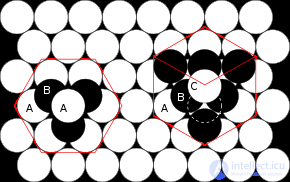
The principles involved can be understood by considering the most efficient way of packing equal-sized spheres and stacking close-packed atomic planes in three dimensions. For example, if plane A lies below plane B, there are two possible ways of placing an additional atom on top of layer B. If the additional layer were placed directly above plane A, this would lead to the following sequence:
... ABABABAB ...
Such an arrangement of atoms in a crystal structure is known as hexagonal close packing (HCP) .
If, however, all three planes are staggered relative to one another and the sequence repeats only after a fourth layer is placed directly above plane A, then the following sequence arises:
... ABCABCABC ...
This type of structural arrangement is known as cubic close packing (ccp) .
The unit cell of a ccp arrangement of atoms is the face-centered cubic (FCC) unit cell. This is not immediately obvious, since the close-packed layers are parallel to the {111} planes of the FCC unit cell. There are four different orientations of the close-packed layers.
Packing efficiency can be worked out by calculating the total volume of the spheres and dividing it by the volume of the cell as follows:
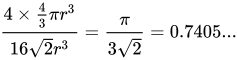
A packing efficiency of 74% is the maximum density possible for unit cells built from spheres of a single size. Most of the crystalline forms of metallic elements are HCP, FCC, or BCC (body-centered cubic). The coordination number of atoms in HCP and FCC structures is 12, and their atomic packing factor (APF) is the figure mentioned above, 0.74. This can be compared with the APF for the BCC structure, which is 0.68.
Grain boundaries are interfaces where crystals of different orientation meet. A grain boundary is a single-phase interface, with the crystals on each side of the boundary being identical except for orientation. Sometimes, though rarely, the term "crystallite boundary" is used. Grain-boundary regions contain those atoms that have been displaced from their original lattice sites, as well as dislocations and impurities that have migrated to the lower-energy grain boundary.
Considering a grain boundary geometrically as the interface of a single crystal cut into two parts, one of which is rotated, we see that five variables are required to define a grain boundary. The first two numbers come from the unit vector defining the rotation axis. The third number denotes the angle of rotation of the grain. The last two numbers define the plane of the grain boundary (or the unit vector perpendicular to that plane).
Grain boundaries impede the motion of dislocations through a material, so reducing crystallite size is a common way of increasing strength, as described by the Hall–Petch relation . Since grain boundaries are defects of the crystal structure, they tend to reduce the electrical and thermal conductivity of the material. The high interfacial energy and relatively weak bonding at most grain boundaries often make them preferred sites for the onset of corrosion and for the precipitation of new phases from the solid. They are also important for many creep mechanisms .
Grain boundaries are usually only a few nanometers wide. In ordinary materials the crystallites are large enough that grain boundaries make up only a small fraction of the material. However, very small grain sizes are achievable. In nanocrystalline solids, grain boundaries make up a significant volume fraction of the material, which has a strong effect on properties such as diffusion and plasticity . In the limit of very fine crystallites, when the volume fraction of grain boundaries approaches 100%, the material ceases to have any crystalline character and thus becomes an amorphous solid .
Real crystals have defects, or irregularities, in the ideal arrangement described above, and it is precisely these defects that critically determine many of the electrical and mechanical properties of real materials. When one atom substitutes for one of the main atomic constituents of a crystal structure, changes in the electrical and thermal properties of the material can occur. [10] Impurities can also manifest as electron-spin impurities in some materials. Studies of magnetic impurities show that a significant change in certain properties, such as specific heat, can be caused by small impurity concentrations, for example impurities in semiconducting ferromagnetic alloys — which can lead to other properties, as was first predicted in the late 1960s. Dislocations in the crystal lattice allow slip to occur under lower stress than would be needed for a perfect crystal structure.
The difficulty of predicting stable crystal structures from knowledge of chemical composition alone has long been a stumbling block on the path to fully computational materials design. Now, thanks to more powerful algorithms and high-performance computing, structures of moderate complexity can be predicted using approaches such as evolutionary algorithms, random sampling, or metadynamics.
The crystal structures of simple ionic solids (such as NaCl, or table salt) have long been rationalized in terms of Pauling's rules , first set out in 1929 by Linus Pauling , whom many have since called "the father of the chemical bond." [14]Pauling also considered the nature of interatomic forces in metals and concluded that about half of the five d-orbitals in transition metals participate in bonding, while the remaining non-bonding d-orbitals are responsible for the magnetic properties. In this way he was able to relate the number of d-orbitals involved in bonding to bond length, and to many physical properties of the substance. He subsequently introduced the metallic orbital, an additional orbital required to resolve the unrestricted resonance of valence bonds among different electronic structures. [15]
In resonating-valence-bond theory, the factors that determine the choice of one of the alternative crystal structures of a metal or intermetallic compound revolve around the resonance energy of bonds between interatomic positions. It is clear that some resonance modes will make a larger contribution (will be more mechanically stable than others), and that, in particular, a simple ratio of the number of bonds to the number of positions will be exceptional. The resulting principle is that special stability is associated with the simplest ratios, or "bond numbers": 1 ⁄ 2 , 1 ⁄ 3 , 2 ⁄ 3 , 1 ⁄ 4 , 3.⁄ 4 and so on. The choice of structure and the value of the axial ratio (which determines the relative bond length) are thus the result of an atom's attempt to use its valence to form stable bonds with simple fractional bond numbers. [16] [17]
By postulating a direct correlation between electron concentration and crystal structure in beta-phase alloys, Hume-Rothery analyzed trends in melting points, compressibility, and bond lengths as a function of group number in the periodic table in order to establish a valence system for transition elements in the metallic state. This treatment thus highlighted the increase in bonding strength as a function of group number. [18]The action of directional forces was emphasized in one paper on the relationship between bonding hybrids and metallic structures. The resulting correlation between electronic and crystal structures is summarized by a single parameter, the weight of d-electrons per hybridized metallic orbital. The "d-weight" is 0.5, 0.7, and 0.9 for FCC, HCP, and BCC structures respectively. Thus the connection between d-electrons and crystal structure becomes evident. [19]
In predicting/modeling a crystal structure, periodicity is usually applied, since the system is represented as unboundedly large in all directions. Starting from a triclinic structure with no additionally assumed symmetry properties, the system can be made to exhibit additional symmetry properties by applying Newton's second law to the particles in the unit cell and a recently developed dynamic equation for the system's period vectors [20] (lattice parameters, including angles), even when the system is subjected to an external action.
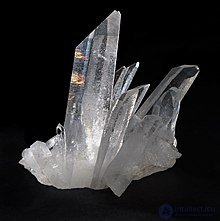
Polymorphism is the occurrence of several crystalline forms of a material. It is found in many crystalline materials, including polymers , minerals , and metals . According to Gibbs's rules of phase equilibrium, these unique crystalline phases depend on intensive variables such as pressure and temperature. Polymorphism is related to allotropy , which refers to elemental solids . The complete morphology of a material is described by polymorphism together with other variables such as crystal habit , amorphous fraction, or crystallographic defects.. Polymorphs have different stabilities and can spontaneously and irreversibly transform from a metastable form (or thermodynamically unstable form) into a stable form at a certain temperature. [21] They also have different melting points , solubilities , and X-ray diffraction patterns .
A good example of this is the quartz form of silicon dioxide, or SiO 2 . In the vast majority of silicates, the Si atom has tetrahedral coordination with 4 oxygen atoms. All crystalline forms but one contain tetrahedral {SiO 4} units joined together by shared vertices in different arrangements. In different minerals the tetrahedra show different degrees of networking and polymerization. For example, they occur singly, joined together in pairs, in larger finite clusters including rings, chains, double chains, sheets, and three-dimensional frameworks. Minerals are classified into groups based on these structures. In each of the 7 thermodynamically stable crystalline forms, or polymorphs, of crystalline quartz, only 2 of the 4 edges of the {SiO 4 } tetrahedra are shared with others, giving the net chemical formula of silica: SiO 2 .
Another example is elemental tin (Sn), which is ductile at ambient temperatures but brittle on cooling. This change in mechanical properties is related to the existence of its two main allotropes, α- and β-tin. The two allotropes that occur at normal pressure and temperature, α-tin and β-tin, are better known as gray tin and white tin respectively. Two further allotropes, γ and σ, exist at temperatures above 161 °C and pressures above several GPa. [22] White tin is metallic and is the stable crystalline form at room temperature or above. Below 13.2 °C tin exists in the gray form, which has a cubic diamond-type crystal structure, similar to diamond , silicon , or germanium . Gray tin has no metallic properties at all, is a dull gray powdery material, and has few uses apart from a few specialized semiconductor applications. [23] Although the nominal α–β transition temperature of tin is 13.2 °C, impurities (such as Al, Zn, etc.) lower the transition temperature considerably below 0 °C, and with the addition of Sb or Bi the transformation may not occur at all. [24]
Twenty of the 32 crystal classes are piezoelectric , and crystals belonging to one of these classes (point groups) exhibit piezoelectricity . None of the piezoelectric classes possess inversion symmetry . Any material develops a dielectric polarization when an electric field is applied, but a substance that has such a natural charge separation even in the absence of a field is called a polar material. The polarity of a material is determined solely by its crystal structure. Only 10 of the 32 point groups are polar . All polar crystals are pyroelectric , so the 10 polar crystal classes are sometimes called the pyroelectric classes.
There are several crystal structures, particularly the perovskite structure , that exhibit ferroelectric properties. This is analogous to ferromagnetism in the sense that, in the absence of an electric field during manufacture, a ferroelectric crystal shows no polarization. When an electric field of sufficient magnitude is applied, the crystal becomes permanently polarized. This polarization can be reversed by a sufficiently strong opposing field, just as a ferromagnet can be flipped. However, although they are called ferroelectrics, the effect is due to the crystal structure (and not to the presence of a ferrous metal).
The most reliable and comprehensive structural information can be obtained for substances in the crystalline state. The use of X-ray crystal structure analysis (sometimes combined with neutron diffraction) [2, 3] makes it possible to construct models of various types and levels (Table 1). Using crystal structures as an example (the information on crystal structures obtained to date is accumulated in databases. More than 100,000 structures of organic compounds and coordination compounds with organic ligands are presented in the Cambridge Structural Database (CSD); atomic coordinates for tens of thousands of inorganic structures are contained in the database of the FIZ Karlsruhe information center (ICSD); structural information for nearly a thousand proteins, enzymes, viruses, polynucleotides, and carbohydrates is collected in the Brookhaven database (PDB).), it is convenient to consider the most important ways of modeling the spatial structure of a substance based on experimental data .
The main result of ordinary (standard) X-ray diffraction structural analysis is the following set of quantities: the unit-cell parameters а, b, с, ,  ,
,  ,
,  , characterizing the basis of the lattice {L}, and the coordinates of the atoms, or the radius vectors ri, describing the arrangement of atoms within the cell. This information constitutes the so-called r-model, in which each atom is represented by a point; this point corresponds, with an accuracy of ~0.01 Å, to the time-averaged position of the nucleus (except for hydrogen atoms, for which the discrepancy can be considerably greater).
However, the model of a crystal structure acquires sufficient clarity only as a result of a "primary treatment" (or "primary interpretation"). When covalent bonds are present, the corresponding atoms
Table 1. Modeling of the crystal structure
| Model type | Primary treatment | Description | Notation |
| r - point model |
{L} = {ri}+F |
r - radius vector of the i-th atom (nucleus), r=r(x,y,z) {L} - lattice basis N - number of atoms in the cell k - symmetry factor F - space group ij - indices of bonded atoms  rij = |ri - rj| - (Ri + Rj), where Ri and Rj are crystallochemical radii rij = |ri - rj| - (Ri + Rj), where Ri and Rj are crystallochemical radii{Ukli} - components of the tensors of mean-square atomic displacements  (r) - electron density (r) - electron density (r) - deformation electron density(r) = - 0, where 0 - is the electron density of spherically symmetric atoms (r) - deformation electron density(r) = - 0, where 0 - is the electron density of spherically symmetric atoms |
|
| r' -model 1)point-and-stick (graph) 2)packing |
chemical bonds
|
+ {ij}
{ |
|
| r, U - model | thermal ellipsoids | + {Ukli} | |
| r, - model |
topological analysis | + (r) |
|
| r, - model |
electron pairs, charge transfer, polarization |
+ (r) |
are joined by "valence bars," and this yields the graph of the crystalline substance. This graph need not be connected: it may consist of subgraphs depicting molecules, chains, or layers. The question of which atoms should be regarded as covalently bonded is usually settled by analyzing interatomic distances, which leads to the r'-model, which most often agrees satisfactorily with the empirical concepts of classical structural chemical theory. But there naturally arises a need for a deeper justification of the system of chemical bonds; for this purpose, analysis of the electron-density distribution is used (see below).
Another useful way of constructing an r'-model is based on the use of crystallochemical radii; in this variant the crystal structure is depicted as a packing of spheres (for ionic and metallic crystals), volumetric models of molecules (for molecular crystals), or volumetric models of chains or layers (for chain and layered crystals).
The next step in modeling crystal structures consists of taking into account the thermal motion of atoms. In the harmonic approximation this can be done using the r, U-model, in which each atom is represented as a so-called "thermal ellipsoid" (fig. 4a)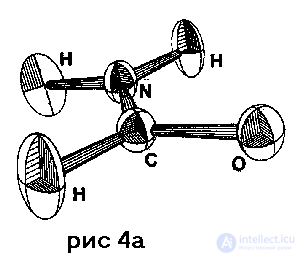 . Here the components of a second-rank tensor are used, expressing the mean-square displacements of atoms and obtained at the refinement stage of the crystal structure from X-ray diffraction data. However, sufficiently accurate values of the quantities Uikl (see table 1) are obtained only at low temperatures and by means of precision X-ray diffraction analysis. On the basis of precision X-ray diffraction, it is possible for the simplest structures to take into account the anharmonicity of the thermal vibrations of atoms.
The main advantage of precision X-ray diffraction analysis is that it makes it possible to construct, in a physically correct way, the continuous spatial distribution of electron density p(r) . Already in the first decades of its existence (in the 1920s – 1930s), X-ray diffraction analysis made it possible to compute the function р(х, у, z), which is actively used even now in routine X-ray diffraction analysis. But this function is constructed under the assumption of spherical symmetry of atomic scattering and is therefore not the true distribution of electron density in the interatomic space. From it one can extract only approximate values of the average coordinates of the nuclei. If, however, data from precision X-ray diffraction analysis are used to construct the spatial distribution p(r), and the characteristics of atomic scattering are refined during the study, the r, -model of the crystal structure becomes accessible, as well as the especially illustrative continuous r, -model (see table 1), depicting the redistribution of electron density resulting from interatomic interaction. The interpretation of these methods of structure modeling is discussed below. In fig. 4 b and c sections of the deformation electron density in crystalline formamide are presented as an example.
In a more general approach to the structure of matter, two levels of its description should be distinguished: local (L) and total (Т). As applied to a crystal structure, the local characteristics relate to individual bonds, to the environment of individual atoms. The total description characterizes the structure as a whole – the arrangement of atoms in the unit cell and the spatial pattern arising from the joining of cells. If a crystal consists of molecules, then the description of the molecule can be assigned to the local level, and the description of the spatial arrangement of the molecules to the total level. An intermediate level (I) is often useful as well, which implies the description of more or less large parts of the structure that go beyond the local level but do not characterize the structure of the substance over its entire spatial extent (these may include, in particular, the nanostructures mentioned above). Moreover, as already noted, the structural model may be not only static but also dynamic, if the description of the vibrational motion of atoms (or atomic nuclei) and other types of mobility are included in it.
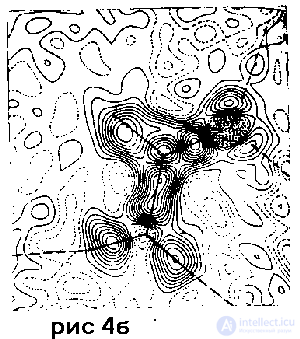 Fig. 4. Results of precision X-ray diffraction analysis of crystalline formamide H2N – CHO at 90 K (based on data from
продолжение следует...
Часть 1 Crystal Structure and Lattice, Its Modeling, Crystal Defects
Часть 2 Bubble model of a crystal - Crystal Structure and Lattice,

Comments