
Lecture
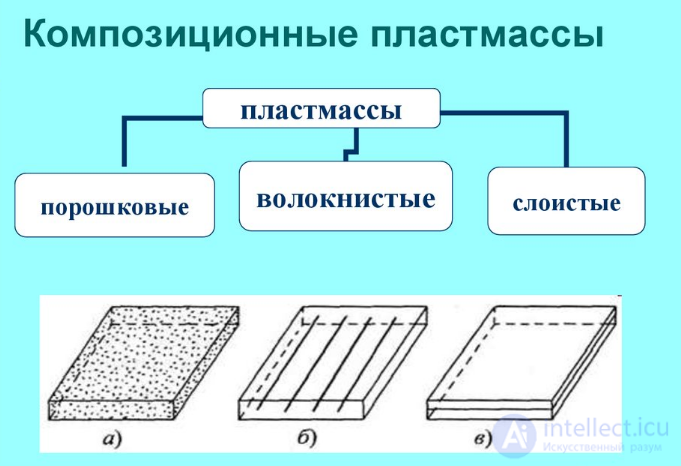
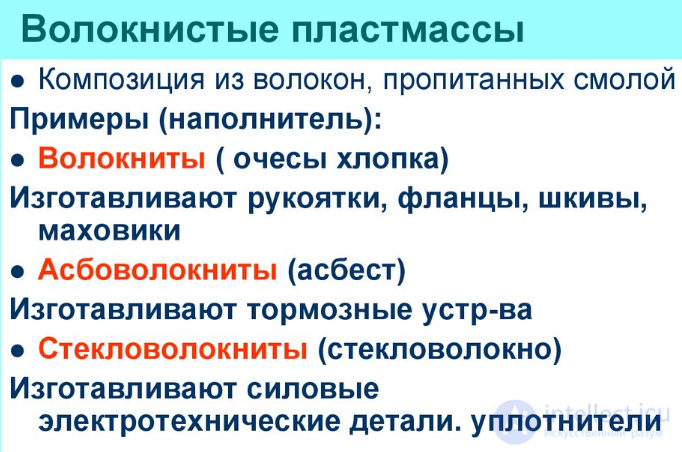
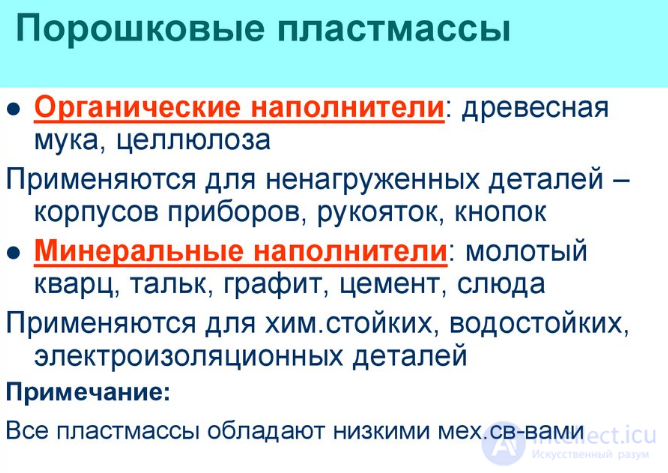
Composite powder plastics, intended for making articles by hot pressing or injection molding, consist of a binder (synthetic resins – cross-linked or linear polymers) and fillers (wood flour, cotton flock, kaolin, quartz sand, asbestos or glass fiber, etc.). In addition, dyes are added to the mass, and for obtaining the best processing properties – plasticizers.
The filler makes the plastic cheaper and at the same time improves the mechanical characteristics of the article. In a number of cases, when a filler is introduced (for example, quartz flour, talc, and others), an improvement in the electrical properties of the dielectric is observed. In mass production of articles of identical shape and size, the use of plastics ensures high labor productivity.
Phenol-formaldehyde, cresol-formaldehyde, aniline-formaldehyde, carbamide-formaldehyde, melamine-formaldehyde, furfural, silicone, and other resins are used as the binder. On the basis of these resins with various fillers, domestic industry produces more than 60 grades of powders with different properties for the production of radio-electronic equipment components.
Phenol-formaldehyde resins are obtained by heating an aqueous solution of phenol in a closed vessel.
As a result of the polycondensation reaction, a brown mass is released and deposited on the bottom of the vessel, which is the synthetic resin.
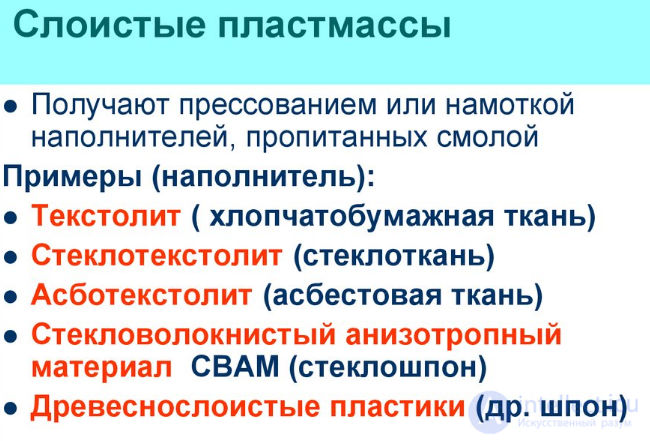
Getinax (phenolic paper laminate) is obtained by hot pressing paper impregnated with phenol-formaldehyde resin or other resins of the same type. Strong, heat-resistant impregnating paper is used for production. Impregnation is carried out using an aqueous suspension of formaldehyde resin. Sheets of bakelized paper, after drying, are assembled into stacks, and these stacks are pressed on hydraulic presses at a temperature of 160°C under a pressure of 10…12 MPa. During pressing, the resin first softens, filling the pores between the sheets and fibers, and then hardens. As a result, the fibrous base is bonded into a strong monolithic material.
The layered structure of getinax leads to anisotropy of properties. Thus, the volume resistivity of getinax along the layers is 50–100 times lower than across them; the electric strength along the layers is 5–8 times lower than across them.
Getinax belongs to the class of strongly polar dielectrics, since the fibrous base and the impregnating substance both have polar properties. Its electric strength (perpendicular to the layers) is about 30 MV/m.
Foil-clad getinax is used for making printed circuit boards for low-frequency radio-equipment circuits. At present, about ten grades of this material are produced. It is a getinax laminate faced on one or both sides with electrolytic red copper foil 0.035…0.05 mm thick. The required printed-circuit pattern is obtained by selective etching.
Textolite – is a plastic similar to getinax, but it is made from impregnated cotton fabric.

Comments