
Lecture
Ceramics are understood as a large group of dielectrics with diverse properties, united by a common technological cycle.
Ceramics (Anc. Greek κέραμος — clay) — materials produced from clays or their mixtures with mineral additives (and sometimes from other inorganic compounds) under the action of high temperature followed by cooling; also products made from such materials .
In the narrow sense, the word «ceramics» refers to clay that has been fired.
The earliest ceramics were used as dishware made of clay or mixtures of clay with other materials. Today ceramics are used as a material in industry (mechanical engineering, instrument making, aviation industry, etc.), construction, art, and are widely used in medicine and science. In the 20th century new ceramic materials were created for use in the semiconductor industry and other fields.
Modern high-temperature superconducting materials are also ceramics .
The word «ceramics» comes from the Greek «keramos», meaning «potter's clay». Previously, all materials containing clay were called ceramic. Today, the word «ceramics» refers not only to clay-containing materials but also to other inorganic materials with similar properties. Producing articles from them requires high-temperature firing.
For modern electrical engineering, ceramic dielectrics are of great importance, possessing many positive properties: high heat resistance, absence of hygroscopicity in most materials, good electrical characteristics combined with sufficient mechanical strength, stability of characteristics and reliability, resistance to high-energy radiation, mold growth and insect damage. Raw materials for the production of the main radio-ceramic products are readily available and inexpensive
Depending on their structure, a distinction is made between fine ceramics (the body is vitreous or fine-grained) and coarse ceramics (the body is coarse-grained). The main types of fine ceramics are porcelain, semi-porcelain, clay-stone bodies, chamotte, faience, and majolica. The main type of coarse ceramics is pottery ceramics.
In addition, a distinction is made between carbide ceramics (tungsten carbide, silicon carbide), alumina ceramics, zirconia ceramics (based on ZrO2), nitride ceramics (based on AlN), and others.
Porcelain has a dense, sintered white body (sometimes with a bluish tint) with low water absorption (up to 0.2%); when tapped it produces a high, melodious ring, and in thin layers it can be translucent. The glaze does not cover the edge of the rim or the base of a porcelain article. Raw materials for porcelain are kaolin, sand, feldspar and other additives.
Faience has a porous white body with a yellowish tint, with a body porosity of 9–12%. Due to its high porosity, faience articles are fully covered with a colorless glaze of low heat resistance. Faience is used for producing everyday tableware. Raw materials for faience production are white-firing clays with the addition of chalk and quartz sand.
Semi-porcelain occupies an intermediate position in properties between porcelain and faience; the body is white, water absorption is 3–5%, and it is used in the production of tableware.
Majolica has a porous body, water absorption of about 15%; articles have a smooth surface, gloss, thin walls, are covered with colored glazes and may have decorative relief ornamentation. Casting is used to produce majolica. Raw materials are white-firing clays (faience majolica) or red-firing clays (pottery majolica), fluxes, chalk, quartz sand.
Pottery ceramics has a reddish-brown body (red-firing clays are used), high porosity, and water absorption of up to 18%. Articles may be covered with colorless glazes and painted with colored clay slips — engobes.



Ceramics have been known since deep antiquity and are possibly the first artificial material created by humans. It was believed that the emergence of ceramics was directly linked to humanity's transition to a settled way of life, and therefore occurred much later than basketry. Until recently, the earliest known samples of ceramics were attributed to the Upper Paleolithic (Gravettian culture) . The oldest object made of fired clay dates to 29,000–25,000 BC. This is the Venus of Věstonice, held in the Moravian Museum in Brno .
Pots found in 1993 in Xianrendong Cave in Jiangxi Province in southeastern China were made 20,000–19,000 years ago . Sherds from a pointed-base vessel found in Yuchanyan Cave in Hunan Province in southeastern China date to 18,300–17,500 years ago . Ceramics on the Gromatukha River (a tributary of the Zeya) in the Amur Region appeared approximately 15,500 years ago .
In Mesolithic cultures, ceramics were used irregularly and, as a rule, at a late stage; the most advanced examples of Mesolithic ceramics are known from the Jōmon culture in Japan. In the Neolithic, ceramics became an indispensable attribute of nearly all archaeological cultures (the exception being the period of the earliest agrarian communities of the pre-pottery Neolithic in the Near East, where the transition to a settled way of life occurred earlier than many other technological innovations).
Peter Jordan (Groningen, Netherlands) believes that ceramics spread from two centers of innovation: East Asia (about 16,000 years before present) and North Africa (about 12,000 years before present) .
The oldest ceramic vessels (12,000 years before present) in Russia have been found in Transbaikalia (at the archaeological sites of the Ust-Karenga culture[10]) and in the Far East (Gromatukha, Osipovka, and Selemdzha[11] cultures; see the Siberian Neolithic). The lower layers of the Rakushechny Yar settlement in Rostov Oblast date to the second half of the 7th millennium BC[12]. The Elshanka culture in the Middle Volga region dates to the 7th millennium BC.
Ceramics with a thick layer of plant wax and fatty residue from the Libyan sites of Uan Afuda (Uan Afuda) and Takarkori (Takarkori) in the Sahara date to the period 8200—6400 BC[13]
Ceramics were originally shaped by hand. The invention of the potter's wheel in the third millennium BC (late Chalcolithic — early Bronze Age) significantly sped up and simplified the process of shaping articles. In the pre-Columbian cultures of the Americas, Native American pottery was made without a potter's wheel until the arrival of Europeans.
Individual types of ceramics developed gradually as production processes improved, depending on the properties of raw materials and the processing conditions achieved.
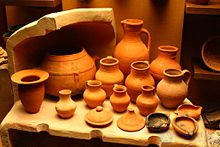
The oldest types of ceramics are various vessels, as well as spindle whorls, loom weights, and other objects. This household pottery was embellished in various ways — relief was applied by stamping, incising, or with appliqué elements. Vessels acquired different colors depending on the firing method. They could be burnished, painted, or decorated with ornament, coated with engobe, a glossy layer (Greek pottery and Roman Terra sigillata[14]), or colored glaze («Hafnerware» of the Renaissance).
By the end of the 16th century, majolica appeared in Europe (depending on its origin, also often called faience). Having a porous body made of iron- and lime-containing but white faience mass, it was covered with two glazes: an opaque one, with a high tin content, and a transparent glossy lead glaze.
Decoration was painted on majolica over the wet glaze, before firing the article at a temperature of about 1000 °C. The paints used for the decoration had the same chemical composition as the glaze, but an essential part of them were metal oxides that could withstand high temperatures (the so-called refractory colors — blue, green, yellow, and violet). Starting in the 18th century, so-called muffle colors began to be used, which were applied to the already fired glaze. These are also used for painting porcelain.
In the 16th century, the production of stoneware pottery spread in Germany. A white (for example, in Siegburg) or colored (for example, in Raeren), very dense body consisted of clay mixed with feldspar and other substances. After firing at a temperature of 1200–1280 °C, stoneware became hard and practically non-porous. In Holland, red stoneware was produced based on the model of Chinese ceramics, and the same feature is found in Böttger ware.
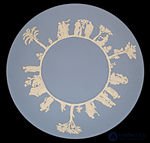
Stoneware was also produced by Wedgwood[15][16] in England. Fine faience, as a special type of ceramics with a white porous body covered with a white glaze, appeared in England in the first half of the 18th century. Faience, depending on the strength of the body, is divided into soft fine faience with a high lime content, medium faience with a lower lime content, and hard faience without lime at all. This last type, in composition and body strength, often resembles stoneware or porcelain.
 |
 |
|
|
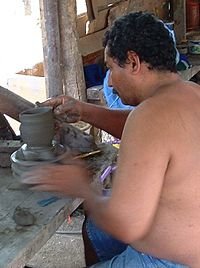
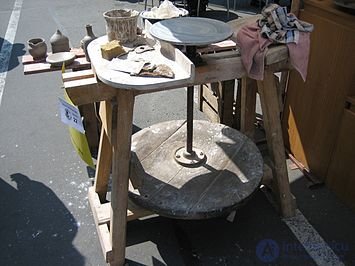
Hand and kick potter's wheels
|
 |
 |
|
|
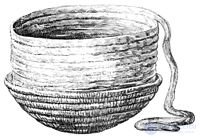
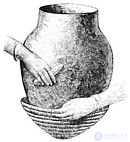
Winding a clay coil and smoothing the surface of a jug
|
Otis Tufton Mason described basket-weaving techniques used by Native Americans[17], and also showed a way of using a basket as a base for forming the bottom of a jug[18].
A notable branch of Old Russian urban pottery-making was the production of glazed ware. Examples of it are usually found during excavations of towns; it is almost absent in rural settlements and very rare among burial mound goods. Glazed ceramics of Old Russian manufacture from the late 10th–11th centuries are concentrated mainly in the towns of southern Rus' — Kiev, Chernigov, Vyshgorod, and Lyubech, that is, in the oldest centers of the Old Russian state. In Old Rus', mostly two-tiered kilns were used (the lower, firing tier was dug into the ground), though single-tiered ones also existed.
During M. K. Karger's excavations in the courtyard of St. Sophia of Kiev, alongside ordinary wheel-thrown 11th-century ceramics, fragments of glazed dishes made of white clay were found, resembling Byzantine dishes with stamped ornament, but quite distinctive: the characteristic «rail-shaped» rim of Byzantine dishes (9th–11th c.) is replaced by a horizontally flared rim; the dishes are covered with spots of green glaze — this is an imitation of Byzantine models. There is no doubt about the Russian origin of these dishes: they are made from local raw material. However, imitation of Byzantine ceramics is characteristic only of the first masters of the glazing craft in Rus'. The bulk of white-clay ware is similar in shape to ordinary wheel-thrown ceramics of Old Russian towns: these are jugs and pots of various shapes.
Fragments of white-clay glazed jugs were found in 11th-century layers in Kiev during excavations near St. Sophia Cathedral, on the territory of the Kiev Pechersk Lavra, in Lyubech, in Chernigov, in Vyshgorod, and in Gorodsk. They had a spherical-elongated body separated from the neck by an appliqué ridge (Makarova T. N., 1967. Table XIII).
Glazed pots repeat the simple ware of that time. Usually these are small pots with a straight or slightly flared rim. A feature of white-clay ceramics is the dense, opaque glaze, bright green, less often yellow. Such ware has been found in small quantities in Vyshgorod, Chernigov, Gorodsk, and in the village of Volosskoye in Dnepropetrovsk Oblast.
White-clay glazed ceramics is nevertheless relatively rare. From the 12th century, many towns of Rus' began producing glazed ware from local light-firing clays, which after firing give a gray body. Where such clay was not available, red-firing clay was used. Before applying the glaze, the vessel was coated with engobe — a layer of clay lighter than the base clay.
There is also glazed ware in Novgorod. It is distinguished by mottled glaze, green with yellow or brown spots. These are mainly pots, similar in shape to Novgorod ware of the 12th–13th centuries. The earliest of them are found in layers of the 11th–12th centuries, and ceramics with the same mottled glaze continued to exist in the 14th–17th centuries: these are pots, water vessels, and toys. Novgorod also retained the method of obtaining a metallic-luster glaze; besides pysanky-like eggs (Makarova T. N., 1966. P. 141–145), tiles with overglaze painting of the Belgorod type were produced here in the 12th–13th centuries, differing from them by a bluish or reddish background tint and metallic luster of the glaze.
An idea of the glazed ceramics of the northern regions of Rus' is given by finds in Beloozero. Alongside imported ceramics from Kiev, quite distinctive thin-walled vessels with a liquid mottled green glaze, pysanky-like eggs, rattles, and abacus beads have been found here (Golubeva L. A. 1973. P. 167–169. Fig. 60, 2, 3).
Finds in Novgorod make it clear that the traditions of the glazing craft were not lost after the 13th century. This is also confirmed by materials from Moscow and the Moscow region. In pre-Mongol Moscow layers, individual fragments of glazed gray-clay ceramics are found… It is likely that the production of glazed ceramics in Moscow was already fairly well developed by the mid-14th century. The role of Kievan traditions in this is undeniable (Avdusina T. D., Vladimirskaya Ya. S., Panova T. D. 1984. P. 48–50).
The Mongol-Tatar invasion affected the development of Old Russian culture. The history of ceramics split into a general European one in the Grand Duchy of Lithuania, Ruthenia, Samogitia and others, and in Muscovy, shifting from the southern regions to the northern and western border towns. In the Muscovite lands the tile art of Old Rus' was destroyed, and many works of Russian potters of the 9th–12th centuries perished. For example, two-handled amphora-jars, vertical lamps, the art of cloisonné enamel, and glaze (the simplest — yellow, which survived only in Novgorod) disappeared, and ornament became simpler.
In the 13th–14th centuries, glazed roof tile spread in Pskov, used for the roofs of Orthodox churches. It probably gave rise to simple facing tiles, and later to decorated tiles with a rumpa for fastening into wall masonry.
On the territory of the Pskov-Caves Dormition Monastery, unique monuments of glazed ceramics have survived — more than a hundred ancient monastic gravestone tiles (keramids), set into the walls of underground galleries. Reaching an average height of 45–60 cm and a width of 30–40 cm, they are made of fired clay with a dark green glaze. The number and high artistic quality of the items testify that ceramic production had flourished at the monastery since ancient times. Keramids were first produced in Rus' precisely in the Pskov region in the 16th century. The monastery had a dedicated pottery workshop.
Pskov pottery products, such as tableware, are recognizable by their forms. The art of the Pskov masters was vividly expressed in the production of decorative ceramics.[19]
A separate branch of Russian, and subsequently modern Russian, ceramics is Gzhel (named after the town). These articles are made in a blue-and-white style.
Source ceramic materials are opaque due to the features of their structure. However, sintering of nanometer-sized particles has made it possible to create transparent ceramic materials with properties (operating wavelength range, dispersion, refractive index) that lie outside the standard range of values for optical glasses.
Nanoceramics — a ceramic nanostructured material (nanoceramics) — is a compact material based on oxides, carbides, nitrides, borides and other inorganic compounds, consisting of crystallites (grains) with an average size of up to 100 nm[20]. Nanoceramics are used for the production of armor ceramics[21], microwave-range generator tubes, substrates for semiconductor devices, insulators for vacuum arc-extinguishing chambers, power semiconductor devices, and electron-optical converters in night-vision devices[22].
The technological process for manufacturing ceramic tile includes the following main stages:
Raw materials for ceramic bodies are divided into plastic (clays and kaolins) and non-plastic. Additions of grog and quartz reduce shrinkage of the products and the likelihood of cracking during forming. Lead red lead and borax are used as glass formers.
Preparation of the slip is carried out in three stages:
Transport from the raw material warehouse is carried out using a loader into receiving hoppers. From there it is sent by conveyor either to the ball mill (for grinding) or to turbo-dissolvers (for dispersing the clay and kaolin)
Glazes – glossy fusible coatings that melt onto the ceramic body in a layer 0.12 — 0.40 mm thick. Glaze is applied to cover the body of the product with a dense, smooth layer, as well as to give the product with a dense body increased strength and an attractive appearance, to ensure dielectric properties, and to protect the decoration from mechanical and chemical influences.
The glaze composition includes finely ground zircon, chalk, and whiting. The finished glaze is loaded into one of the vessels designated by the process engineer. It is passed several times through vibrating screens and magnetic separators to remove metallic impurities, whose presence in the glaze can lead to the formation of defects during production. Glue is added to the mix, and the glaze is sent to the line.
Before forming, the slip is loaded into one of the vessels. Three vessels are used in rotation (changing approximately once a day) for a given stand. The mold is first cleaned of residual slip from the previous forming, treated with slip water, and dried.
The slip is poured into the dried molds. The molds are rated for 80 pourings. The casting method is used for forming. The mold absorbs part of the water, and the volume of the slip decreases. Slip is topped up into the mold to maintain the required volume.
After hardening, the products are dried, and an initial rejection of defective products (cracks, deformations) is carried out.
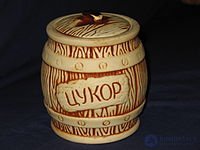
After forming, the products go to the manual processing shop.
After the glaze is applied, the product is sent for firing in a kiln. The kiln is equipped with a pre-drying module and dedusting and blow-off chambers. Heat treatment is carried out at a temperature of 1230 degrees, and the length of the kiln is about 89 meters. The cycle from loading to unloading of the trolley is about a day and a half. Firing of the products in the kiln takes about a day.
After firing, sorting is carried out: division into groups of similar products, identification of defects. If the defects can be corrected, the products are sent for rework and are removed by hand at the restoration station. Otherwise, the product is considered defective.

Comments