
Lecture
It is known from physics that electrons possess the property of wave-particle duality. Therefore, the motion of electrons in a metal can be regarded as the propagation of plane waves whose wavelength is determined by the de Broglie relation:
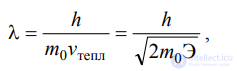
where m0 – electron mass; vtherm – thermal velocity; h – Planck's constant.
Since in metals the electron-gas concentration n is practically independent of temperature, the temperature dependence of the electrical conductivity σ is determined entirely by the temperature dependence of the mobility µ of the charge carriers – the electrons of the degenerate electron gas. In a sufficiently pure metal the impurity concentration is small, and down to quite low temperatures the mobility is determined by the scattering of electrons on lattice vibrations.
In the region of high temperatures the electron mobility is inversely proportional to T. It is known that the electrical conductivity is given by the expression
σ = enµ .
Consequently
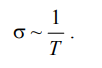
The resistivity
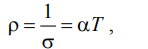
where α – temperature coefficient of resistance.
In the region of low temperatures the phonon-gas concentration is proportional to T 3. Therefore the electron mean free path, due to scattering on phonons, should be inversely proportional to T 3:
L ~ T−3.
However, this relation does not take into account the fact that at low temperatures the average phonon momentum turns out to be so small compared with the momentum of the conduction electrons that not one but ν ~ T 2 scattering events on phonons are required to destroy the electron's motion in a given direction. Therefore the effective mean free path of the electron Leff, over which randomization of its motion occurs, is equal to
Leff ~ T−5 .
Consequently σ ~ T−5 and ρ ~ T5 .

Comments