
Lecture
This group of materials conventionally includes conductors with a resistivity under normal conditions of no more than 10–7 Ohm⋅m. The most common of these are copper and aluminum.
Advantages of copper:
After extraction, copper intended for electrical engineering purposes is subjected to electrolytic refining.
Cold drawing produces hard-drawn copper (marked MT), which, as a result of work hardening, has a high tensile strength.
After annealing, copper becomes soft (marked MM), with lower strength, a higher elongation coefficient, and higher specific conductivity.
Standard copper in the annealed state at 20°C has a resistivity of 1.7241⋅10–8 Ohm⋅m.
Copper grades. Copper grades M1 and M0 are used as conductor materials. Here the grading is based on impurity content.
M1 contains 99.90% base metal, with oxygen accounting for no more than 0.08%. At elevated oxygen content, the mechanical and technological properties of copper noticeably deteriorate, and soldering and tinning become difficult.
Copper M0 has the best mechanical properties (99.95% base metal, oxygen not exceeding 0.02%). The thinnest wire can be made from M0 copper.
Special grades of copper. In electron-tube technology, special oxygen-free grades of copper are used. They are obtained from electrolytic copper remelted in a protective atmosphere of reducing carbon monoxide gas. The oxygen released when copper is heated reacts with the carbon monoxide and is removed as carbon dioxide gas. This copper contains 99.97% base metal. Even purer is vacuum copper, smelted in vacuum induction furnaces in graphite crucibles at a residual gas pressure of about 10–3 Pa. It contains 99.99% base metal. Oxygen-free copper differs little in mechanical strength and electrical conductivity from electrolytic copper remelted by the conventional method. Its significant advantage is high ductility.
Properties of copper. The specific conductivity of copper is highly sensitive to the presence of impurities. For example, at a content of 0.5% Zn, Cd, or Ag impurity in copper, its specific conductivity decreases by 5%. At the same content of Ni, Sn, or Al, the specific conductivity of copper drops by 25…40%. An even stronger effect is exerted by impurities of Be, As, Fe, Si, or P, which reduce its specific conductivity by 55% or more. At the same time, additions of many metals increase the mechanical strength and hardness of copper, both in the cold-drawn and annealed states.
A drawback of copper is its susceptibility to atmospheric corrosion with the formation of oxide and sulfide films. The oxidation rate increases rapidly on heating, but the adhesion strength of the oxide film to the metal is low. Due to oxidation, copper is not suitable for low-current contacts. Metal flaking and thermal decomposition of the oxide film cause increased wear of copper contacts at high currents.
Hydrogen has a significant effect on the mechanical properties of copper. After hydrogen annealing, the hardness of copper can decrease several-fold. The destructive effect of hydrogen is especially strong in the presence of oxygen in commercial copper in the form of cuprous oxide Cu2O. Hydrogen, readily penetrating deep into the metal at elevated temperatures, reacts as follows:
Cu2O + H2 = 2Cu + H2O
The pressure of the water vapor formed in the metal, due to the low rate of its diffusion, can reach several thousand atmospheres. This leads to the formation of microcracks that break the vacuum tightness of the material and make it brittle and prone to fracture. In production, this phenomenon is called «hydrogen disease». In copper containing less than 0.001% oxygen, «hydrogen disease» is practically absent.
Applications of copper. Copper is used in electrical engineering for making wires, cables, switchgear busbars, transformer windings, electrical machines, current-carrying parts of instruments and apparatus, and anodes in electroplating. Copper strips are used as cable shields. Hard copper is used in cases where especially high mechanical strength, hardness, and abrasion resistance are required, for example, for making bare wires. If good flexibility and ductility are required, and tensile strength is not of significant importance, then soft copper is preferable (for example, for hookup wires).
In addition, copper is used to make copper-clad laminate and is used in microelectronics in the form of films deposited on substrates, which serve as conductive interconnects between functional elements of a circuit.
Oxygen-free copper — electrolytic copper free of copper oxides.
Copper obtained from ore by electrolysis contains a significant amount of copper oxide, which, during subsequent annealing in a hydrogen atmosphere, reacts with it (hydrogen readily passes through the metal and reduces Cu2O). The resulting water vapor damages the ingot, forming cracks, pores, and voids (the so-called «hydrogen disease of copper»). To prevent this, after annealing in a hydrogen atmosphere, the copper is remelted in a vacuum.
To reduce the oxygen content in copper at further processing stages and thereby prevent «hydrogen disease», phosphorus deoxidation is applied to semi-finished and finished products for non-electrical purposes. Thus, the Soviet (Russian) grade M1F copper and its European analog Cu-DHP contain from 0.012% (0.015% for Cu-DHP) to 0.04% phosphorus by mass, which drives the oxygen content in them toward zero and, as a result, it is not specified.
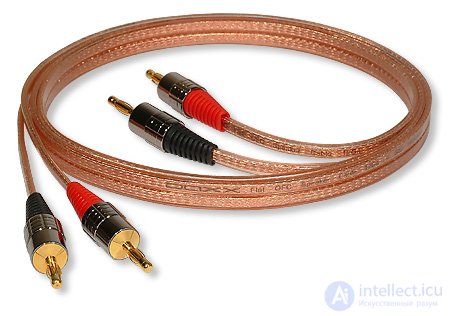
From oxygen-free copper grade M1F (per GOST 1173-2006), foil, strips, and sheets are made, which are used as roofing material, shields, etc. Oxygen-free copper is also used to make water and gas pipes (GOST R 52318-2005) and fittings (GOST R 52922-2008), soldering-iron tips, and electroacoustic and video cables.
The second most important conductor material after copper is aluminum. The resistivity of aluminum is 1.6 times that of copper, but aluminum is 3.5 times lighter than copper.
A drawback of aluminum is its low mechanical strength (3 times lower than that of copper).
Aluminum grades. For electrical engineering purposes, commercially pure aluminum AE is used, containing no more than 0.5% impurities. Wire made from AE aluminum and annealed at a temperature of 350 ± 20°C has a resistivity at 20°C of no more than 2.8⋅10–8 Ohm⋅m. High-purity aluminum A97 (no more than 0.03% impurities) is used to make aluminum foil, electrodes, and electrolytic capacitor cases. In ultra-pure aluminum A999, impurities do not exceed 0.001%. Its purity is monitored by the value of the residual resistivity at liquid helium temperature, which should not exceed 4⋅10–12 Ohm⋅m.
Different impurities reduce the specific conductivity of aluminum to varying degrees. Impurities that do not form solid solutions with aluminum have little effect on electrical conductivity, while impurities that form a solid solution noticeably reduce it. Quenching increases the resistance of aluminum in the presence of those impurities whose solubility increases upon heating.
At liquid nitrogen temperature, aluminum's resistivity nearly matches that of copper, and at even lower temperatures it becomes even better than copper's. Therefore, the use of aluminum as a cryoconductor is promising.
Surface of aluminum. Aluminum oxidizes readily and becomes covered with a thin oxide film of high electrical resistance. This film protects aluminum from corrosion, but it creates high contact resistance at points of contact between aluminum wires, which makes it impossible to solder aluminum by ordinary methods.
Therefore, special solder pastes are used for soldering aluminum, and in microtechnology – ultrasonic welding. A thicker oxide layer, which withstands relatively high voltages, is obtained by means of electrochemical treatment of aluminum. Oxide insulation is very strong: a layer 0.03 mm thick has a breakdown voltage of about 100 V, and one 0.04 mm thick – about 250 V.
Various coils are made from anodized aluminum without additional interturn and interlayer insulation. The drawbacks of oxide insulation are its limited flexibility (especially at greater thickness) and noticeable hygroscopicity (in cases where high heat resistance is not required, it is coated with varnish).
In practice, the issue of protection against galvanic corrosion at points of contact between aluminum and copper is of great importance. If the contact area is exposed to moisture, a local galvanic couple with a fairly high EMF value arises. The polarity of this couple is such that current flows from aluminum to copper, as a result of which the aluminum conductor can be severely destroyed by corrosion. Therefore, joints between copper and aluminum conductors must be protected from moisture (coated with varnish, etc.).
Aluminum films are widely used in integrated circuits as contacts and interconnects. Films are usually deposited onto silicon substrates by evaporation and condensation in vacuum. The advantages of aluminum as a contact material are that it is easily sputtered, has good adhesion to silicon and to the SiO2 insulation layer widely used in semiconductor integrated circuits, provides good resolution in photolithography, and gives a good ohmic contact with silicon. It is also used for making mirrors.
Silver (Ag from Latin Argentum) — an element of group 11 (in the older classification — subgroup B of group I), period 5 of the periodic table of chemical elements of D. I. Mendeleev, with atomic number 47.
The simple substance silver is a malleable, ductile, gray-white noble metal. Its crystal lattice is face-centered cubic. Melting point — 962 °C, density — 10.5 g/cm³.
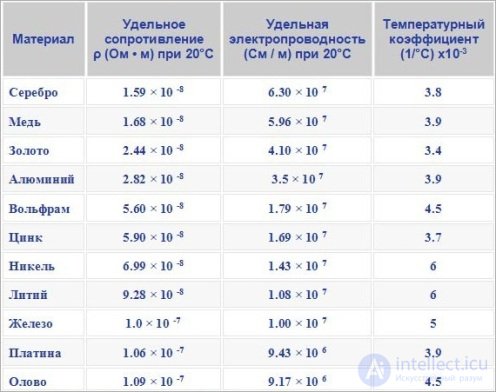
Pure silver — a fairly heavy (lighter than lead, but heavier than copper, density — 10.5 g/cm³), extraordinarily ductile silvery-white metal (the reflectance of light is close to 100%). Thin silver foil appears violet in transmitted light. Over time, the metal tarnishes, reacting with traces of hydrogen sulfide in the air and forming a sulfide layer, whose thin film then gives the metal a characteristic pinkish tint. It has the highest thermal conductivity of all metals. At room temperature it has the highest electrical conductivity of all known metals (resistivity 1.59⋅10−8 Ohm·m at a temperature of 20 °C). It is a relatively refractory metal, with a melting point of 962 °C.
applications of silver
Gold (Au from Latin Aurum) — an element of group 11 (in the older classification — subgroup B of group I), period 6 of the periodic table of chemical elements, with atomic number 79. The simple substance gold is a noble metal of yellow color.
Pure gold is a soft, yellow-colored metal. The reddish tint of some gold products, for example coins, comes from admixtures of other metals, particularly copper. In thin films, gold transmits green light. Gold has high thermal conductivity and low electrical resistance.
Gold is a very heavy metal: the density of pure gold is 19.32 g/cm³ (a sphere of pure gold 46.237 mm in diameter has a mass of 1 kg).
Gold is a very soft metal: hardness on the Mohs scale ~2.5, on the Brinell scale 220—250 MPa (comparable to the hardness of a fingernail).
Gold is also highly ductile: it can be hammered into sheets as thin as ~0.1 µm (100 nm) (gold leaf); at such thickness gold is translucent and appears yellow in reflected light, while in transmitted light it appears bluish-green, complementary to yellow. Gold can be drawn into wire with a linear density down to 2 mg/m.
Linear coefficient of thermal expansion — 14.2⋅10−6 K−1 (at 25 °C). Thermal conductivity — 320 W/m·K, specific heat capacity — 129 J/(kg·K), resistivity — 0.023 Ohm·mm2/m.
Electronegativity on the Pauling scale — 2.4. Electron affinity energy is 2.8 eV; atomic radius 0.144 nm, ionic radii: Au+ 0.151 nm (coordination number 6), Au3+ 0.082 nm (4), 0.099 nm (6) .
Gold solders wet various metal surfaces very well and are used in soldering metals. Thin gaskets made from soft gold alloys are used in ultra-high vacuum technology.
In terms of chemical resistance and mechanical strength, gold is inferior to most platinum-group metals, but is irreplaceable as a material for electrical contacts. Therefore, in microelectronics, gold conductors and electroplated gold coatings on contact surfaces, connectors, and printed circuit boards are used very widely.
Gold is used as a target in nuclear research, as a coating for mirrors operating in the far-infrared range, and as a special shell in neutron bombs. A thin layer of gold (20 nm) on the inner surface of window and stained-glass panes significantly reduces unwanted heat loss in winter, while in summer it protects the interiors of buildings and vehicles from heating by infrared rays.
Platinum – a chemical element, a precious metal that is an exchange-traded commodity. It is usually denoted by the symbol Pt, which comes from the Spanish word plata – «silver»; platina is a diminutive form, literally «little silver».
Platinum is used in the following industries:
- automotive manufacturing. Today the main consumer of platinum – it is required for catalytic converters that afterburn automobile exhaust gases. The use of this technology began in the mid-1970s in connection with tightening requirements for air quality protection. In developed countries, this sector accounts for up to 90 tonnes of platinum consumption per year;
- the oil and gas industry. Platinum is used to obtain high-octane gasoline, aromatic hydrocarbons, and technical hydrogen from gasoline and naphtha fractions of oil. The volume of use is 6-7 tonnes per year;
- electrical engineering and electronics. Platinum is used as a material for the contacts of electrical devices and resistance furnaces. Miniature magnets and special mirrors for lasers are made from its alloys. The electronics industry consumes 6-8 tonnes per year;
- the chemical industry. Platinum is used in making distillation retorts for the production of hydrofluoric acid. Electrodes for obtaining a number of substances, such as, for example, hydrogen peroxide, are made from it. In total, the chemical industry uses about 10 tonnes of platinum per year.
In addition, platinum is used in the glass industry (up to 10 tonnes per year) and in medicine (about 8 tonnes).
Up to a third of all platinum produced is used in the jewelry industry.

Comments