
Lecture
Basic concepts. Polarization processes involving the displacement of any charges in a substance, occurring over time until an equilibrium state is established and reached, give rise to polarization currents, or displacement currents, in dielectrics. Displacement currents of elastically bound charges during electronic and ionic polarization are so short-lived that they usually cannot be detected by an instrument.
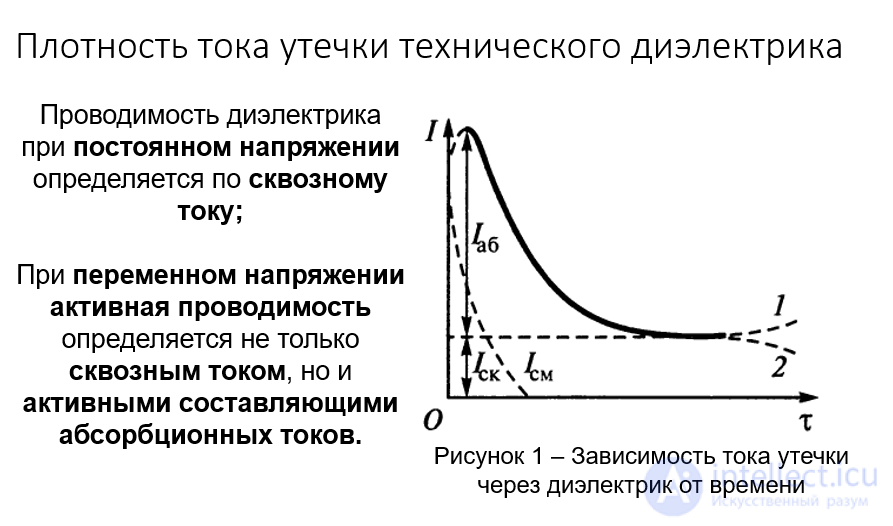
Under constant voltage, displacement currents, changing their direction, flow only during the periods when the voltage is switched on and off. Under alternating voltage, they occur throughout the entire time the material remains in the electric field.
The presence in technical dielectrics of a small number of free charges, as well as their injection from the electrodes, leads to the appearance of small through-conduction currents (or leakage currents).
Thus, the total current density in a dielectric, called the leakage current, is the sum of the densities of the displacement current and the through current:
Jleak = Jdisp + Jthrough .
The displacement current density is determined by the rate of change of the electric displacement (induction) vector D:
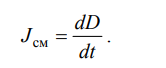
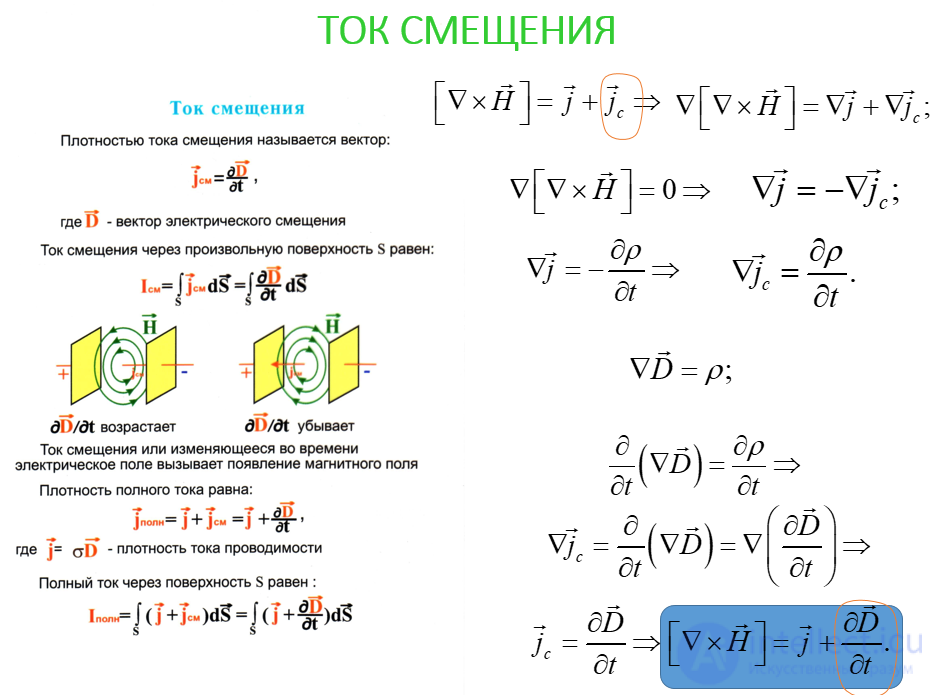
After the polarization processes are complete, only the through current flows through the dielectric.
The conductivity of a dielectric under constant voltage is determined from the through current, which is accompanied by the release and neutralization of charges at the electrodes. Under alternating voltage, the active conductivity is determined not only by the through current but also by the active components of the polarization currents.
In most cases, the electrical conductivity of dielectrics is ionic, and less often electronic.
The resistance of a dielectric enclosed between two electrodes, under constant voltage, can be calculated using the formula:
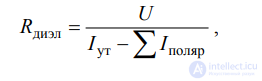
where ∑ Ipolar – is the total current caused by polarization of the dielectric.
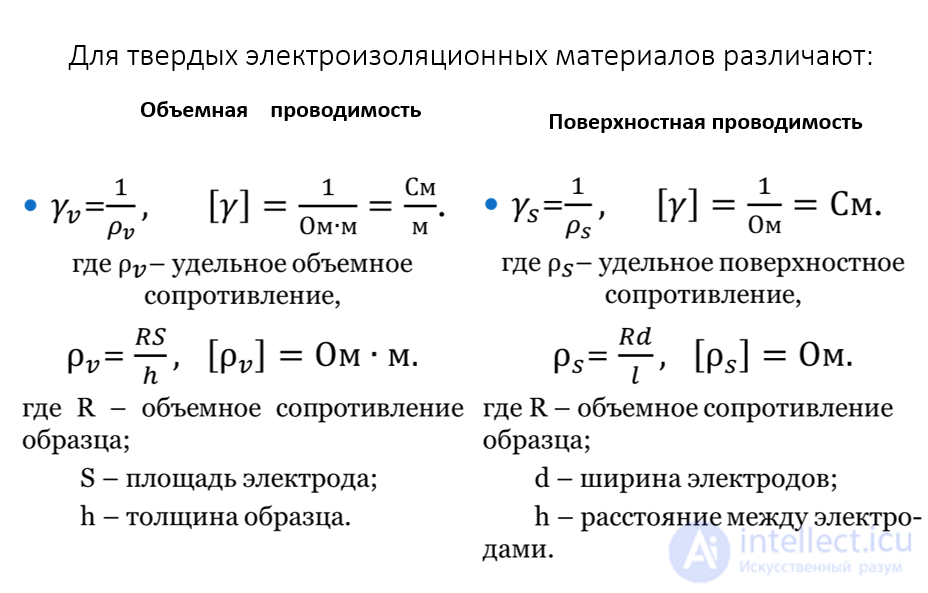
For solid insulating materials, a distinction is made between volume and surface electrical conductivity.
To compare the volume and surface conductivity of different materials, the volume resistivity ρ and the surface resistivity ρS are also used.
Volume resistivity ρ is numerically equal to the resistance of a cube with a 1 m edge, mentally cut out of the material under study, if the current passes through two opposite faces of this cube; ρ is expressed in Ω⋅m; 1 Ω⋅m =100⋅Ω⋅cm.
In the case of a flat sample of material in a uniform field, the volume resistivity is calculated using the formula:
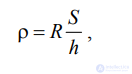
where ρ – is the volume resistance, Ω; S – is the electrode area, m2; h – is the thickness of the sample, m.
Specific, surface resistance ρS is numerically equal to the resistance of a square (of any size) mentally marked out on the surface of the material, if the current passes through two opposite sides of this square (ρS is expressed in ohms):
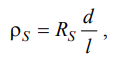
where RS – is the surface resistance of the material sample between electrodes placed in parallel, of width d, spaced from one another at a distance l.
From the volume resistivity one can determine the volume conductivity γ = 1/ρ and, correspondingly, the surface conductivity γS = l/(ρS).
The total conductivity of a solid dielectric, corresponding to its resistance Rdiel, is made up of the volume and surface conductivities.
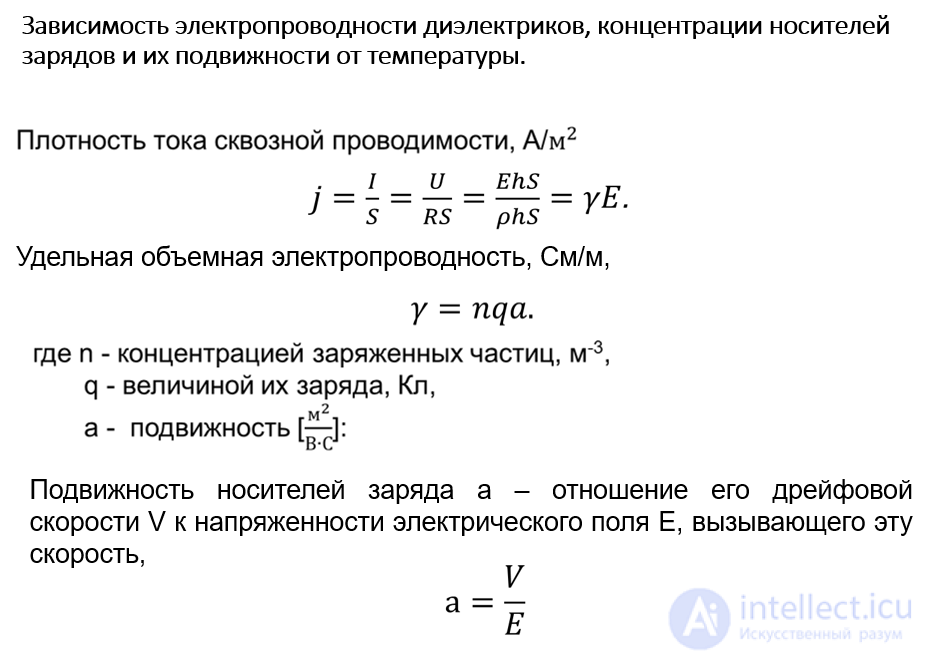
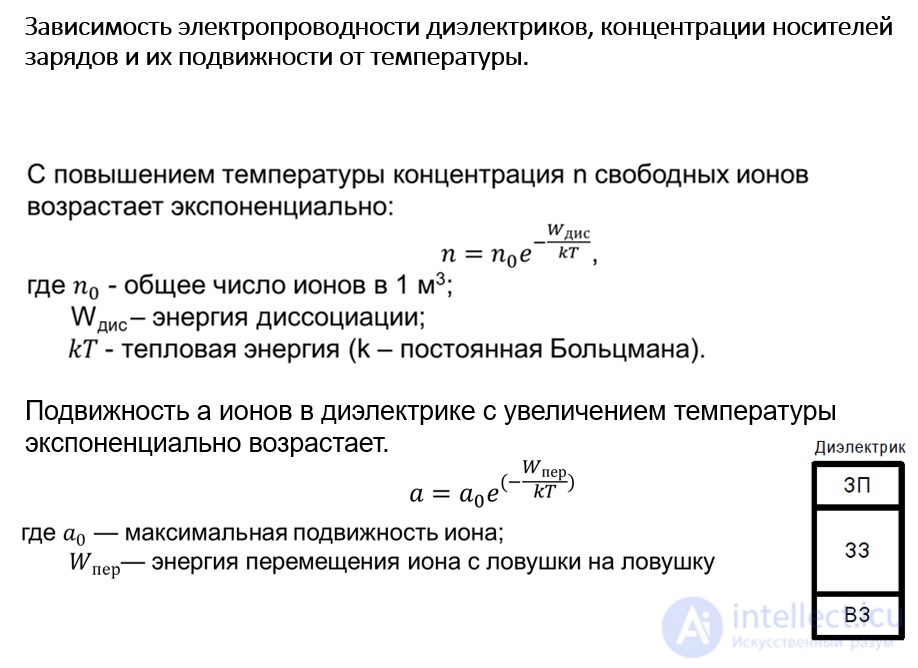
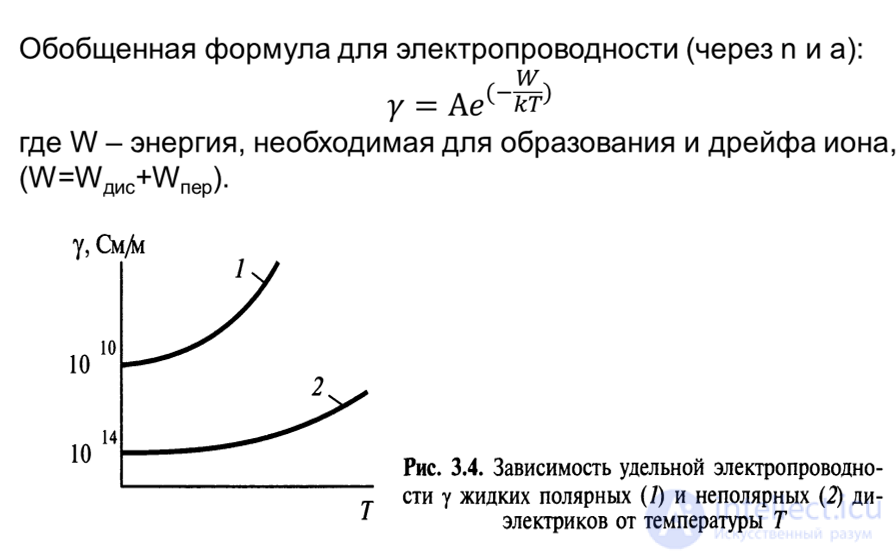
The electrical conductivity of dielectrics depends on their state of aggregation, as well as on the humidity and temperature of the surrounding environment.
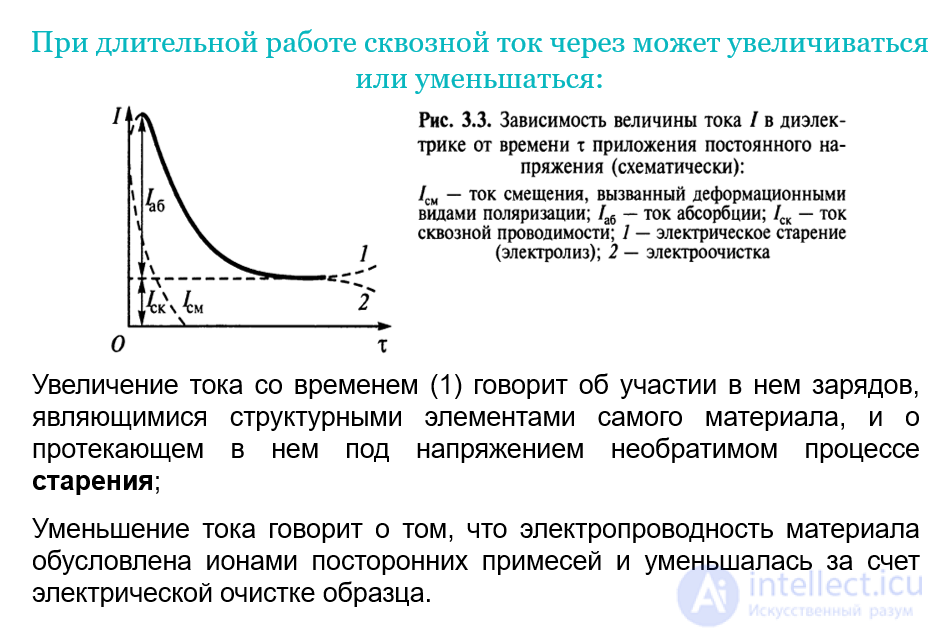
During prolonged operation under voltage, the through current passing through solid or liquid dielectrics may decrease or increase over time. A decrease in the through current over time indicates that the electrical conductivity of the material was caused by ions of foreign impurities and decreased owing to electrical purification of the sample. An increase in the current over time indicates the involvement of charges that are structural elements of the material itself, and of an irreversible aging process taking place in the dielectric under voltage, which can gradually lead to destruction – breakdown of the dielectric.
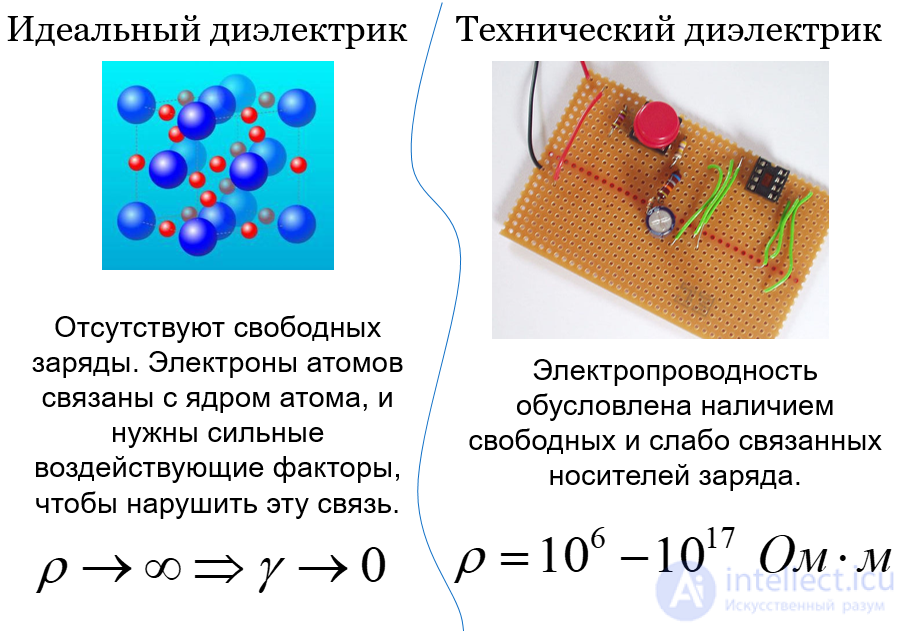
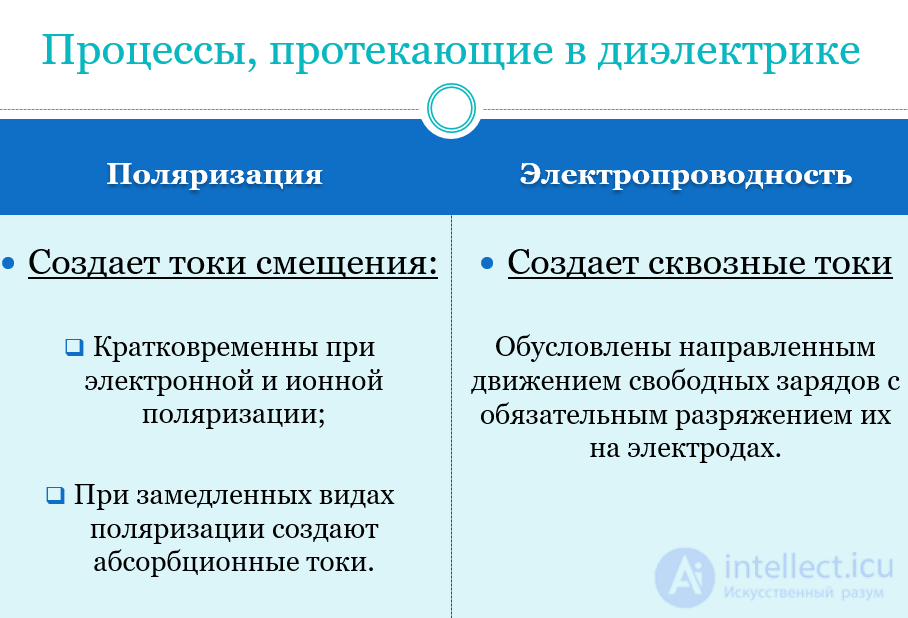
Processes occurring in a dielectric
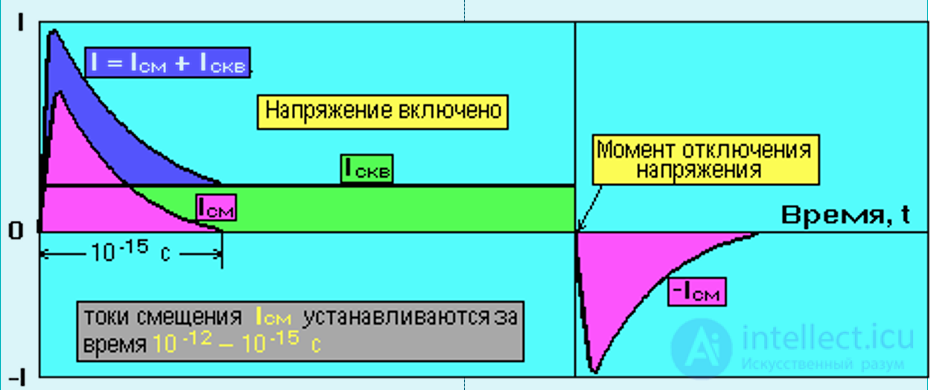
Leakage current density of a technical dielectric
For solid electrical insulating materials, a distinction is made between:
During prolonged operation, the through current may increase or decrease:

Comments