
Lecture
Based on their response to an external magnetic field and the nature of their internal magnetic ordering, all substances in nature can be divided into five groups: diamagnets, paramagnets, ferromagnets, antiferromagnets, and ferrimagnets. These types of magnetic materials correspond to five different types of magnetic state of matter: diamagnetism, paramagnetism, ferromagnetism, antiferromagnetism, and ferrimagnetism.
Five basic types of magnetic properties are distinguished, associated with the concepts of diamagnetism, paramagnetism, ferromagnetism, antiferromagnetism, and ferrimagnetism. It has been established that, besides the diamagnetism of filled electron shells and the diamagnetism and paramagnetism of conduction electrons, there are properties caused by the presence of microscopic magnetic moments on some or all atoms in a solid; the difference in properties between different bodies is determined by the arrangement of magnetic moments within them. Magnetism in solids was a problem of magnetic-moment ordering as long as one considered ordered systems containing identical magnetic ions located at equivalent atomic sites of a regular crystal lattice.
The situation changed thanks to a sharp intensification of theoretical and experimental research into two related types of systems: amorphous solids, in which there is not a single pair of equivalent atomic positions, and disordered solids, in which different atoms randomly occupy the sites of a regular crystal lattice. New types of magnetic ordering were discovered, arising where there is no long-range order at all, as well as other orderings appearing only in a regular crystal lattice. From that point the subject became more complex, and instead of the five original types of magnetic properties it came to include almost three times as many types, with the corresponding terminology expanding proportionally. It was noted that magnetism needed a systematizer who could really make sense of names such as mictomagnetism, metamagnetism, asperomagnetism, speromagnetism, sperimagnetism, spin glass, cluster glass, and many others currently in circulation. It is clear that such a situation could confuse an outside observer.
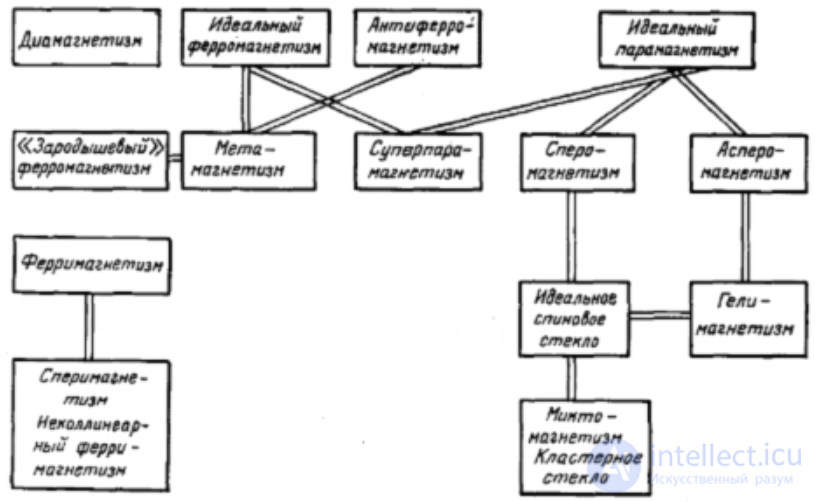
Fig. 1. Fourteen types of magnetism.
Diamagnets are substances that magnetize opposite to the direction of an external magnetic field. In the absence of an external magnetic field, diamagnets are non-magnetic. Under the action of an external magnetic field, each atom of a diamagnet acquires a magnetic moment I (and each mole of the substance acquires a total magnetic moment) proportional to the magnetic induction H and directed opposite to the field. Therefore, the magnetic susceptibility χ = I/H of diamagnets is always negative. In absolute value the diamagnetic susceptibility χ is small and weakly dependent on both the magnetic field strength and the temperature.
Examples: silicon, germanium, water.
Diamagnets are substances whose magnetic susceptibility is negative and does not depend on the strength of the external magnetic field.
Diamagnetism is caused by a small change in the angular velocity of the orbital rotation of electrons when an atom is placed in a magnetic field. The diamagnetic effect is a manifestation of the law of electromagnetic induction at the atomic level. An electron orbit can be regarded as a closed loop with no active resistance. Under the action of an external field the current in the loop changes and an additional magnetic moment arises. According to Lenz's law, this moment is directed opposite to the external field.
Diamagnets include the inert gases, hydrogen, nitrogen, many liquids (water, oil and its derivatives), a number of metals (copper, silver, gold, zinc, mercury, gallium, etc.), most semiconductors (silicon, germanium, AmBv and AnBVI compounds) and organic compounds, alkali-halide crystals, inorganic glasses, and others. All substances with covalent chemical bonding and substances in the superconducting state are diamagnetic.
The external manifestation of diamagnetism is the expulsion of diamagnets from a non-uniform magnetic field.
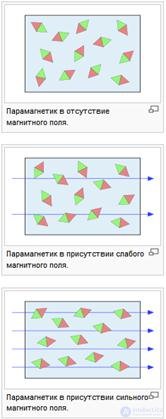
Paramagnets are substances that magnetize in an external magnetic field in the direction of that field. Paramagnets belong to the weakly magnetic substances; their magnetic permeability differs only slightly from unity  .
.
Atoms (molecules or ions) of a paramagnet possess intrinsic magnetic moments which, under the action of external fields, become oriented along the field and thereby create a resultant field exceeding the external one. Paramagnets are drawn into a magnetic field. In the absence of an external magnetic field a paramagnet is not magnetized, since due to thermal motion the intrinsic magnetic moments of the atoms are oriented completely at random.
Paramagnets include aluminum (Al), platinum (Pt), many other metals (alkali and alkaline-earth metals, as well as alloys of these metals), oxygen (O2), nitric oxide (NO), manganese oxide (MnO), ferric chloride (FeCl2), and others.
Ferro- and antiferromagnetic substances become paramagnetic at temperatures above the Curie point or the Néel point, respectively (the temperature of the phase transition to the paramagnetic state).
Paramagnets are substances with a positive magnetic susceptibility that does not depend on the strength of the external magnetic field. In paramagnets the atoms possess an elementary magnetic moment even in the absence of an external field, but due to thermal motion these magnetic moments are distributed at random. An external magnetic field causes a preferential orientation of the atomic magnetic moments in one direction. Thermal energy opposes the establishment of magnetic order. Therefore, the paramagnetic susceptibility depends strongly on temperature.
Because of their positive magnetization, paramagnets placed in a non-uniform magnetic field are drawn into it. In very strong fields and at low temperatures, a state of magnetic saturation can occur in paramagnets, in which all elementary magnetic moments are oriented parallel to H.
Paramagnets include oxygen, nitric oxide, the alkali and alkaline-earth metals, some transition metals, and salts of iron, cobalt, nickel, and the rare-earth elements.
The paramagnetic effect is, in its physical nature, largely analogous to the dipole-relaxation polarization of dielectrics.
Ferromagnets are substances (usually in a solid crystalline or amorphous state) in which, below a certain critical temperature (the Curie point), long-range ferromagnetic ordering of the magnetic moments of atoms or ions (in non-metallic crystals) or of collectivized electron moments (in metallic crystals) is established. In other words, a ferromagnet is a substance that, below the Curie point, can possess magnetization in the absence of an external magnetic field. Recent research in physics has shown that some ferromagnets, under certain conditions, can acquire paramagnetic properties at temperatures substantially above the Curie point. Thus ferromagnets, along with many other magnetic substances, turn out to remain poorly understood materials even today.
Properties of ferromagnets:
Ferromagnets are substances with a large positive magnetic susceptibility that depends strongly on the magnetic field strength and on temperature. Ferromagnets possess an internal magnetic order, expressed in the existence of macroscopic regions with parallel-oriented atomic magnetic moments. The most important feature of ferromagnets is their ability to magnetize to saturation in relatively weak magnetic fields.
An antiferromagnet is a substance in which antiferromagnetic ordering of the magnetic moments of atoms or ions has been established.
In other words, a simple antiferromagnet can be envisioned as a set of two interpenetrating identical ferromagnetic crystalline sublattices, whose moments are arranged so that the spin of an ion in one sublattice is antiparallel to the spins of the neighboring ions of the other sublattice.
Simple antiferromagnetism can exist only in a crystalline system, since it is impossible to divide an amorphous body into two identical sublattices.
A substance usually becomes an antiferromagnet below a certain temperature TN, the so-called Néel point, and remains an antiferromagnet up to T/K.
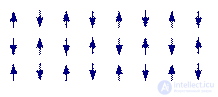
In an antiferromagnet, the magnetic moments of the substance are directed oppositely and are equal in magnitude.
Antiferromagnets are substances in which, below a certain temperature, an antiparallel orientation of the elementary magnetic moments of identical atoms or ions of the crystal lattice spontaneously arises. Antiferromagnets are characterized by a small positive magnetic susceptibility that depends strongly on temperature. On heating, an antiferromagnet undergoes a phase transition to the paramagnetic state. The temperature of this transition, at which the magnetic order disappears, is called the Néel point (or the antiferromagnetic Curie point).
Antiferromagnetism has been found in chromium, manganese, and a number of rare-earth elements (Ce, Nd, Sm, etc.). Typical antiferromagnets are the simplest chemical compounds based on transition-group metals, such as oxides, halides, sulfides, carbonates, and the like. About a thousand compounds with antiferromagnetic properties are known in total.
Ferrimagnets are materials in which the magnetic moments of atoms belonging to different sublattices are oriented antiparallel, as in antiferromagnets, but the moments of the different sublattices are not equal, so that the resultant moment is not zero. Ferrimagnets are characterized by spontaneous magnetization. The different sublattices in them consist of different atoms or ions — for example, these may be different iron ions, Fe2+ and Fe3+. Ferrimagnetic properties are found in some ordered metallic alloys, but mainly in various oxide compounds, among which ferrites are of the greatest practical interest.
Ferrimagnets have a domain structure consisting of two or more sublattices coupled antiferromagnetically (antiparallel). Since the sublattices are formed by atoms (ions) of different chemical elements, or by unequal numbers of them, they have magnetic moments of different magnitude directed antiparallel. As a result, a nonzero difference between the sublattice magnetic moments appears, leading to spontaneous magnetization of the crystal. Thus ferrimagnets can be regarded as uncompensated antiferromagnets (their atomic magnetic moments are not compensated). These materials got their name from ferrites — the first uncompensated antiferromagnets — and the magnetism of ferrites was called ferrimagnetism. In ferrites, as in ferromagnets, a domain structure forms at temperatures below the Curie point. All the magnetic characteristics introduced for ferromagnets are applicable to ferrites. Unlike ferromagnets, they have a high resistivity, a lower saturation induction, and a more complex temperature dependence of induction. Ferromagnetism in metals is explained by the presence of exchange interaction, which arises between adjacent atoms, together with the mutual orientation of the spin magnetic moments. In ferrimagnets the magnetic moments of the ions are oriented antiparallel, and the exchange interaction occurs not directly but through an oxygen ion O2-. Such exchange interaction is called indirect exchange or superexchange. It becomes stronger as the intermediate angle approaches 180° from 0°.
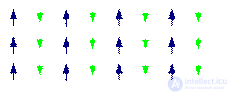
Ferrimagnetic ordering.
Ferrimagnets are substances whose magnetic properties are due to uncompensated antiferromagnetism. Like ferromagnets, they have a high magnetic susceptibility that depends substantially on the magnetic field strength and on temperature. At the same time, ferrimagnets are characterized by a number of significant differences from ferromagnetic materials.
Ferrimagnetic properties are found in some ordered metallic alloys, but mainly — in various oxide compounds, among which ferrites are of the greatest practical interest.
Dia-, para-, and antiferromagnets can be grouped together as weakly magnetic substances, whereas ferro- and ferrimagnets are strongly magnetic materials.
Metamagnetism
A METAMAGNET is an antiferromagnet in which the exchange interaction within atomic layers is much greater than that between layers. In weak magnetic fields it has the properties of an antiferromagnet, and in stronger fields (above 5–10 kOe) those of a ferromagnet. Metamagnets include the chlorides and bromides of the iron-group elements (FeBr2, CoCl2, etc.) and some compounds of rare-earth elements (GdN, TbAs, DySb, Eu3O4, etc.).
Speromagnetism
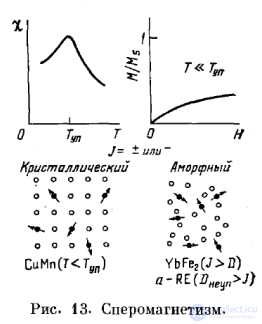
A substance possessing a magnetic state in which the localized magnetic moments of a given type have arbitrary orientations, and in which there is neither net magnetization nor any regular pattern of local ordering beyond the nearest neighbors, is called a speromagnet (the term comes from the Greek for "equally likely to be scattered in all directions"). In other words, if P(φ) is the probability that an arbitrary magnetic moment makes an angle φ with a fixed direction, then in a speromagnet the ratio P(φ)/sin(φ) is constant, since sin(φ) is proportional to the solid angle contained between φ and
φ + Δφ. It is important to distinguish this magnetic structure from the paramagnetic one, in which the directions of the magnetic moments fluctuate continuously and randomly in time. In a speromagnet, below a certain ordering temperature Tord, which may appear as a point of sharp transformation (Fig. 13), the directions of the magnetic moments "freeze" and no longer change with time. The resulting arrangement of magnetic moments is not unique but represents one of many nearly degenerate ground states possessed by the system; it is determined by the local equilibrium of exchange interactions at each site where a magnetic moment is located. (Not every magnetic moment is necessarily frozen, since the forces acting on it at a given site may turn out to be exactly compensated; hence so-called "free moments" can exist.)
Asperomagnetism
A magnetic state formed from localized magnetic moments of a given type, randomly placed in space, whose directions below a certain ordering temperature Tord are fixed such that there are preferred orientations, more probable than the others, is called asperomagnetic. In this state spontaneous magnetization exists. Asperomagnetism differs from speromagnetism in that the ratio P(φ)/sin(φ) depends on φ.
Since the direction of the magnetic moment changes from point to point in a not entirely random way, there is a probability of local ordering within limited regions or domains.
Asperomagnetism is fairly common in amorphous materials – alloys and compounds of 4f- and 3d-elements.
Sperimagnetism
The sperimagnetic structure resembles the ferrimagnetic structure to some extent. In it, too, the magnetic moments of the sublattices (in crystalline materials) or subsystems (in amorphous materials) are directed opposite to one another. The sperimagnetic structure contains ions of two (or more) magnetic substances, with the magnetic moments of at least one of them frozen in random orientations. The difference from a ferrimagnet is that in a sperimagnet the magnetic moments in one or both subsystems are oriented randomly within a certain spatial cone (Fig. 3, в). This situation arises in both crystalline and amorphous materials if ions of one kind possess a strong local single-ion anisotropy D, which is somewhat smaller than the exchange integral А between ions from different magnetic subsystems (for example, amorphous compounds Tb-Fe, Tb-Co).
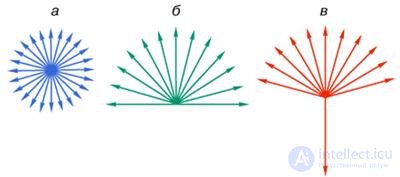
Fig. Speromagnetic (а), asperomagnetic (б), and sperimagnetic (в) structures.
Helimagnetism
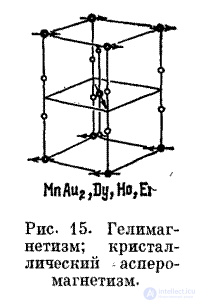
The magnetic state that arises in a system of magnetic moments localized at the sites of a crystal lattice below a certain temperature, and that possesses, for various orientations of the individual moments, a certain preferred direction (axis), is called helimagnetic. This state is nothing other than the crystalline form of asperomagnetism, and its genetic precursors are speromagnetism and asperomagnetism.
A typical example of a spiral, or helicoidal, structure is provided by MnAu2 (Fig. 15), in which the preferred orientation of the moments changes systematically from one atomic plane of the crystal to the next. Mn ions carry magnetic moments and form a body-centered tetragonal structure. Their magnetic moments are parallel within each plane normal to the c-axis, but their direction rotates through an angle of about 50° on going from plane to plane along the C-axis. More complex forms of helimagnetism occur in rare-earth metals, in which the directions of the magnetic moments rotate as one moves along the C-axis over the surface of a cone rather than in a plane.
Crystalline asperomagnets of another class include two (or more) antiferromagnetic sublattices whose magnetic moments are tilted relative to one another by a certain angle and are therefore not entirely collinear, i.e., they produce a net magnetization.
Spin glass
Spin glasses — are dilute magnetic alloys (for example, CuMn, AgMn, or AuFe), that is, nonmagnetic materials with an admixture of magnetic impurities at a relative concentration of magnetic ions from 10−3 to 10−1. A long-range RKKY exchange interaction exists between the magnetic ions via the conduction electrons.
A crystalline alloy containing magnetic ions of a given kind embedded in a nonmagnetic matrix, when cooled below a critical temperature Тfr, can order speromagnetically. This process is called "freezing of the spin glass." The randomness in the orientation of the magnetic moments resembles the randomness in the arrangement of the constituents of ordinary glass; hence the name spin glass.
But above the spin-glass freezing temperature Tsg, in the paramagnetic state, the moments become free and can undergo random fluctuations (Fig. 16).
The spin-glass state in crystalline alloys exists only within a limited range of concentrations of the dissolved magnetic substance. The concentration must be high enough for a correlation to arise between the ions via the RKKY interaction, and at the same time low enough to avoid the formation of clusters or chains of directly connected magnetic moments extending throughout the entire sample.
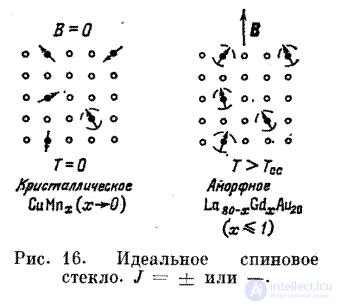
Spin glasses are considered as a state of a magnetic system with a random distribution of spin-spin interactions. There is no long-range order in the system, and the disorder in the system is frozen, that is, it does not change with time. The exchange interaction energy oscillates, changing sign, depending on the distance between atoms, so ferromagnetic and antiferromagnetic interactions compete in spin glasses, distributed in a random (but time-invariant) manner owing to the random arrangement of the magnetic atoms.
Spin glasses differ from other magnets in a number of properties:
Mictomagnetism
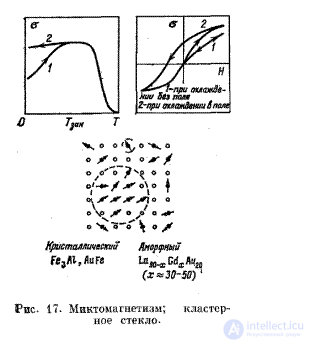
A mictomagnet is generally similar to an ideal spin glass, except that local correlations between magnetic ions (pairwise, triple, etc.) dominate in it owing to an increased concentration of magnetic impurities. For certain materials it is characteristic that small groups of ions bond with one another through direct exchange interaction and coexist as separate entities embedded in the spin-glass matrix (Fig. 17). The moments of the clusters interact with one another indirectly via the RKKY interaction and freeze cooperatively below a certain temperature Tfr as in a speromagnet.
Freezing of the moments in a mictomagnet is caused by thermal blocking of the superparamagnetic moments of the clusters. Since a whole range of cluster sizes is usually observed in a mictomagnet, one can expect that there is likewise a corresponding range of temperatures at which the blocking of magnetic moments occurs. This makes the freezing process less sharply defined than that which occurs in a system with clusters of a single size. Another characteristic feature of mictomagnetism — is the dependence of the magnetization σ on the magnetic history of the sample (see Fig. 17). Cooling the sample below Тfr in comparatively weak fields (~1 T) creates a preferred direction in the configuration of the frozen cluster moments. Such an asperomagnetic state (2 in Fig. 17) has a characteristic shifted hysteresis loop and an increased value of σ below Тfr, corresponding to the "frozen-in" effective field of the partially ordered moments.
Short-range order — ordering in the mutual arrangement of atoms or molecules in a substance which (unlike long-range order) repeats only over distances comparable to the distances between atoms, that is, short-range order is the presence of regularity in the arrangement of neighboring atoms or molecules.
Short-range order in the arrangement of atoms or molecules is possessed, alongside crystals, also by amorphous bodies and liquids.
Long-range order — ordering in the mutual arrangement of atoms or molecules in a substance (in the liquid or solid state) which (unlike short-range order) repeats over unboundedly large distances.
Long-range order in the arrangement of atoms or molecules is possessed, for example, by crystals.
Néel point — the antiferromagnetic Curie point, the temperature TN, above which an antiferromagnet loses its specific magnetic properties and becomes a paramagnet (a second-order phase transition). Near TN, anomalies of the nonmagnetic properties of antiferromagnets (heat capacity, coefficient of thermal expansion, temperature coefficient of electrical conductivity, etc.) reach their maximum value. Named after Louis Néel.
Curie point, or Curie temperature, — the temperature of a second-order phase transition associated with an abrupt change in the symmetry properties of a substance (for example, magnetic — in ferromagnets, electric — in ferroelectrics, crystal-chemical — in ordered alloys). Named after P. Curie. At a temperature T below the Curie point Q, ferromagnets possess spontaneous magnetization and a definite magnetocrystalline symmetry. At the Curie point (T = Q), the intensity of the thermal motion of the atoms of the ferromagnet becomes sufficient to destroy its spontaneous magnetization ("magnetic order") and change its symmetry, as a result of which the ferromagnet becomes a paramagnet. Similarly, in antiferromagnets at T = Q (at the so-called antiferromagnetic Curie point or Néel point), the magnetic structure characteristic of them (the magnetic sublattices) is destroyed, and antiferromagnets become paramagnets. In ferroelectrics and antiferroelectrics at T = Q, the thermal motion of the atoms reduces to zero the spontaneous ordered orientation of the electric dipoles of the unit cells of the crystal lattice. In ordered alloys, at the Curie point (in the case of alloys it is also called the Kurnakov point), the degree of long-range order in the arrangement of the atoms (ions) of the alloy's components becomes zero.
Thus, in all cases of second-order phase transitions (of the Curie-point type) at T = Q, some form of atomic "order" disappears in the substance (the ordered orientation of magnetic or electric moments, long-range order in the distribution of atoms over the sites of the crystal lattice in alloys, etc.). Near the Curie point, specific changes occur in the substance in many physical properties (for example, heat capacity, magnetic susceptibility, etc.), reaching a maximum at T = Q, which is usually used for the precise determination of the phase-transition temperature.

Comments