
Lecture
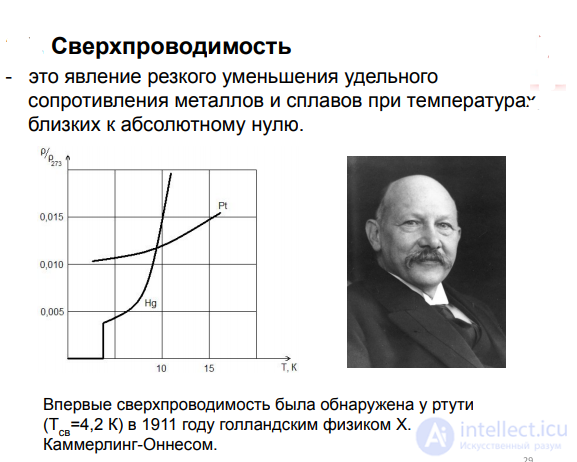
The phenomenon of superconductivity at cryogenic temperatures is fairly widespread in nature. 26 metals exhibit superconductivity. Most of them are superconductors with critical transition temperatures into the superconducting state below 4.2 K. This is one of the reasons why most superconducting metals cannot be used for electrical engineering purposes. A further 13 elements exhibit superconducting properties at high pressures. These include such semiconductors as silicon, germanium, selenium, tellurium, antimony, and others.
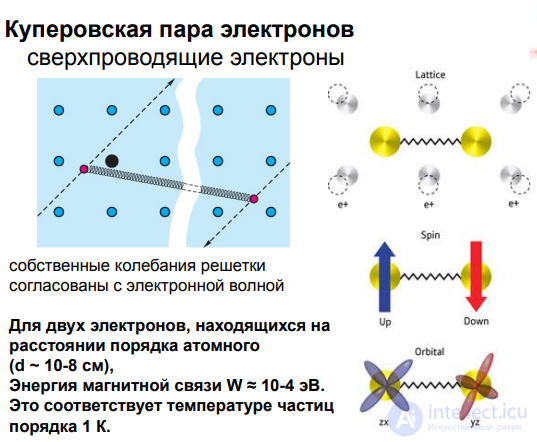
The phenomenon of superconductivity arises in cases where the conduction electrons (located near the Fermi level) are attracted to one another. Attraction between electrons is possible only in a medium containing positively charged ions, whose field weakens the repulsive forces between the electrons. Electrons attracted to one another form pairs called Cooper pairs. The formation of Cooper pairs is illustrated in fig. 2.6. An electron flying between the positive ions of the lattice attracts the nearest ions to itself by electrostatic forces. In the vicinity of the electron's trajectory, the density of positive charge locally increases. A second electron, moving behind the first, is attracted by this positive charge of increased density. As a result, owing to interaction with the lattice, an attraction arises between electrons 1 and 2 – a Cooper pair is formed.
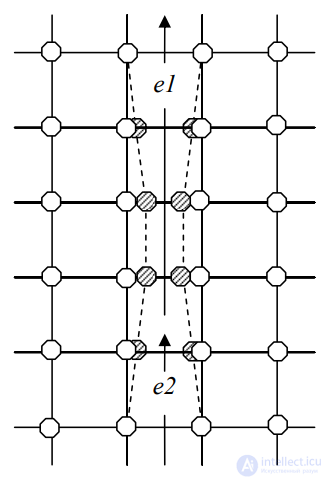
Fig. 2.6. Diagram of the formation of electron pairs in a superconductor
Since the attractive forces are small, these paired formations constantly break apart and re-form.
It should be noted that superconductivity is not exhibited by the metals that are the best conductors under normal conditions. These include gold, copper, and silver. The low resistance of these materials indicates weak interaction between electrons and the lattice. Such weak interaction does not create, near absolute zero, sufficient inter-electron attraction capable of overcoming Coulomb repulsion. Therefore their transition into the superconducting state does not occur.
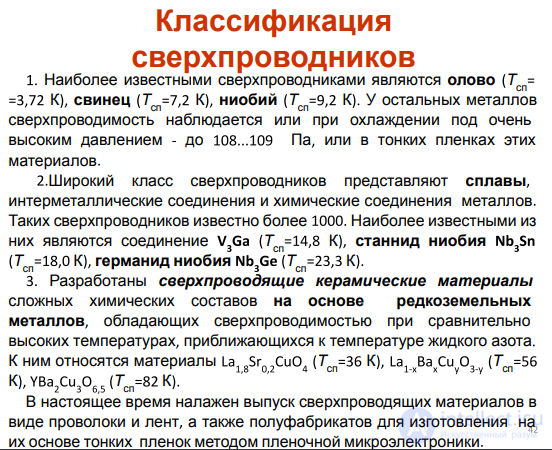
Besides pure metals, superconductivity is exhibited by many intermetallic compounds and alloys. The total number of superconductors known at present is about 2000.
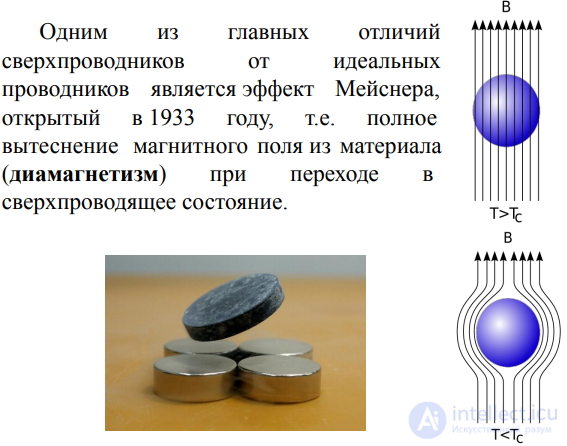
Magnetic properties of superconductors. The most important feature of superconductors is that an external magnetic field does not penetrate into the bulk of the sample at all, decaying within an extremely thin layer. The lines of force of the magnetic field bend around the superconductor. This phenomenon, known as the Meissner effect, is due to the fact that when a superconductor is placed in a magnetic field, a circular non-decaying current arises in its surface layer, which completely compensates the external field within the bulk of the sample. The depth to which the magnetic field penetrates is typically 10–7 … 10– 8 m. Thus, in terms of their magnetic properties, superconductors are ideal diamagnets with magnetic permeability µ = 0. Like all diamagnets, superconductors are expelled from a magnetic field. This expulsion effect is so strong that a load can be suspended in space by means of a magnetic field.
The state of superconductivity can be destroyed if the magnetic field strength exceeds a certain critical value.
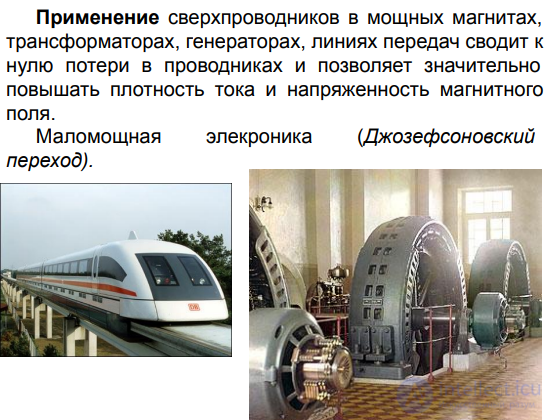
Applications of superconductors. One of the main applications of superconductors is related to obtaining ultra-strong magnetic fields.
There are broad prospects for the use of superconductors in measurement technology. Superconducting elements make it possible to register very subtle physical effects, to measure with high precision, and to process large amounts of information.
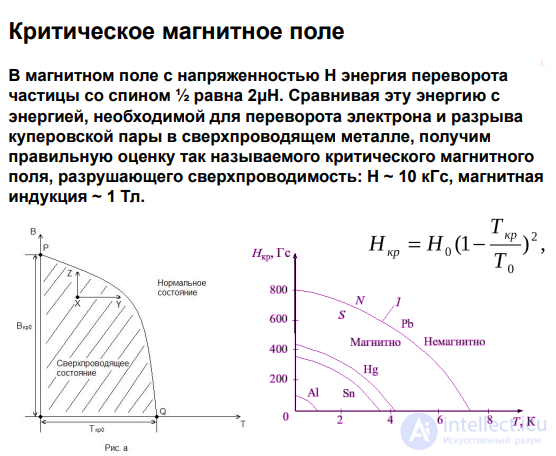
Critical magnetic field
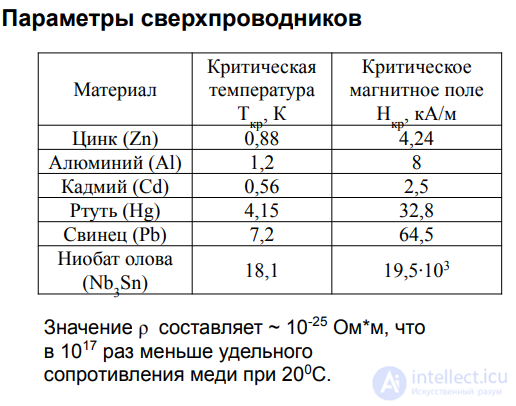
Parameters of superconductors
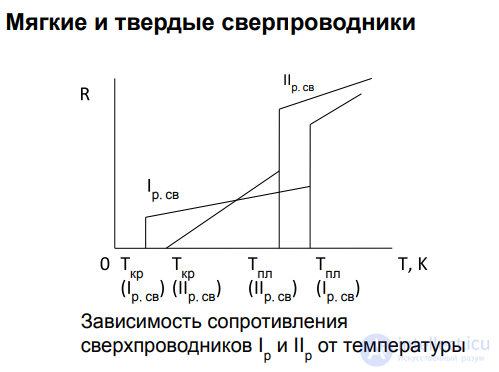
Fig. soft and hard superconductors
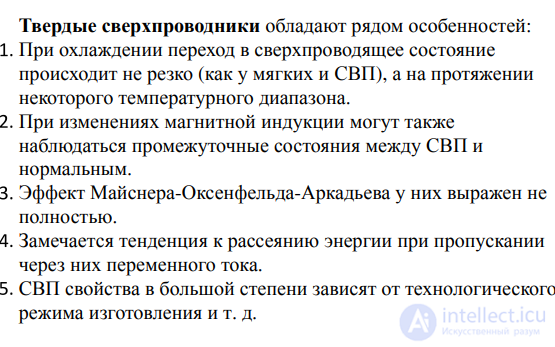
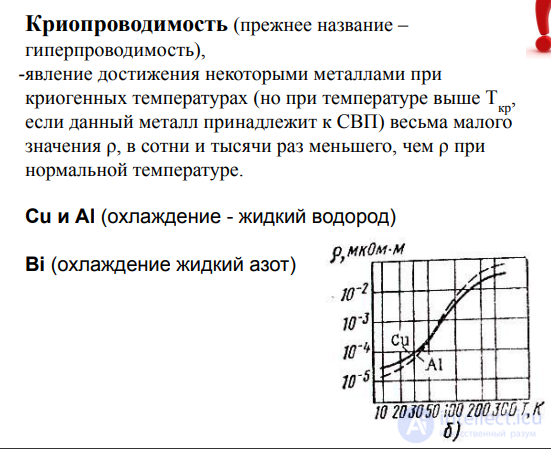
Cryoconductivity

Comments