
Lecture
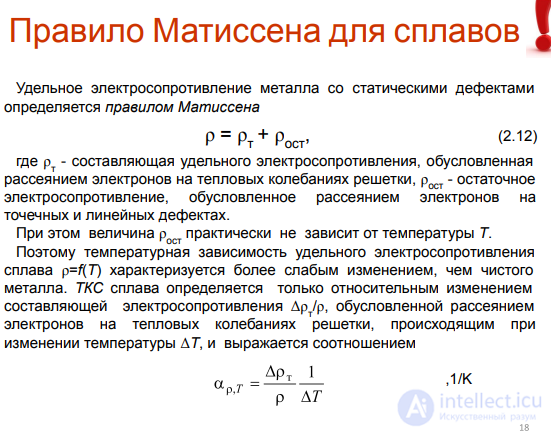
The causes of electron-wave scattering in a metal include not only thermal vibrations of the lattice sites but also static defects of the crystal structure, which likewise disrupt the periodicity of the crystal's potential field. Scattering by static defects does not depend on temperature. Therefore, at low temperatures the resistance of metals tends toward a constant value called the residual resistance. Matthiessen's rule states that the total resistance of a metal is the sum of the resistance due to electron scattering by thermal lattice vibrations and the residual resistance due to scattering by static structural defects:
ρ = ρт + ρост .
The exception is superconducting metals, in which the resistance tends to zero once a certain low temperature is reached.
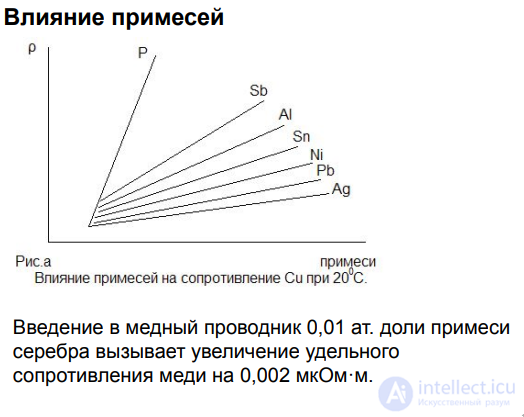
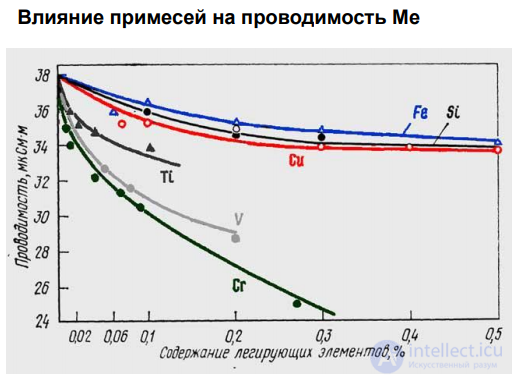
The most significant contribution to the residual resistance comes from scattering by impurities, which are always present in conductors either as contamination or as alloying elements. Any impurity increases the resistivity, even if it has a higher conductivity than the base metal. For example, introducing 0.01 atomic fraction of silver impurity into a copper conductor causes the resistivity of copper to increase by 0.002 µΩ·m. Experiment shows that at low impurity content the resistivity increases in proportion to the concentration of impurity atoms. This is related to the limitation of the electron's mean free path. In a real conductor this quantity is given by the expression:

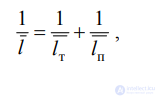
 where
where  and
and  – are the average values of the mean free path for scattering by thermal lattice vibrations and by impurities.
 Treating the impurity atom as a sphere with scattering cross-section Sп , for the mean free path lп
we can write:
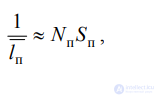
where Nп – is the number of impurity atoms per unit volume.
Different impurities affect the residual resistance of metallic conductors to different extents. The effectiveness of impurity scattering is determined by the perturbing potential in the lattice, the value of which is higher the more the valences of the impurity atoms and the base metal differ.
In addition to impurities, some contribution to the residual resistance comes from intrinsic structural defects – vacancies, interstitial atoms, dislocations, and grain boundaries. The concentration of point defects increases exponentially with temperature and can reach high values near the melting point. Furthermore, vacancies and interstitial atoms are readily produced in a material upon irradiation with high-energy particles. From the measured resistance value one can judge the degree of radiation damage to the lattice. In the same way, one can also track the recovery (annealing) of an irradiated sample.
The resistivity of metals and alloys is strongly affected by distortions caused by a stressed state. The degree of this influence is determined by the nature of the stresses. For example, under all-around compression the resistivity of most metals decreases. This is explained by the atoms being drawn closer together and by a reduction in the amplitude of the lattice's thermal vibrations.
Under elastic tension and torsion, the interatomic distances increase. This is accompanied by enhanced electron scattering and an increase in ρ. The effect of elastic tension or compression, provided the current flows along the direction of the applied force, is described by the formula:
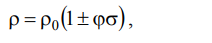
where  – is the pressure coefficient of resistivity; σ – is the mechanical stress in the cross-section of the sample.
The plus sign in the expression corresponds to deformation under tension, and the minus sign – to compression. Typically the coefficient  = (1−5)10−11Pa−1.
Plastic deformation and work hardening always increase the resistivity of metals and alloys. However, this increase, even under significant work hardening of pure metals, amounts to only a few percent.
Thermal quenching leads to an increase in ρ, which is associated with lattice distortions and the appearance of internal stresses. Upon recrystallization annealing, the resistivity can be reduced to its original value as a result of the elimination of defects and the relief of stresses.

Comments