
Lecture
Corrosion-resistant steels and alloys (stainless steels). About 33% of metal structures fail because of corrosion damage. Therefore, protection against corrosion and the creation of corrosion-resistant steels and alloys is an important task.
Two types of corrosion are distinguished: electrochemical and gaseous.
Electrochemical corrosion involves the formation of a galvanic couple, so this type of corrosion develops in liquid media – electrolytes: humid atmosphere and soil; sea and river water; aqueous solutions of salts, alkalis, and acids.
To compare the electrochemical resistance of metals, the standard electrode potential is used
(V0, V):
Ion … Al3+ Zn2+ Fe2+ Sn2+ H+ Cu+ Ag+ Pt2+ Au+
V0, V … –1.63 –0.76 –0.44 –0.14 0 +0.52 +0.8 +1.19 +1.68
The more negative the electrode potential, the lower the resistance of the metal to electrochemical corrosion. Thus, tin is more corrosion-resistant than iron.
However, this rule does not always hold. The properties of the corrosion products are of great importance. Aluminum is an example. On its surface, in oxidizing media, a very dense, inert Al2O3 oxide film forms, which is impermeable to the electrolytic medium. Therefore, despite its negative electrode potential, aluminum does not corrode in many oxidizing environments. However, in an alkaline medium the oxide film dissolves actively and the aluminum is quickly destroyed.
Chemical corrosion develops in dry gases and liquid dielectric media. Most often these are oxygen-containing gases: dry air, carbon dioxide, dry steam, pure oxygen.
In chemical corrosion the metal surface oxidizes; the higher the temperature, the more actively chemical corrosion proceeds. Resistance to gaseous corrosion (heat resistance) is determined mainly by the affinity of the metal for oxygen and the density of the oxide film. The oxides of metals such as Cr, Al, and Si have the highest density, so they protect the metal well against gaseous corrosion (see «heat resistance»).
Stainless steels. If iron (or low-carbon steel) is alloyed with chromium in an amount of >12.5%, the iron, and the steel, become passive; the corrosion current and corrosion rate drop sharply. In other words, steel containing >12.5% Cr becomes stainless. Chromium steels are resistant at temperatures ≤30°C in humid air, tap and river water, and in nitric and many organic acids; in seawater these steels have relatively low corrosion resistance, and many of them are prone to stress-corrosion cracking.
As the chromium content increases above 17%, the corrosion resistance of the steel increases, but the steel acquires a single-phase ferritic structure and loses the ability to be strengthened by heat treatment. Steels containing 13% Cr undergo an austenite ↔ ferrite (γ ↔ α) transformation on heating and cooling and can therefore be heat treated. The strength (hardness) after quenching and tempering is higher the more carbon the steel contains. The most common chromium steels are grades 12Kh13 (ferritic-martensitic class), 20Kh13, 30Kh13, 40Kh13 (martensitic class).
Steels 12Kh13 and 20Kh13 are the most ductile; they can undergo cold pressure working and weld well.
Steels 30Kh13 and 40Kh13 are less ductile and can only undergo hot pressure working. Cracks form in the weld zone when these parts are welded.
Steels 12Kh13 and 20Kh13 are used in products made by stamping and welding: hydroturbine blades, vessels, apparatus, household appliances. Heat treatment of these steels consists of quenching from 1,000…1,050°C in oil (ferrite + martensite structure) with subsequent tempering at 700°C (ferrite + chromium carbide structure).
Steel 30Kh13 is used for machine and instrument parts (gears, shafts, springs) that operate in aggressive environments under high cyclic loads. Heat treatment of steel 30Kh13: oil quenching from 1,050°C to martensite (~55 HRC) + high tempering at ~700…750°C to a sorbite structure (~30 HRC).
Steel 40Kh13 corresponds in structure and properties to tool steels. It is most often used for surgical and household cutting instruments, and for ball bearings operating in aggressive environments. Steel 40Kh13 is quenched from 1,050°C in oil to a martensite structure (~60 HRC) followed by tempering at 200°C (tempered martensite).
Adding a certain amount (9…10%) of nickel to an 18% chromium steel converts it to the austenitic state. Chromium-nickel austenitic steel has better mechanical and technological properties, has higher corrosion resistance, and does not lose toughness at deep-cold temperatures. After slow cooling from 1,000…1,100°C, the steel has a multiphase A + F + K structure; such a structure does not provide high corrosion resistance and ductility. These properties improve significantly if the steel is rapidly cooled (in water) from the single-phase austenitic region (~1,050…1,100°). Rapid cooling fixes the austenitic state at room temperature. In the single-phase state, virtually all the chromium is in solid solution (in the austenite) and provides the steel with maximum corrosion resistance in oxidizing media. In the austenitic state, chromium-nickel stainless steels have high ductility, although they have relatively low strength characteristics (σv = 500…600 MPa, δ = 35…45%), which allows them to undergo cold plastic deformation; these steels weld well.
Chromium-nickel steels containing >0.08% C are susceptible to intergranular corrosion (IGC). The tendency toward IGC appears only after heating above 500°C. This phenomenon is related to the fact that on heating above 500°C, chromium carbides (Cr23C6) precipitate from the austenite in the grain-boundary zone, and this zone becomes so depleted in chromium that it loses corrosion resistance (the chromium remaining in solution drops below <12.5% Cr). In this state, the steel will corrode along the austenite grain boundaries in an aggressive environment. Ductility and strength decrease sharply as a result of intergranular corrosion, and under slight force the steel readily fractures and can be reduced to powder. There are several ways to prevent IGC:
a) reduce the carbon content to values <0.05%;
b) alloy the steel with titanium (~1% Ti); titanium bonds with carbon more readily than chromium does, so chromium carbides do not form;
c) if chromium carbides have already precipitated, the steel can be heated to 1,000…1,050°C. The chromium carbides dissolve in the austenite. Subsequent rapid cooling (in water) fixes the single-phase (austenitic) state, and the tendency toward IGC is suppressed.
Among the steels of this class, the most widely used are grades 04Kh18N10, 08Kh18N10, and 10Kh17N13M3T. They are used to make vessels, pipelines, chemical equipment, and are used in aircraft, machine, instrument, and shipbuilding, etc.
As acid-resistant steels, austenitic steels additionally alloyed with molybdenum and copper with an increased nickel content are used (06Kh23N28M3D3T). These steels have corrosion resistance in media such as phosphoric acid, including hot phosphoric acid, dilute hydrochloric acid (up to 5%) at room temperature, sulfuric acid at room temperature, etc.
Nickel-based alloys have even higher acid resistance, for example the so-called Hastelloy type, 80% Ni + 20% Mo, with additional alloying by cobalt and other elements.
The highest corrosion resistance in acids is possessed by refractory metals such as molybdenum, niobium, and tantalum.
Alloys with special thermal and elastic properties. Instruments often require alloys with a coefficient of linear expansion equal to that of glass, or with a coefficient equal to zero, or with a very large coefficient, and so on. These alloys, along with magnetic and electrical engineering alloys, are called precision alloys. Iron-nickel alloys are mainly used as materials with a specified coefficient of thermal expansion; their coefficient of thermal expansion (α) varies with composition in a complex way. Thus, an alloy with 25% Ni has an α almost twice that of iron (α = 20⋅10–6 versus 11.6⋅10–6 for iron), while an alloy with 36% Ni has a coefficient of linear expansion eight times smaller (α ≈ 1.5⋅10–6).
The alloy containing 36% Ni is called Invar (grade 36N); it can be considered practically non-expanding in the temperature range from –80 to +100°C.
The alloy with 42% Ni has a constant coefficient of thermal expansion (α = 7.5⋅10–6) in the temperature range from 20 to 200°C.
There are alloys whose coefficient α matches the coefficient of linear expansion of various materials, for example glass or platinum.
Alloys with a constant modulus of elasticity. For a number of precision-instrument parts (springs, tuning forks, etc.) a metal with elastic moduli (E, G) that do not change with temperature is required. In this case, Elinvar alloys (invariable elasticity) are used, which contain roughly 36% Ni, 8% Cr, with Fe making up the balance. As an example, alloy N35KhMV can be cited, containing ~1.2% C, ~9% Cr, ~35% Ni, 3% W, 2% Mo, with Fe making up the balance. The temperature coefficient of the normal elastic modulus of this alloy is so small that it provides a clock temperature error of ~0.5 s per day per 1°C.
Low-melting alloys. These typically include multicomponent alloys of eutectic or near-eutectic composition with a melting point below 230°C. Among the well-known alloys, Wood's alloy L68 can be noted (12.5% Sn, 25% Pb, 12.5% Cd, and 50% Bi), which has a melting point of 68°C
Steel is an alloy of iron with carbon in which the carbon mass fraction is 2.14% (theoretically). In practice, the carbon concentration does not exceed 1.5%. In addition to carbon, steel contains permanent impurities: silicon, manganese, sulfur, phosphorus, and other chemical elements. Steel production consists of the secondary processing of merchant white pig iron by various methods: open-hearth, converter, electric-melting, and others. The essence of steel production is the removal of carbon and other chemical elements during the melting of a charge consisting of liquid or pig iron, steel scrap, iron ore, and limestone. Melting is carried out in various steelmaking units: open-hearth furnaces, converters, electric-arc, electric-induction, and other metallurgical units.
Along with cast irons, steel is also a primary structural material in mechanical engineering and other branches of industrial production.
Under ordinary conditions, plain carbon steels are used; at high temperature and in an aggressive environment — special alloy steels (for example, for making pumps for pumping acids, mechanisms operating in seawater, etc.).
Accordingly, our country's ferrous metallurgy industry produces steels with a wide range of physicochemical and mechanical properties. All branches of industry receive steels of various grades, sizes, and names from metallurgists. Remembering this variety of steels supplied by metallurgists is practically impossible, so the science of metals — metallurgy (materials science) — classifies all steels produced according to various criteria. Every qualified worker must not only remember individual steel grades but also know the principles for classifying these steels (Fig. 1).
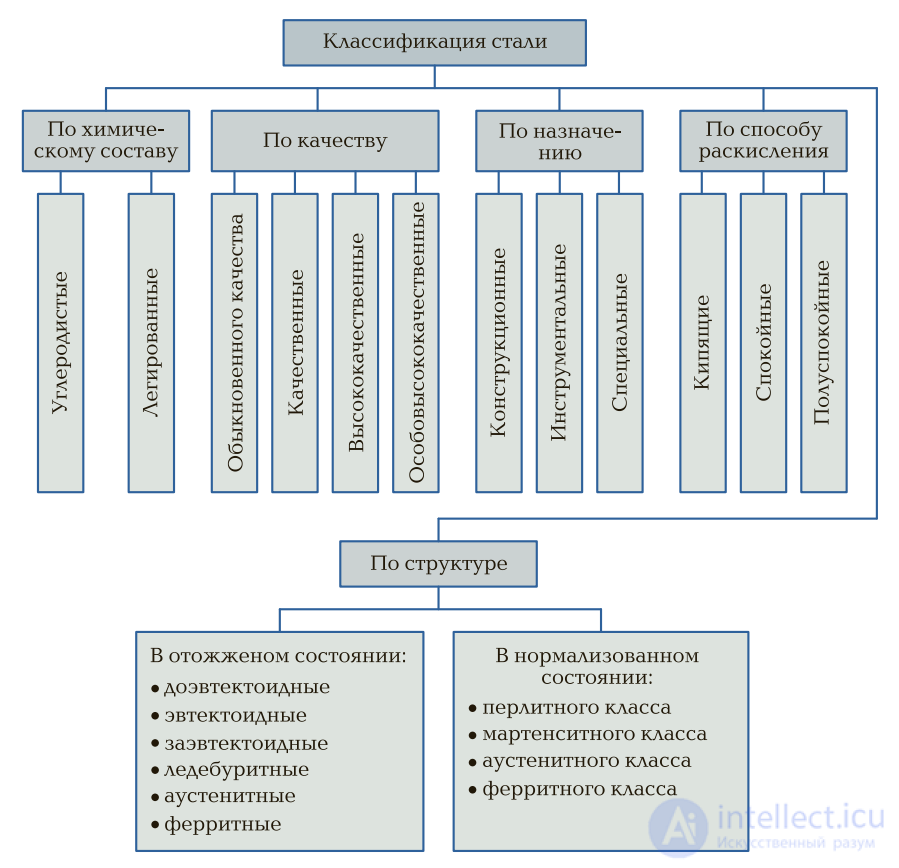
Fig. 1. Classification of steels
By chemical composition, steels and alloys are divided into two large groups: carbon and alloy steels.
Carbon steels contain iron, carbon, and the permanent impurities inherent to iron-carbon alloys. No other chemical elements are present in carbon steels. Carbon steels are divided by carbon mass fraction into low-carbon (up to 0.3% carbon), medium-carbon (0.3…0.6% carbon), and high-carbon (more than 0.6% carbon) steels. Alloy steels, besides carbon, contain various chemical elements, both metals and non-metals. These elements are introduced during melting to obtain higher physicochemical and mechanical properties than in carbon steels.
To alloy means to fuse together, to combine, so the chemical elements introduced into steel are called alloying elements, and steels fused with them are called alloy steels.
The quality of steels depends on the characteristics of the metallurgical processes, the raw materials processed, the type of melting, and other factors. These factors determine the chemical composition of the steels, the presence of harmful impurities in them — sulfur and phosphorus — as well as the presence of various gases: nitrogen, hydrogen, and oxygen. Harmful impurities and the gases present in them give steels adverse physicochemical and mechanical-technological properties, i.e., they degrade their quality. Accordingly, by quality, both carbon and alloy steels are divided into four groups: ordinary-quality steels, high-quality steels, premium-quality steels, and superior-quality steels.
Steels of ordinary quality contain 0.045…0.060% sulfur, 0.04…0.07% phosphorus.
High-quality steels are made with a sulfur mass fraction of no more than 0.04% and phosphorus of 0.035…0.040%. High-quality steels can be either carbon or alloy steels.
Premium-quality carbon and alloy steels contain no more than 0.02% sulfur and 0.03% phosphorus.
Superior-quality steels have a sulfur mass fraction of no more than 0.015% and phosphorus of no more than 0.025%. Superior-quality alloy steels are obtained by electroslag or vacuum-arc remelting.
By application, carbon and alloy steels and alloys are divided into structural, tool, and special steels.
Structural steels, both carbon and alloy, are used to make various machine parts, welded building structures, etc. Specific requirements are placed on these steels regarding chemical composition and mechanical, technological, service, and chemical properties. These may be carburized, heat-improved, or high-strength steels. Some of these steels undergo chemical-thermal treatment, others only heat treatment. By technological characteristics, structural steels are divided into stampable, weldable, castable, and free-machining (automatic) steels. By application, these steels can be spring steels, ball-bearing steels, magnetic, electrical, structural, and others.
By chemical properties, structural steels are divided into corrosion-resistant, acid-resistant, scale-resistant, and others. Depending on chemical resistance, these groups of steels are produced as structural and special-purpose steels.
Structural carbon steels include ordinary-quality steels (grades St0, St1, etc.), as well as high-quality steels (grades 05, 10, 15, etc.). Alloy structural steels include a large group of low- and medium-alloy steels subjected to chemical-thermal and heat treatment (for example, 20Kh, 15G, 15KhF, 40Kh, 45KhN, and others).
Tool carbon and alloy steels are used to make cutting, measuring, and impact tools, and dies for hot and cold forming. High requirements are placed on tool carbon and alloy steels for hardenability, red hardness (hot hardness), and durability (time in service between sharpenings), among others.
Special alloy steels and alloys are, as a rule, structural materials with special properties. These include corrosion-resistant, heat-resistant, magnetic, electrical, high-electrical-resistance, and heat-resistant steels, among others. This group consists of highly alloyed steels and alloys with an alloying-element mass fraction above 10%. Chromium, nickel, manganese, and others are used for alloying. The choice of alloying elements is determined by the required properties. For example, corrosion-resistant steels must have a chromium mass fraction of at least 13%, heat-resistant steels — depending on the required temperature — 9…17% chromium, 2% silicon. Certain grades also contain nickel or titanium (for example, 40Kh9S2, 06Kh17G, and others).
Steels are divided into three categories according to the deoxidation method: rimmed, killed, and semi-killed.
Deoxidation is the process of removing iron oxide (FeO) from liquid steel; FeO forms during melting and gives the steel an active tendency toward corrosion. In addition, deoxidation removes nitrogen and hydrogen from the liquid steel. Deoxidation is carried out by adding silicon, manganese, or aluminum before the steel is tapped into the ladle, depending on the required degree of deoxidation.
It has been established in practice that when steel contains oxygen that has reacted with iron (FeO), high brittleness develops during hot deformation. In addition, iron oxide lowers the strength at subzero temperatures and creates a strong tendency toward intergranular corrosion.
Rimmed steels are deoxidized with manganese. As the steel cools in the ingot molds, gases are released, creating the false impression that the steel is boiling as it solidifies. Rimmed steels are produced both as ordinary-quality and as high-quality steels. As a rule, these steels are low-carbon.
Killed steels are deoxidized with aluminum, manganese, and silicon. In these steels the oxygen reacts almost completely with the deoxidizers, floats to the top, and is removed with the slag. On cooling they solidify quietly, without gas evolution. All alloyed high-quality steels and carbon high-quality steels are produced as killed steels.
Semi-killed steels occupy an intermediate position between rimmed and killed steels. They are deoxidized with manganese and aluminum. Semi-killed steels are produced only as carbon steels.
The structure of steel is strongly influenced by the mass fraction of carbon, the alloying elements, and the delivery condition. Accordingly, by structure, steels are classified in the annealed (equilibrium) and normalized conditions.
In the annealed condition the structure of steels is divided into six classes:
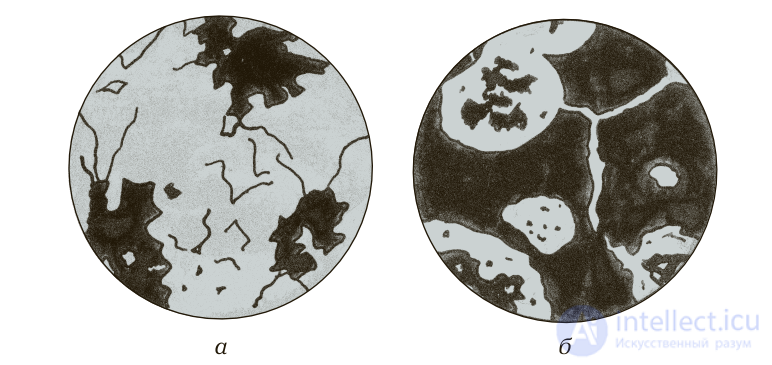
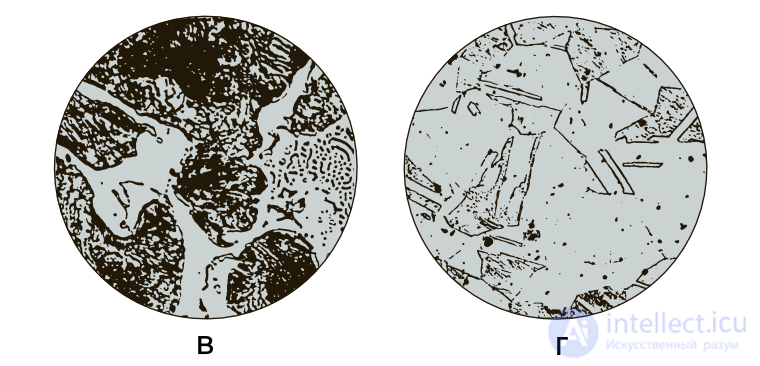
Fig. 2. Microstructure of carbon and alloy steels in the annealed condition: a — ferritic; b — ferritic-pearlitic; c — alloyed ledeburitic steel; d — alloyed austenitic steel
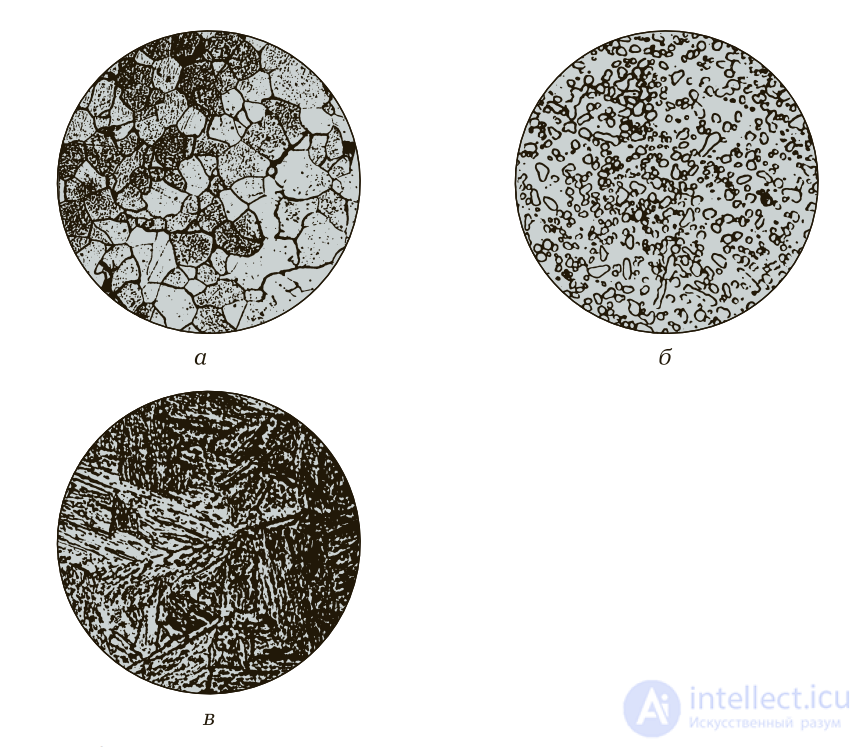
Fig. 3. Microstructure of carbon and alloy steels in the normalized condition: a — ferritic-class steel; b — pearlitic-class steel; c — martensitic-class steel
Carbon steels have the structure of the first three classes, while alloy steels can have all six classes. Ledeburitic, austenitic, and ferritic structural classes form when nickel, vanadium, tungsten, and other alloying elements are introduced into the composition. Under certain combinations, intermediate structural classes may form, for example semi-ferritic, semi-austenitic, and others.
In the normalized condition steels have four structural classes: ferritic, pearlitic, martensitic (Fig. 3), and austenitic.
The structure of ferritic-class steel is unstable. Depending on the cooling rate in air, this steel can acquire a structure of pearlite, troostite, or sorbite. All carbon and low-alloy steels belong to the ferritic class.
Low-carbon steels with a carbon mass fraction of up to 0.15%, alloyed with chromium (12…15%), form a stable ferrite structure. This class of steel does not change its structure on heating and cooling.
Martensitic-class steels have high stability and form a hard, fine-dispersed structure on cooling. Medium- and highly alloyed steels belong to this class.
Austenitic-class steels form at a high mass fraction of nickel and manganese combined with chromium. Steels of this class have high impact toughness.
Ordinary-quality carbon structural steel (general-purpose steel). Ordinary-quality (general-purpose) carbon steel to GOST 380—2005 is produced as various hot-rolled products (St0, St1kp, St1ps, St2kp, St3sp, St3Gsp, St4kp, St5Gsp, St6ps, and others).
The letters St in the steel designation denote ordinary-quality steel; the letter G denotes an increased manganese content. The letters kp (rimmed steel), ps (semi-killed steel), and sp (killed steel) denote the deoxidation method. The numbers following the letters St denote the conventional grade number, depending on the mass fraction of chemical elements and the mechanical properties of the steel. The higher the number, the more carbon and other chemical elements the steel contains, and the higher its mechanical properties. In ordinary grades the mass fraction of the main alloying chemical element (carbon) is 0.06…0.49%, and manganese 0.25…0.65%. At an increased manganese content (0.8…1.1%) the alloy contains 0.1…0.3% silicon and 0.05…0.06% each of sulfur and phosphorus. In addition to these chemical elements, ordinary-quality carbon steels contain chromium, nickel, and copper within 0.3…0.4%, and certain grades smelted from Kerch ores contain 0.08% magnesium. These are incidental impurities and are not indicated in the designation.
Ordinary-quality carbon structural steels have a strength of σv = 310…600 MPa (31…60 kgf/mm2); hardness in the as-delivered condition of 103…158 HB; elongation δ = 15…35%.
These steels weld, forge, stamp, and machine well. They are not subjected to quenching. The mechanical properties of machine parts made from these steels are improved by carburizing, after which quenching with subsequent tempering is carried out. The heating temperature for quenching carburized parts is selected depending on the diffusion of carbon.
Steel grades St1kp, St1ps, St1sp, St2kp, St2Gps, St2sp, St3ps, St3sp, St3Gps, and St3Gsp are supplied with a guarantee of weldability. In this case the letters "sv" are indicated after the grade in the technical documentation.
Ordinary-quality carbon structural steel is used to make welded building structures, fasteners, lightly loaded machine parts, as well as standard and normalized parts: handles, knobs, grips, plugs, caps, hinge pins, etc. (Table 1).
High-quality carbon structural steel. High-quality carbon structural steel is produced as various hot-rolled and cold-drawn (calibrated) sectional products (GOST 1050—88*) of the following grades: 05kp, 08kp, 08ps, 10ps, 15kp, 15ps, 15, 18kp, 20kp, 20ps, 20, 25, 30, 35, 40, 45, 50, 55, and 60. Steel of this group is also produced as rolled products with a special surface finish (silvering) with a diameter (or thickness) of up to 250 mm.
The numbers in the designation of high-quality carbon structural steel indicate the average mass fraction of carbon in hundredths of a percent. For example, grade 05kp steel contains no more than 0.06% carbon, grade 10 contains 0.07…0.14%, and grade 50 contains 0.47…0.55%. The letters kp and ps denote the deoxidation method (kp — rimmed, ps — semi-killed). In grades where the deoxidation method is not indicated, the steel is killed. Grade 58 (55p) steel has reduced hardenability and a manganese mass fraction of 0.1…0.3%.
High-quality carbon steel contains 0.05…0.65% carbon, up to 0.37% silicon, and 0.25…0.50% manganese (low-carbon steel group) or 0.5…0.8% manganese (medium-carbon steel group). Sulfur in all high-quality steels does not exceed 0.04%, and phosphorus does not exceed 0.035%. In addition, steels of this group contain copper and nickel, the mass fraction of which must not exceed 0.25% for each element.
| Table 1. Applications of ordinary-quality (general-purpose) carbon structural steel | ||
| Steel grade | Application | |
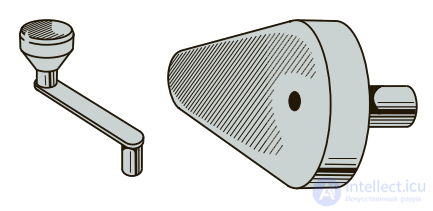
| St0
St1 |
Thin-sheet steel;
roofing steel; protective enclosures etc. |
 |
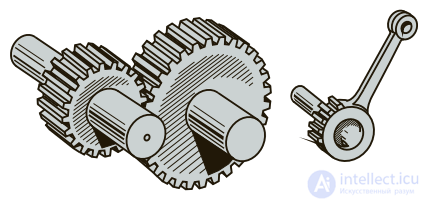
| St4
St5 St6 |
Machine parts subjected to carburizing:
gears, sprockets, shafts, axles, brackets, levers, etc. |
 |
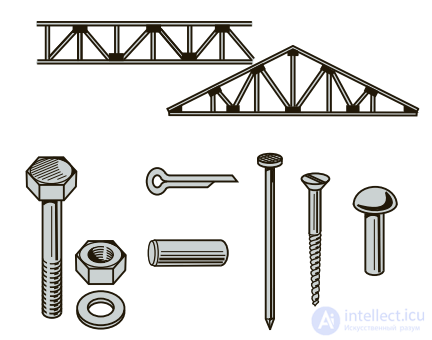
| St2
St3 St4 |
Non-critical welded structures,
fasteners, screws, bolts, studs, washers, nuts, cotter pins, rivets, nails, screws |
 |
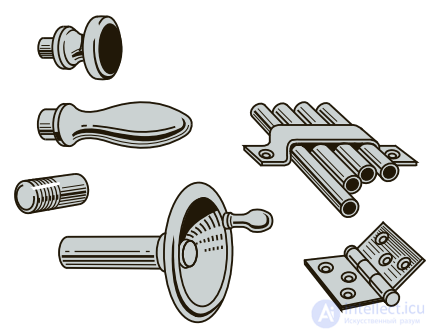
| St5
St6 |
Standardized parts:
handles, knobs, grips, plugs, caps, bushings, hinge pins, brackets for fastening pipes etc. |
 |
In the as-delivered condition without heat treatment, high-quality carbon structural steel has the following mechanical properties: Brinell hardness 131…255 HB, tensile strength σv = 330…690 MPa (33…69 kgf/mm2), elongation δ up to 33%, and reduction of area Ψ = 35…60%. The mechanical properties depend on the mass fraction of carbon and the condition of the rolled product. Work-hardened steel has higher hardness and strength and reduced ductility. Grades with a minimum carbon mass fraction have lower mechanical properties. As the carbon mass fraction increases, the mechanical properties improve.
By mechanical properties, steel of this group is divided into categories 1, 2, 3, 4, and 5. By the condition of the rolled product, steel is supplied without heat treatment, heat-treated (T), and work-hardened with a special surface finish (N).
Depending on the type of processing, hot-rolled and forged steel is divided into subgroups:
The surface quality of calibrated (cold-drawn) steel to GOST 1051—73* is divided into groups B and V.
Steel with a special surface finish to GOST 14955—77* is divided into groups V, G, and D. The steel group depends on the surface roughness class.
Sectional hot-rolled steel is produced as bars of round, square, hexagonal, and rectangular cross-section. Sectional round steel to GOST 2590—2006, with a diameter of 4 to 250 mm, is produced in three rolling-accuracy classes: V — high, B — increased, D — ordinary.
Sectional square steel with a side length of 5 to 200 mm is supplied in bars and coils in three accuracy classes: A, B, and V. Hexagonal steel with an across-flats size of 8 to 100 mm is produced in two accuracy groups: P(B) and V.
Flat (strip) steel (GOST 103—76*) is produced in two groups:
Forged round and square steel (GOST 1133—71) is produced with a diameter or square side of 40 to 200 mm.
Sectional calibrated (cold-drawn) steel has more precise cross-sectional dimensions and surface roughness.
The subgroups, groups, and classes of steel are indicated in the technical documentation accompanying the delivery.
Low-carbon steel has high formability, forgeability, and weldability, as well as good machinability. This group of steels is not subjected to quenching. The mechanical properties of machine parts made from low-carbon steels are improved by chemical-thermal treatment (carburizing). Medium-carbon steel with a carbon content of 0.3% and above also readily accepts quenching, tempering, and normalizing. Practically all grades of heat-treatable steels in this group show virtually no tendency toward temper embrittlement.
From low-carbon high-quality steel grades 05, 08kp, 08ps, 10, 10ps, 10kp, and 11kp, parts are made by stamping and cold heading: tubes, gaskets, caps, fasteners, washers, forks, bushings, and rods.
Steel grades 15, 18, 20, and 25 of all deoxidation degrees are used to make lightly loaded machine parts — rollers, bushings, pins, stops, cams, axles, gears, and other parts operating at temperatures of 40…425°C.
Steel grades 30–60 are used to make critical machine parts improved by quenching with subsequent tempering and normalizing: connecting rods, crankshafts, splined shafts, rods, stems, keys, gear wheels, and others.
To GOST 1435—99, carbon tool steel is produced hot-rolled, forged, calibrated with a special surface finish, and for cores. By cross-sectional shape, the steel is produced in square and round sections, including with radiused (rounded) corners, and as strips, bands, sheets, hexagons, wire, and special profiles for files, needle files, and other tools.
Depending on chemical composition, carbon tool steel is produced in the following grades:
By application, steels of all grades are divided into five groups depending on the mass fraction of chromium, nickel, and copper:
Some steels can be classified under both group 4 and group 5: grades U7A, U8A, U8GA, U9A, U10A, U11A, U12A, U13A — for hot-rolled and forged steel (chromium mass fraction — 0.20…0.35%, nickel and copper — 0.2% each); grades U8A, U9A, U10A — for cold-drawn steel with a special surface finish (chromium mass fraction — 0.3…0.5%, nickel and copper — 0.2% each).
In the designation, the letter U indicates that the steel is carbon tool steel. The numbers following the letter U correspond to the mass fraction of carbon in tenths of a percent. The letter G indicates an increased manganese content (0.4…0.6%); the letter A at the end of the grade indicates that the steel is premium quality, with a reduced content of harmful impurities (sulfur and phosphorus). Grades without the letter A in the designation are high-quality.
Thus the mass fraction of carbon in steels of this group is 0.66…1.34%, depending on the grade. The mass fraction of silicon is 0.17…0.28%, and manganese 0.17…0.60%. High-quality steels contain 0.028% sulfur, premium-quality steels — 0.018%. Steels obtained by electroslag remelting contain no more than 0.015% sulfur (these steels are marked with the letter Sh at the end of the grade, e.g., U9-Sh).
High-quality steels contain 0.03% phosphorus, premium-quality steels — 0.025%.
Carbon tool steel grades U7 and U7A belong to the hypoeutectoid steels according to the iron–cementite diagram. They have a ferrite + pearlite structure, with an as-delivered Brinell hardness of 187 HB.
Steel grades U8, U8A, U8G, U8GA belong to the eutectoid steels. These steels have a pearlite structure, with a hardness of 187…192 HB. Steel grades U9, U9A, U10, U10A, U11, U11A, U12, U12A, U13, and U13A are hypereutectoid steels. The structure of these steels is pearlite and pearlite + cementite, with a hardness of 192…217 HB.
Carbon tool steels have high forgeability. The forging start temperature is 1,180°C, the finish temperature is 800°C. Steel for quenching is heated to a temperature of 750…840°C and cooled in water, a salt solution, or oil. The hardness after quenching is not less than 58…63 HRC. This steel is not prone to temper embrittlement. The heating temperature for tempering is 140…250°C. Because of its limited weldability, this steel is not used for welded structures, but when necessary it can be welded by resistance (contact) welding.
Carbon tool steels are widely used for making locksmith and assembly tools, measuring tools, and carpentry and joinery tools: chisels, gouges, hammers, metal-cutting shears, axes, wood chisels, pliers, saws, milling cutters, countersinks, gauges, drills, needle files, files, and so on.
Tools made from carbon tool steels have good cutting properties.
The drawbacks of this steel include low heat resistance (red hardness). At a temperature of 200 … 250 °C, the tool softens during operation and loses its cutting properties.
The alloying elements determine the name of the alloy steel or alloy. For example, chromium, vanadium, and chromium-nickel steels contain, respectively, chromium, vanadium, and chromium with nickel as alloying elements in their composition.
To increase structural strength, one or two alloying elements are introduced into the steel. To obtain a set of physicochemical properties, several alloying elements are introduced.
Manganese — is a natural, permanent impurity in carbon steels (up to 0.6%). With an artificial increase in the mass fraction of manganese (above 1%), hardness, wear resistance, and impact toughness increase. The ductility of the steel does not decrease. Manganese itself neutralizes the harmful effect of sulfur by binding it.
Silicon — is also a permanent impurity in steels (up to 0.4%). As the mass fraction of silicon increases, structural strength and elasticity increase. A high mass fraction of silicon gives the steel special physical properties, owing to which silicon steels are widely used in the electrical engineering industry. Silicon also gives the steel acid resistance and scale resistance. A high silicon content promotes the decomposition of the cementite structure with the formation of a ferrite-pearlite structure and gives the steel elasticity. Spring steels are, as a rule, silicon steels.
Chromium increases strength, hardness, and hardenability. The ductility of chromium steels decreases somewhat. A high chromium content (12% or more) makes the steel corrosion-resistant and gives it magnetic properties. Chromium is an economically inexpensive, non-scarce alloying metal.
Nickel gives the steel strength, ductility, and impact toughness, and lowers the annealing, normalizing, and quenching temperature. Nickel steels have high hardenability. Nickel is also used as an active deoxidizer, promoting the removal of oxygen, hydrogen, and nitrogen from the steel in the liquid state, thereby increasing its density. Nickel steels have a low coefficient of linear and volumetric thermal expansion.
Titanium increases strength, hardness, and ductility, as well as the annealing and normalizing temperature and the heat resistance (scale resistance) of the steel. With a small titanium content, the hardenability of the steel increases, while at a content above 12% it decreases.
Copper increases hardenability, the annealing and normalizing temperature, strength, hardness, and ductility. It gives the steel corrosion resistance. Copper is introduced mainly into structural (construction) steels.
Cobalt decreases hardenability and ductility. It gives heat resistance and magnetic properties. It increases heat resistance (creep resistance) and impact toughness.
Molybdenum increases strength, hardness, wear resistance, elasticity, impact toughness, and heat resistance, slightly decreases ductility, and increases hardenability and the annealing, normalizing, and quenching temperature.
Tungsten sharply increases hardness, wear resistance, red hardness, hardenability, and heat resistance, and raises the annealing, normalizing, and quenching temperature. With a mass fraction of tungsten within 1%, the ductility of the steel increases.
Vanadium increases wear resistance, hardness, strength, and ductility, and increases hardenability and the heating temperature for annealing, normalizing, and quenching.
In heat-resistant, corrosion-resistant, and electrical engineering steels, rare-earth elements are also introduced:
According to GOST 5950—2000, the following conventional letter designations for alloying elements have been adopted:
In addition, the standard also provides for other designations of individual groups of alloy steels:
Alloy steels are produced both as steels improved by heat treatment and as case-hardening (carburized) steels, i.e., steels subjected to chemical-thermal treatment. Essentially, all the classification features of alloy steels are embedded in the marking (grade-designation) principles. Having examined and studied the marking principles, one can determine from the grade the purpose of the steel, its quality, chemical composition, and whether it belongs to the heat-treatment-improved or case-hardening steels.
Depending on the main alloying elements, alloy structural steel according to GOST 4543—71* is produced in the following groups:
Let us consider the marking principle for alloy structural steels using examples. Grade 15KhA — is an alloy structural chromium steel, case-hardening, high-quality, with a carbon mass fraction of 0.15%, chromium — approximately 1%, with a reduced content of harmful impurities (sulfur and phosphorus). Grade 30KhGSN2A — is an alloy structural steel improved by heat treatment, chromium-silicon-manganese-nickel, high-quality, with a carbon mass fraction of 0.3%, chromium, manganese, and silicon — 1% each, nickel — 2%, and has a reduced content of harmful impurities. According to GOST 4543—71*, alloy structural steels are subdivided by carbon mass fraction into case-hardening steels and heat-treatment-improved steels.
Case-hardening alloy steels — are low-carbon (up to 0.3% carbon) and low- and medium-alloy steels of grades 15Kh, 20Kh, 15G, 20G, 10G2, 18KhGT, 20KhGT, and others. Owing to the low carbon mass fraction, these steels are not subjected to quenching. To improve the mechanical properties of part surfaces, they are saturated with carbon (carburizing). After carburizing, quenching is performed followed by tempering. After quenching and tempering, the surface of the parts has high wear resistance, a hardness of 58 … 63 HRC, and a strong, tough core.
Heat-treatment-improved alloy steels — are medium-carbon (carbon mass fraction — more than 0.3%) and medium-alloy steels of grades 30Kh, 30G, 35Kh, 38KhA, 40Kh, 50Kh, 50G, 50G2, 30KhGT, and others. The mechanical properties of heat-treatment-improved alloy steels are increased by quenching followed by tempering.
Alloy steels are marked with figures indicating the mass fraction of carbon and alloying elements, and with letters denoting the alloying elements.
The letter A at the end of the grade denotes high-quality steel, while the letter Sh denotes premium-quality steel. These steels have a reduced mass fraction of harmful impurities — sulfur and phosphorus.
The figures at the beginning indicate the carbon content: in structural steels — in hundredths of a percent, and in tool steels — in tenths of a percent.
If there are no figures at the beginning of the grade, the carbon mass fraction is within 1%.
The figures following the letters correspond to the mass fraction of the alloying elements in percent.
If there are no figures after the letters, the mass fraction of the alloying elements is within 1%.
For example, 18Kh2N4MA — is an alloy structural high-quality (with a reduced content of sulfur and phosphorus) chromium-nickel-molybdenum steel (2% chromium, 4% nickel, 1% molybdenum, 0.18% carbon).
Since the carbon mass fraction is up to 0.3%, the steel is case-hardening, i.e., it is improved by chemical-thermal treatment.
Alloy structural steel is supplied in the form of rolled stock, including shaped, calibrated and ground bar and bright-drawn (silver) bar, strip, forgings and forged billets, tubes, sheets of various thicknesses, and other types of rolled products. Alloy structural steel is produced hot-rolled and forged with turned or peeled surfaces, calibrated, and with special finishing of round-section surfaces.
Depending on its intended use, steel is subdivided into four subgroups:
Steel can be supplied in a heat-treated state (T), without heat treatment, and work-hardened (N).
Alloyed case-hardening structural steels are used for making parts operating under friction at low loads: bushings, pins, rollers, tappets, gears, and others.
Heat-treatment-improved alloy structural steels are used for making parts operating at medium and high loads:
The main requirements placed on tool steels are high hardness, wear resistance, impact toughness, and hardenability. In addition, depending on the operating conditions, specific requirements may be imposed. For example, a cutting tool operating at a high cutting speed must have high wear resistance at a temperature of 500 … 600 °C, while a tool operating at low cutting regimes requires wear resistance at temperatures up to 200 °C. Hand tools (files, dies, taps, and others) must have high wear resistance under normal conditions. Dies operating under hot deformation are subject to requirements of hot hardness, adhesion, heat resistance, elasticity, and impact toughness.
High requirements arising from the specifics and operating conditions of various tools are met by the presence of particular alloying elements.
Alloy tool steels are supplied in the form of hot-rolled calibrated rolled stock, forgings, ground bar, strip, forged billets, and rolls.
The mass fraction of harmful impurities (sulfur and phosphorus) in alloy tool steels must not exceed 0.03% for each element. In steel obtained by the electroslag remelting method, the mass fraction of sulfur is allowed to be no more than 0.015%.
In the as-supplied state, the hardness of alloy tool steel ranges, depending on chemical composition, within 217 … 269 HB. All alloy tool steels are improved by quenching. The hardness of a tool made from alloy steel, after quenching, will be as follows: for cutting tools — 60 … 64 HRC, for measuring tools — 50 … 58 HRC.
Since various requirements are placed, during operation, on tools made from alloy tool steels, these steels are subdivided into the following groups:
In addition, alloy steels are subdivided into quality, high-quality, and premium-quality grades (the latter two groups are indicated in the marking).
Steel for cutting and measuring tools. Medium- and high-carbon, low- and medium-alloy steels are used for these purposes. The carbon mass fraction in these steels ranges within 0.7 … 1.0%, and certain grades contain up to 1.4%.
Steels for cutting and measuring tools are subdivided into steels of shallow and deep hardenability.
Steels of shallow hardenability include chromium, chromium-vanadium, chromium-tungsten, and vanadium steels. The mass fraction of alloying elements ranges within 1 … 5%, and the carbon mass fraction — 0.6 … 1.1%. A characteristic feature of these steels, owing to the small content of alloying elements, is low hardenability. Tools made from these steels are cooled in water during quenching and have a soft, unhardened core. Accordingly, shallow-hardenability steels are used for making cutting and measuring tools with a cross-section of up to 25 mm, which, during quenching, prevents warping and promotes hardening throughout the entire cross-section of the tool.
Grades of steel in this group: 7KhF, 8KhF, 9KhF, 11KhF, 11KhF (11Kh), 13Kh. From steels of these grades, thread gauges, taps, dies, reamers, broaches, and other special tools and tooling are made.
Steels of deep hardenability contain 1 … 4% alloying elements; certain grades have up to 8 … 10% alloying elements. The main alloying element that increases hardenability is chromium. Its mass fraction, as a rule, is 1.0 … 1.5%. Silicon and manganese also increase hardenability, but the presence of these elements in the steel complicates the quenching technology.
Grades of steels in this group: 9X1 (9X), 12X1 (20X), 9KhS, KhGS, 9KhVG, KhVG, KhVSG, 9Kh5VF (120X), 8Kh4V3M3F2.
From these steels, the same tools are made as from shallow-hardenability steels, as well as cold-heading dies, punches, stamps, dies for embossing, and other critical parts requiring increased wear resistance.
Steel for die tools. Die steels, intended for making tools that deform metal, are subdivided into the following groups:
Steels for cold deformation must have high hardness and strength, high wear resistance, satisfactory toughness, and high hardenability.
Steels for hot deformation must have high resistance to plastic deformation, high heat resistance, and high resistance to heat checking (crazing), i.e., high resistance to thermal fatigue.
High-speed tool steels. High-speed steels are highly alloyed steels intended for making cutting tools operating at high cutting regimes. GOST 19265—73 provides for the supply of high-speed tool steel in the form of hot-rolled, calibrated rolled stock, forged, in the form of strips and bars with special surface finishing, of the following grades: R9, R18, R6AM5, R6M5K5, 11R3AM3FA, R6AM5F2, R12F3, R18K5F2, R9M4K8.
The following designations are adopted in the marking of high-speed steels:
In the designation of high-speed steel grades, the mass fraction of chromium, molybdenum up to 1% inclusive, and vanadium is not indicated in steel grades P9, P18, P6AM5, P9K5, P6M5K and P9M4K8.
All high-speed steels contain 0.70…1.12% carbon depending on the grade, 3.8…4.4% chromium, 0.4% nickel.
High-speed steels have high red hardness up to 620 °C, impact toughness in the as-supplied condition of 18…26 J/cm2, hardness of 220…260 HB, tensile strength σв = 840…940 MPa (84…94 kgf/mm2). High red hardness and hot hardness are created by the alloying elements — tungsten, vanadium, chromium and molybdenum.
High-speed steels are used to make solid turning and planing tools, milling cutters, reamers, modular cutters, broaches for gears, pull broaches, drills, taps and dies. In addition, high-speed steels are used for the manufacture of various stamping tools (punches, dies, shear blades, hacksaw blades for metal) and other tools.
High-speed tool steels are capable of self-hardening in air. For this reason, during forging these steels are cooled in heated pits or in salt baths. Slow cooling in the pits causes coarsening of the grains of sorbite-like pearlite and carbides. In addition, to improve machinability by cutting, high-speed steels undergo isothermal annealing. As a result of these operations, hardness reaches 200…255 HB.
With subsequent step quenching at a temperature of 1,270…1,290 °C and triple tempering at a temperature of 550…570 °C, high strength, hardness and impact toughness are achieved, as well as high cutting properties of the tool. The structure after quenching is: carbides, martensite and retained austenite. Retained austenite somewhat lowers hardness, and it is eliminated by multiple tempering and cold treatment. After these operations it transforms into martensite.
By cutting properties, these steels are of normal and increased productivity. Normal productivity is shown by grades P18, P12, P9, Р9Ф5 (tungsten steels), P6M3, P6M5 (tungsten-molybdenum steels); the hardness of these steels is 98 HRA, heat resistance — 620 °C. Grades Р10К5Ф5, Р18К5Ф2 (with an increased mass fraction of vanadium and cobalt content) have increased productivity; the hardness of these steels is more than 64 HRC, heat resistance — 630…640 °C. Steels of this last group are used for machining high-strength steels with an austenitic structure and other hard structural materials.
General characteristics of high-alloy steels and alloys. Practice has established that corrosion can be halted by alloying structural steels and cast irons with chromium, or with chromium and nickel and other alloying elements. In active environments, these alloying elements pass into a passive state; thin oxide films form on their surface, and the surface acquires high corrosion resistance.
Alloying steel with nickel makes it possible to obtain a single-phase (austenitic) structure, which has higher corrosion resistance than chromium and chromium-nickel steels.
High-alloy steels and corrosion-resistant, heat-resistant, and creep-resistant alloys (GOST 5632—72) are produced on iron, iron-nickel and nickel bases and are supplied in the form of section and shaped rolled products, calibrated bar, bar with special surface finishing, thin and thick sheet, strip, forgings and forged blanks, wire and tubes. They are intended for the manufacture of various parts, mechanisms and structures for operation in corrosive environments and at high temperatures.
High-alloy steels and alloys are produced by electroslag remelting (ESR), vacuum-arc remelting (VAR) and induction melting (IM), and depending on their main properties are divided into the following groups:
Corrosion-resistant steels and alloys. Corrosion-resistant structural materials are those that resist the chemical and electrochemical action of the environment.
Corrosion-resistant steels and alloys are resistant to chemical and electrochemical corrosion (atmospheric, soil, alkaline, acid, intergranular, and stress corrosion).
By carbon content, corrosion-resistant steels and alloys are produced as low-carbon (carbon mass fraction less than 0.3%) and medium-carbon (carbon mass fraction more than 0.3%).
The most corrosion-resistant chemical elements are chromium and nickel, so these chemical elements are the permanent alloying elements used in producing corrosion-resistant steels and alloys. Practice shows that stable corrosion resistance in steels and alloys is achieved at a chromium mass fraction of 12.5% and above.
The structure and properties of chromium steels depend on the mass fraction of chromium and carbon. With a chromium content of 13, 17 and 25% and the presence of 0.1…0.4% carbon, the steels acquire high heat resistance (scale resistance).
Chromium steels have high technological properties: formability, weldability and heat-treatability, so the main group of corrosion-resistant steels is produced on a chromium base, with individual grades based on chromium and nickel, as well as titanium. Titanium and nickel are introduced to refine the grain, and nickel separately to increase strength, hardness and impact toughness.
The most widely used corrosion-resistant
продолжение следует...
Часть 1 6. Steels and Alloys for Special Purposes
Часть 2 7. Carbon and alloy steels for special purposes - 6.

Comments