
Lecture
Dielectric materials are classified according to various criteria. Let us give the most commonly encountered ones.
By the functions that dielectrics perform in devices and equipment, as well as by the effect exerted on them by external factors, a distinction is made between electrical insulating and capacitor materials (linear, or passive), and active dielectrics (nonlinear, or controllable).
By the functions they perform, dielectrics can be divided into electrical insulating and capacitor materials
(passive dielectrics) and controllable materials (active dielectrics) (Fig. 4.5).
Electrical insulating materials are used to create electrical insulation, which surrounds the current-carrying parts of electrical devices and separates circuit or structural elements that are at different electrical potentials from one another.
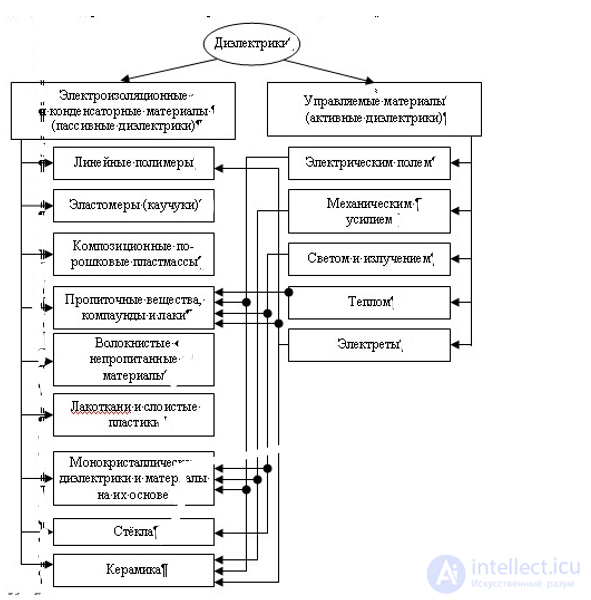
Fig. 4.5. Classification of dielectrics
The use of dielectrics in capacitors makes it possible to obtain the required capacitance values, and in some cases provides a particular character of dependence of this capacitance on external factors. The dielectric of a capacitor can store, and then return to the circuit, electrical energy (a capacitive storage element). Sometimes a capacitor is used to separate direct-current and alternating-current circuits, to change the phase-shift angle, and so on.
Some dielectrics are used both to create electrical insulation and as capacitor materials (for example, mica, ceramics, glass, polystyrene and other films). Nevertheless, the requirements for electrical insulating and capacitor materials differ significantly. Whereas an electrical insulating material is required to have a low relative permittivity and high resistivity, a capacitor dielectric, on the contrary, must have an increased permittivity and a small value of tgδ. The role of the dielectric in a capacitor also cannot be considered active, but the capacitor is already a functional element in the electrical circuit.
Capacitors with controllable (active) dielectrics can be used for power amplification of signals, for creating various converters, memory elements, sensors for a number of physical processes, and for generating oscillations. In the classification scheme of Fig. 4.5, controllable dielectrics are, in turn, subdivided according to the control principle.
Further on, the classification of materials is carried out on the basis of the structural features they possess in the states in which they are used in practice, and, consequently, on the basis of the features of their properties. Such features include: the inert high-polymer structure of materials that are plastic in processing – plastics; the highly elastic state of other polymeric materials – elastomers (rubbers); fibrous structure; single-crystallinity; polycrystallinity; the glassy state; or multiphase character. Owing to the diversity of dielectrics used in practice, the differences in their properties, and certain historically established conventions for subdividing materials, such a classification cannot always be strictly maintained.

Comments