
Lecture
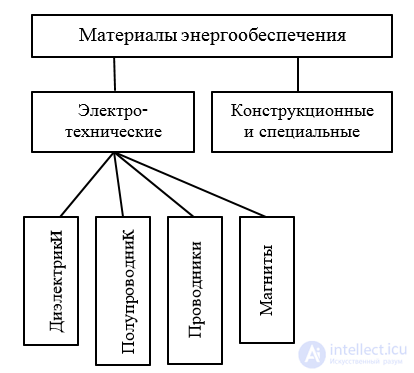
Materials used in the power industry are divided into electrical engineering, structural, and special-purpose materials (Fig. 1.1). Electrical engineering materials are materials characterized by specific properties with respect to the electromagnetic field and used in engineering with these properties in mind.
By their behavior in a magnetic field, materials are classified as magnetic.
By their behavior in an electric field, materials are divided into conductors, semiconductors, and dielectrics.
Conductor materials are materials with strongly pronounced electrical conductivity and low resistivity at normal temperature.
Semiconductor materials are materials that are intermediate in conductivity between conductors and dielectrics, whose distinguishing property is a strong dependence of conductivity on the concentration and type of impurities or various defects, as well as on external energy influences (temperature, radiation, etc.).
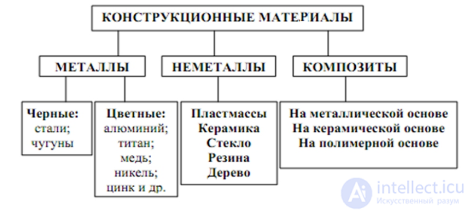
By purpose and functional properties, material types are quite diverse, but the main ones can be represented as six groups (Diagram 2):
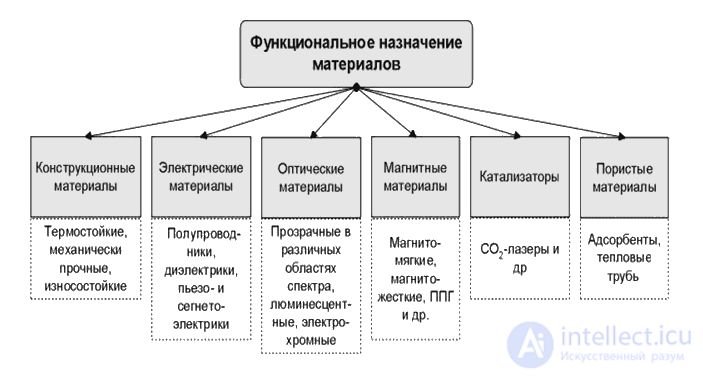
Diagram 2. Classification of materials by functional purpose
The use of each group of materials is based on their functional properties.
Dielectric materials are materials with a wide band gap, in which electrical conductivity (in ideal dielectrics) is absent. A real dielectric is closer to an ideal one the lower its conductivity.
When dielectrics are used, taking into account their active and passive properties, two types of dielectrics are distinguished.
Passive dielectrics are used as electrical insulation materials and as dielectrics in capacitors. The permittivity of such materials should be as low as possible so as not to introduce parasitic capacitances into circuits and electrical networks.
Active (controllable) dielectrics include ferroelectrics, piezoelectrics, pyroelectrics, electroluminescent phosphors, materials for emitters and shutters in laser technology, electrets, and others.
Conventionally, materials with a resistivity ρ <10−5 Ω⋅m are classed as conductors, and materials with ρ >108 Ω⋅m as dielectrics. It should be noted that the resistivity of good conductors can be as low as
10−8 Ω⋅m, while for the best dielectrics it can exceed 1018 Ω⋅m. The resistivity of semiconductors, depending on the structure and composition of the material and on the operating conditions, can vary within the range 10−5 −108 Ω⋅m. Metals are good conductors. Besides elemental substances, there are thousands of chemical compounds, alloys, or compositions with the properties of conductors, semiconductors, and dielectrics. A sharp boundary between the different classes of materials cannot be drawn. For example, many semiconductors behave like dielectrics at low temperatures. The qualitative difference is that for metals the conducting state is the ground state, whereas for semiconductors and dielectrics it is an excited state.
Solid-phase materials are diverse in composition. From the standpoint of the main classes of inorganic compounds, they can be grouped into several categories (Diagram 1):
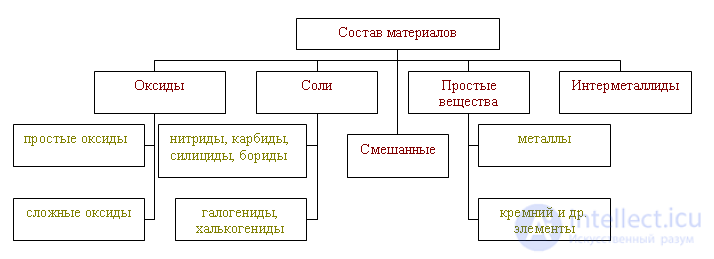
Diagram 1. Classification of materials by composition

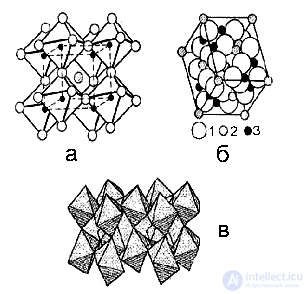
Fig. 1. Structures of unit cells
of various configurations: a – perovskite CaTiO3;
b – spinel MeFe2O4; c – coordination
octahedra of the orthoferrite unit cell GdFeO3
From the outset of their introduction, structural materials for electronic engineering were required to have temporal and temperature stability, mechanical strength, and thermal-shock resistance, since they were used as mounting materials for radio components, for example tubes with heated cathodes. Such materials include various silicates, aluminosilicates, and the like. Magnetic materials are characterized primarily by the parameters of the magnetization curve (Fig. 2).
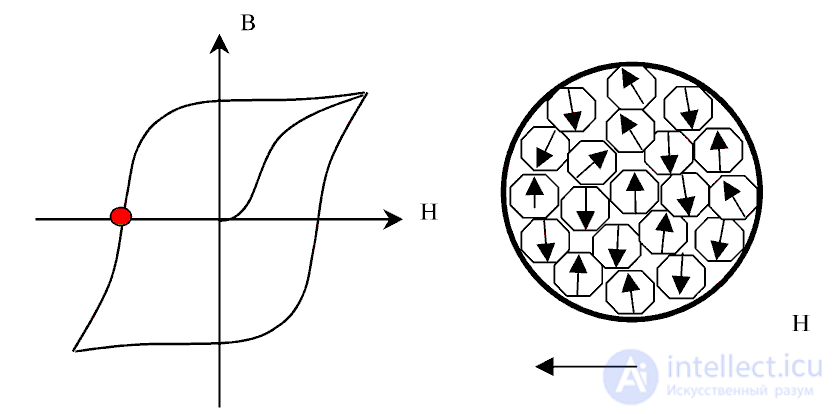
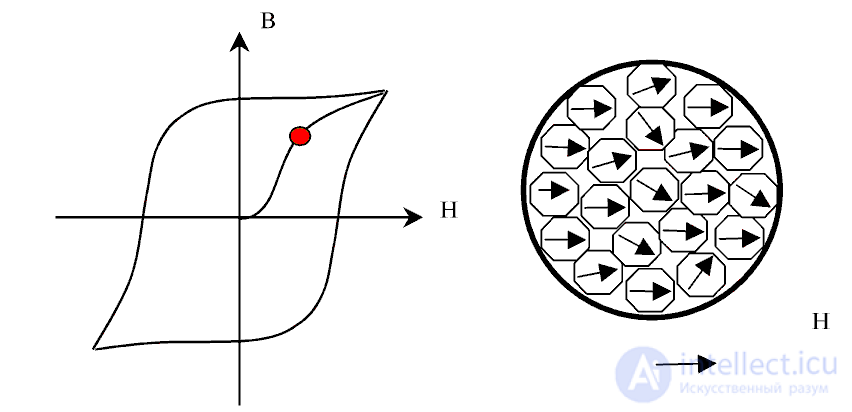
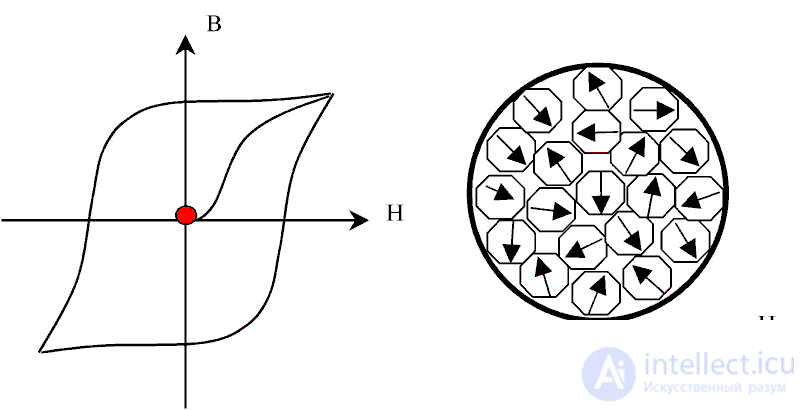
Fig. 2. Magnetization curve and arrangement of magnetic domains as a function of the external magnetic field strength H
On the first segment of this curve, those domains of the solid body that have a sufficiently small misalignment relative to the external magnetic field orient themselves along its direction. The remaining domains then reorient, and after this process is complete the curve reaches saturation.
The most important class comprises complex oxides (ferrites, cobaltates, cuprates, niobates, molybdates, manganates, and other compounds of alkali, alkaline-earth, and rare-earth elements and their various more complex combinations). What unites all complex oxides is their structure. Transition metals in the structure of complex oxides coordinate oxygen polyhedra of various configurations (usually tetrahedral, octahedral) (Fig. 1). The structure itself is formed by various combinations of these polyhedra, which in different arrangements can be connected to one another by vertices, edges, or faces. Larger cations of alkali metals, alkaline-earth elements, and rare-earth elements are located in the voids formed by fragments of polyhedral chains.
Many properties of complex oxides depend not only on their composition and structure but also on their defect structure, which makes it possible to purposefully influence their functional properties. By state, solid-phase materials can be divided into ceramics, thin films, single crystals, and thick-film coatings.
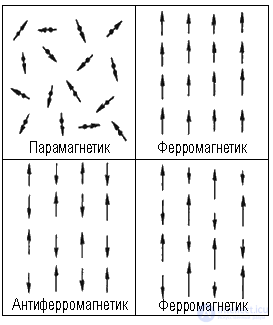
Fig. 3. Schematic interaction
between the spin moments
of electrons of ferromagnetic ions and
atoms in the structure of materials
Single crystals or oriented films of ferrites are able to rotate the plane of polarization of plane-polarized light through the interaction of the material's magnetic moments with electromagnetic light oscillations, i.e., the Faraday effect. This effect appears when an external magnetic field is applied whose direction coincides with the vector of the magnetic moment of the material's crystal lattice, which is used to create image-visualization devices, modulators, and magneto-optical shutters, for example for laser equipment. For this, light passes through a polarizer, then through the ferrite material placed in a control coil, and then through an analyzer (its position can be crossed or aligned with respect to the polarizer). As the magnetic field produced by the coil changes, the amount of light transmitted by the system also changes (Fig. 4).
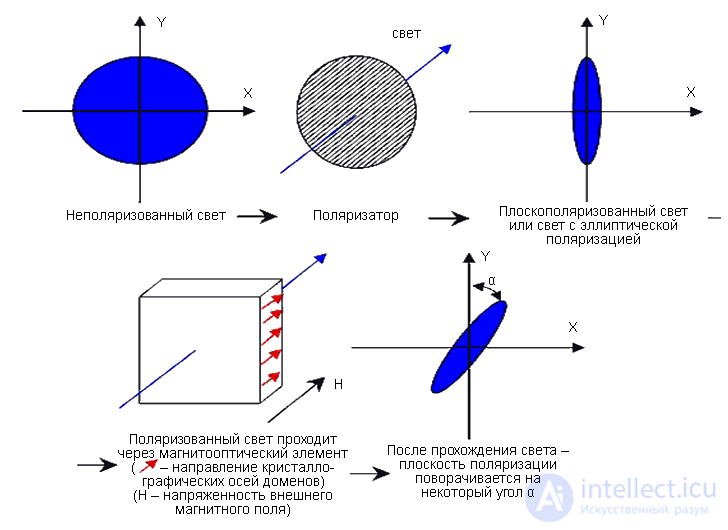
Fig. 4. The Faraday effect
The Faraday effect can also be used for magneto-optical storage devices, in which it is desirable to have a material with cylindrical or bubble magnetic domains, since its magnetization, and correspondingly its optical density, can change sign due to a local action, for example a laser. The magnitude of the Faraday effect depends on the wavelength of light and decreases as the wavelength increases; on the other hand, ferrites have a transparency window in the IR region of the spectrum. To achieve an acceptable combination of light transmission and modulation depth (the ratio of the modulated-signal intensity to the initial intensity), it is necessary to use magneto-optical devices and find a compromise between these parameters, which somewhat limits the range of applications.
Soft magnetic materials are those with a sufficiently narrow hysteresis loop; they can be used in devices requiring fast signal control with minimal energy expenditure. The most convenient materials (for example, in storage devices) are those with a fairly steep magnetization curve and a hysteresis-loop shape close to rectangular. The slope of the curves is determined by the initial magnetic permeability. Hard magnetic materials, which require very significant energy for remagnetization, are used as permanent magnets in various devices. These include intermetallics of the SmCo5 type or those based on neodymium–boron–iron compounds, ferrites with a magnetoplumbite-type structure, Ba1-xSrxFe12O19, and others. The nature of magnetism in solids lies in the interaction between the spin moments of electrons of ferromagnetic ions and atoms in the structure of materials (Fig. 3). When the spin moments of the components of the crystal lattice coincide in direction, the material exhibits ferromagnetic properties; when such moments are fully mutually compensated, an antiferromagnet (AFM) forms; and partial compensation gives rise to ferrimagnetic materials (ferrites), which often include the ferrites used in practice: for example, AB2O4 spinels or ferrogarnets with the general formula M3Fe5O12.
In yttrium iron garnet (YIG) there are two crystallographic sites occupied by iron ions: octahedral and tetrahedral. Yttrium ions occupy dodecahedral cavities. Because the iron sites are inequivalent and contain different amounts of iron, a resultant imbalance of the material's magnetic moment is created. If elements that substitute for iron and yttrium, for example vanadium and calcium, are introduced into the ferrogarnet, the situation changes.
Piezoelectric and ferroelectric materials differ from each other in that the former lack spontaneous polarization. The polarization of these materials can be viewed as the electrical analog of magnetization. Ferroelectric materials also exhibit a domain structure, have a polarization curve as a function of external electric field strength with a hysteresis loop (the slope depends on the permittivity), and a Curie temperature; on their basis, electro-optical shutters, modulators, sound-recording and playback devices, and other similar devices can be created. Ferroelectrics with high values of permittivity are used as capacitor materials.
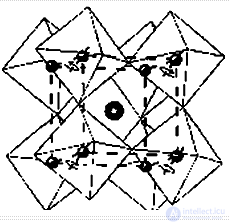 |
|
Fig. 5. Structure of barium |
Other groups of materials also exist. These include, in particular, electric-heating, catalytic, and electrode materials (for electron emission and gas-medium regeneration in sealed-off CO2 lasers), gas-sensing materials, and so on. In all the groups listed, oxides find wide application both as simple and as complex compounds (Table 1, Fig. 6).
Table 1. Examples of materials based on natural and synthetic oxides
|
Fields of application |
Oxide-based materials |
|
Electronic engineering |
|
|
Substrates for microcircuits |
Al2O3, SiO2 |
|
Thin-film resistors |
SnO2, TiO2, Cr2O3, WoO3, Al2O3, Ta2O5, SiO2, etc. |
|
Lighting technology |
|
|
Window glass |
SiO2, PbO2, Na2O, K2O, B2O3, TiO2, ZrO2, etc. |
|
Heat-reflecting windows |
SnO2, SnO2:M, In2O3:Sn |
|
Windows with selective transmission |
In2O3, TiO2, ZrO2, Bi2O3 |
|
Abrasives |
Al2O3, Cr2O3 |
|
Ceramics |
|
|
High-alumina |
MgO, Al2O3 |
|
Nanocrystalline |
ZrO2 |
|
Catalysts |
Al2O3, TiO2, MnO2, Cr2O3 |
|
Sensors |
|
|
Thick-film |
SnO2, SnO2:M |
|
Thin-film |
SnO2, ZnO, CoO, MgO, V2O5, In2O3 |
|
Ceramic |
SnO2, TiO2, V2O5, In2O3, ZnO, Fe2O3 |
a - generator |
b - artificial hip |

c - implant |
Fig. 6. Materials based on: a - zinc oxide; b, c - zirconium(IV) oxide
The wide use of oxide systems in materials science is due to the range of their physical and chemical properties. For example, most solid-state oxides have high strength, their heat of formation is high, many have semiconducting properties, and finally, they are widely distributed in nature, which makes their use economically advantageous.
A typical representative of this class is barium titanate, which has a perovskite-type structure (Fig. 5). The reason ferroelectric properties appear is that the centers of gravity of the titanium ions are displaced relative to the geometric centers of the oxygen octahedra, which creates an electrical imbalance of the sublattices of positively and negatively charged ions. The range of materials used that possess specific electrical properties is quite broad. Dielectric substances have a wide band gap, and electrons cannot pass from the valence band into the conduction band. In semiconductor materials, the transition of charge carriers into the conduction band is facilitated by the presence of intermediate donor or acceptor energy levels. In solid ionic conductors, charge transfer occurs through the mobility of ions in the crystal lattice by one mechanism or another; unipolar transport is possible, i.e., transport by ions of only one sign, as in materials used to create electrochemical fuel cells. Such a device is capable of generating electrical energy.

Comments