
Lecture
Это окончание невероятной информации про кристаллическая структура.
...
):
а – thermal ellipsoids; with a probability of 0.5, the nucleus of an atom is located inside such an ellipsoid at any given moment; the directions in which the ellipsoids are elongated correspond to the maximum displacements, while the directions in which they are compressed correspond to the minimum displacements during thermal vibrations;
б – deformation electron density; a cross-section taken through the plane of the molecule is shown; maxima located on the bonds are visible – they correspond to valence electron pairs – as well as maxima corresponding to the lone electron pairs of the О atom;
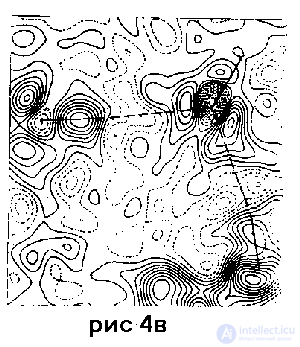 в – deformation electron density in the region of intermolecular hydrogen bonds; a cross-section taken through the plane O'...NH2...O" is shown; on the NH...O lines there are maxima corresponding to the valence pairs of the N – H bonds and to the lone pairs of the О atom
Another aspect of modeling the spatial structure of matter consists in the fact that the description of the structure is carried out either at the level of abstract canonical images (stereotypes), or by means of specific geometric parameters (their numerical values are given).
In the first case, the description is called topological (it is useful to note that in structural chemistry the content of the term "topology" only partially coincides with its mathematical interpretation). A vivid example is the structural formula of a molecule (in mathematical language this is a graph); this category also includes conformational types (cyclohexane in the "chair" form and in the "boat" form), and types of coordination polyhedra (tetrahedra, octahedra, etc.). Symmetry plays an important role in characterizing stereotypes. In the second case, we are dealing with a quantitative description of the structure. Both the topological and the geometric description can pertain either to a stationary (static) model or to a mobile object.
Thus, four aspects of structure modeling can be distinguished: topology in statics, topology in dynamics, geometry in statics, and geometry in dynamics. Each of these aspects of the structure of a given object can be considered at the local, intermediate, and total levels.
The approach presented is in principle applicable to the description of the most varied atomic-molecular systems. In table 2, as the most important example, a scheme for modeling the structure of a molecule is given.
Table 2. Modeling of the structure of a molecule
| Model type | Abstract models | Specific (geometric) models | |
| general description | local characteristics | ||
| Static models |
Structural formula (graph)
Electronic structure (orbitals) |
Conformation (discrete model) Electron density |
Interatomic distances, bond and torsion angles Details of the electron-density distribution |
| Dynamic models | Modes of normal molecular vibrations | Equations of intramolecular vibrations
|
Bond frequencies, mean-square atomic displacements |
In the topological description of a structure, first of all the sequence of connection of the atoms – the structural formula – is fixed. The electronic structure can be represented, for example, in the language of the orbital concept of chemical bonds (the molecular orbital method). Gradient analysis of the continuous electron-density distribution p(r), considered in detail below, also gives topological characteristics that qualitatively describe features of this function. At the same time, one can also obtain quantitative characteristics of individual regions of p(r), in particular those where chemical bonds are localized.
A dynamic model includes a description of the vibrational motion of atoms (more precisely, of atomic nuclei). This description in turn can be abstract (for example, identifying the types of so-called "normal" vibrations and their classification) and specific (periodic variation of geometric parameters in time). In addition, it is sometimes necessary to describe specific intramolecular motions (internal rotation, proton migration, etc.). Here, as already mentioned, the description is carried out at different levels (L, I, Т). Local characteristics relate to individual bonds, to the environment of individual atoms. The intermediate level can be represented by features characteristic of certain parts of the molecule (in statics – for example, their conformation; in dynamics – the description of librational motion). Finally, the general (total) description characterizes the structure of the molecule as a whole. Ideally, it would be desirable to create a model that contains all the information contained in this scheme. But in reality, the available experimental or computational material almost always allows only certain structural characteristics to be discussed.
To describe the structure of a molecular liquid, one may bear in mind the information presented in table 3, where, generally speaking, it is desirable to consider all the characteristics contained in this table both in statics and in dynamics.
It should be said that liquids (and especially liquid solutions), with respect to a complete, comprehensive structural description, are objects of extreme complexity, much more complex than other condensed phases. The reason for this lies not in the absence of a suitable experimental method, as is sometimes said, but in the very nature of the liquid state. The structure of a liquid is constantly changing in time, and this change is by no means periodic. Describing such a system in dynamics is so difficult in itself that there is as yet no question of developing an experimental method adequate to this task. At present, the only way to obtain such information is computer simulation.
Table 3. Elements of the structure of a condensed phase
| Level of description | Topology | Geometry |
| L level | Coordination of atoms, conformation of molecules | Interatomic distances, bond and torsion angles |
| I level | Presence and structure of associates (agglomerates) of molecules | Intermolecular contacts. Distances and angles characterizing the relative arrangement of molecules in associates (agglomerates) |
| Т level | Spatial network of intermolecular hydrogen bonds or other specific intermolecular contacts. Structural class (for a crystal) | Lattice parameters (for a crystal or liquid crystal). Quantitative characteristics of the relative arrangement of molecules |
A substantial simplification of the problem of describing the structure of a liquid is provided by the jump-change model. This model makes it possible to consider the lifetime of individual structural elements (topological stereotypes, considered at the total, local, and, especially, intermediate levels). Unfortunately, however, the jump model cannot be regarded as universal – smooth, continuous structural rearrangements (drift) surely make a significant, and often the dominant, contribution to the dynamic structure of the liquid.
The methods of modeling and describing structure usually discussed are customarily related to an equilibrium system or to an averaged structure. In reality, however, the approach presented is also applicable to non-equilibrium systems, instantaneous structures, and metastable intermediates (with appropriate adjustment of the dynamic characteristics).
On the difficult path of understanding an experimental fact or a theoretical proposition, almost everyone feels a need for an image, a visual picture, a simplified model. Perhaps this is an exaggeration, but it seems that one of the essential components of a scientist's and teacher's talent lies in the ability to invent images, analogies, and models capable of explaining a physical phenomenon and deepening its understanding.
What should a model be like? What should a model be able to do? What can be asked of it, and what must be demanded of it? One can ask for help, and one must demand the absence of falsehood, the presence of at least a grain of truth relating to the phenomenon being described. In life we regard half-truths with contempt, but with respect to a model, a "half-truth" is high praise. And of course, a model must be clear, understandable without tiresome commentary. It is best if commentary is altogether unnecessary, if the clarity is so evident that it almost acquires the force of proof.
Physics knows many expressive and beautiful models, and the physics of the solid state especially so. In this article, one "living" model will be described, one that magnificently illustrates (conveys, reflects) the structure of a real crystal, the defects present in it, and their complex interactions. This model is not new. It was invented by the outstanding English physicist L. Bragg back in the early 1940s, and was then realized by him and his collaborators W. Lomer and J. Nye. Thus we shall call it the BLN model (Bragg-Lomer-Nye).
The answer is clear: a real crystal. What does "real crystal" mean? It means a collection of an enormous number of identical atoms or molecules, arranged in strict order, forming a crystal lattice. In some places the strict order may be disrupted, and these disruptions signify the presence of defects in the crystal. And there is one more very important characteristic: the atoms forming the crystal interact with one another. As to how they interact – a little later; but here is simply the indisputable statement: they do interact! Because if they did not interact, there would be no crystal, but merely a heap of randomly piled-up atoms. The maintenance of order in a crystal is a direct consequence of the interaction between the atoms forming it.
The so-called dead model of a crystal is very widespread. It is built like this: wooden or clay balls connected to one another by straight wires. The balls are atoms, the wires are symbols of the bonds between atoms, of their "frozen" interaction. It is this frozenness of the interaction that makes the model dead.
In this model, atoms of different kinds are balls of different sizes and colors, and different distances between atoms are wires of different lengths. This is a sensible and very useful model of a crystal. While not telling the whole truth about the crystal, it tells only the truth about it, without any falsehood. It contains no kind of atomic motion in the crystal, but it very clearly reflects the order in their arrangement. The dead model of a crystal is a superb aid when one needs to visualize the spatial arrangement of atoms or, for example, the directions in a crystal along which it deforms or conducts electric current more easily than in others. It is indispensable when, using experimental data and so-called general considerations, one needs to picture the possible arrangement of atoms in a crystal that has not yet been studied. It was precisely such modeling – balls and wires – that helped make one of the greatest discoveries of the 20th century: establishing the structure of the DNA molecule. No small achievement for the dead model!
We, however, want to model not a "dead" but a "living" crystal. For this, obviously, we must learn to model the interaction between atoms in a crystal, to bring to life the interaction frozen in the wires.
Perhaps the most important characteristic of this interaction follows directly from the simplest fact: the distance between two neighboring atoms in a real crystal at constant temperature has a quite definite value. (We are speaking, of course, of the distance between the positions around which the atoms perform thermal vibrations. The amplitude of these vibrations is considerably smaller than the distance between atoms.)
A definite distance means that if we try to increase it, the atoms, resisting this, will be attracted to one another, and if we try to decrease it, they will repel one another. Thus, from the mere fact that there is a definite distance between atoms, it follows that the interaction between them has features of both attraction and repulsion at the same time.
At a certain distance between atoms (which we called the definite distance), the forces of attraction and repulsion turn out to be equal in absolute magnitude. It is at this distance that the atoms are positioned in the lattice.
It would be good to devise a modeling technique that would convey the competition between the forces of attraction and repulsion. In other words, one that would "bring to life" the interaction between atoms in a crystal. This is exactly what the authors of the BLN model did! As the building elements in this model, they used not clay or wooden balls, but... small soap bubbles.
They are not indifferent to one another: two separate soap bubbles on the surface of water are attracted to each other, and upon touching, repel each other. This can be observed in a very simple experiment. Here it is.
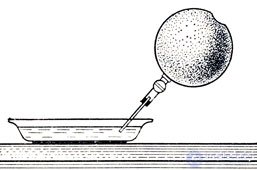
First let us obtain the necessary "equipment": a plate, a medical syringe needle, a volleyball bladder, and a clamp with adjustable pressure, with which one could squeeze a rubber tube – the stem of the volleyball bladder – with varying force. Now let us prepare the experiment. Fill the plate almost to the top with soapy water and add a few drops of glycerin to it. This is so that the bubbles we will blow on the surface of the soapy water come out stable. Inflate the volleyball bladder, clamp its stem, and insert the syringe needle into it (of course, the blunt end). Lower the free end of the needle under the water (not deeply) and loosen the clamp slightly (Fig. 70) – strictly identical portions of air will begin to emerge one after another from the needle, turning into identical soap bubbles. We will need many bubbles later, but for the first experiment we need to manage to create just two bubbles at some distance from each other. If it doesn't work at first, it will work by the fifth try! It is convenient to conduct this experiment with bubbles whose diameter is 1-2 mm.
The bubbles are created, now we can observe them. First very slowly, then accelerating (without our intervention), the bubbles will move toward each other. Upon colliding, they will not touch at a point but will, as it were, press into one another. In doing so, two bubbles of equal size and two bubbles of different sizes will behave somewhat differently. Observe it!
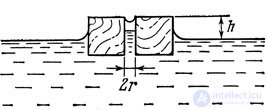
Let us try to understand the origin of the force that makes the bubbles spontaneously approach each other. It is somewhat more convenient to do this by considering not two soap bubbles but two matchsticks lying parallel on the surface of the water. Both bubbles and matchsticks are wetted by the water on which they float, so the general character of the interaction is the same for both. The convenience of this substitution is that two floating bubbles, being close to one another, together with the liquid form a very complex surface, whereas the matchsticks form a much simpler one (Fig. 71). The force that draws two floating matchsticks together arises as follows. Water wets the matchsticks, so its surface near the matchstick curves. The curvature of the surface gives rise to forces acting on the liquid. These are forces due to surface tension, directed in our case vertically upward (we will assume complete wetting). Under the action of these forces, the liquid rises along the walls of the matchsticks, and the rise is much more noticeable in the region between the matchsticks (see Fig. 71). Here the liquid turns out to be, as it were, stretched, and the pressure in it is lowered relative to atmospheric pressure by an amount equal to the additional pressure 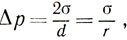 where σ is the surface tension coefficient, d is the distance between the matchsticks, r = d/2 is the radius of curvature of the liquid surface. Consequently, the force of the liquid's pressure on the matchsticks in the region between them is smaller in absolute magnitude than the force of atmospheric pressure acting on the matchsticks from outside. Thus, the absolute magnitude of the force drawing the matchsticks together equals

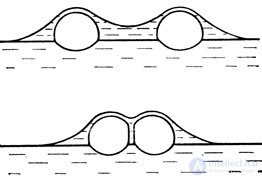
Let us predict a curious phenomenon: since the force F~l/d2, matchsticks in a viscous medium will approach each other with a speed that increases as the distance between them decreases. And not only matchsticks. Bubbles also approach each other with increasing speed (Fig. 72). In our laboratory we observed the approach of bubbles as follows. Above a tray with soap solution and bubbles we placed a movie camera and, when the bubbles began to approach each other, turned it on (Fig. 73).
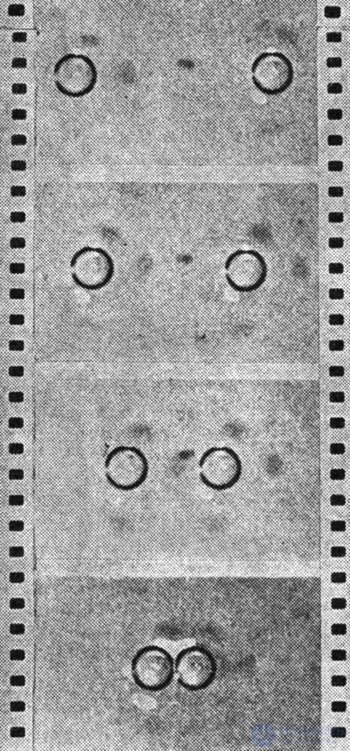
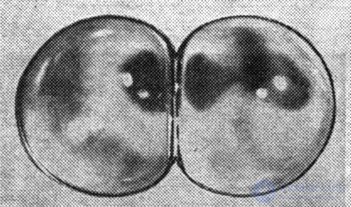
The approach of the bubbles can be traced right up to their collision. After the bubbles collide, a repulsive force begins to act between them. It is caused by the fact that in the mutually indenting bubbles (Fig. 74) the gas pressure increases, which as it were pushes the bubbles apart.
Apparently, soap bubbles are quite suitable for creating a model of a crystal, if not one, not two, but a great many identical bubbles are placed on the surface of the soap solution. If the radius of a bubble is R = 5*10-2 cm, then on the surface of the soap solution in an ordinary plate whose radius is RT ≈ 10 cm, one can fit N~(RT/R)2~4*104 bubbles! Such a raft, made up of bubbles between which forces of attraction and repulsion act, represents a two-dimensional model of a crystal. For example, the authors of this very beautiful model showed that the interaction of bubbles with radius R ∼ 10-1 cm closely resembles the interaction of atoms in a copper crystal.
It would be good to show all readers the film in which the BLN model in action was captured. They would see both an ideal crystal and a crystal with moving and interacting defects, and many simple and complex processes that occur in a real crystal. In this article we can only tell about some of it and illustrate a little of it with photographs and film sequences.
With the help of the BLN model it turned out to be possible to check some consequences of the theory built for a crystal completely free of any defects, the so-called ideal crystal. An experimenter can practically never obtain such a crystal in reality, but building one out of bubbles turned out to be simple and accessible (Fig. 75).
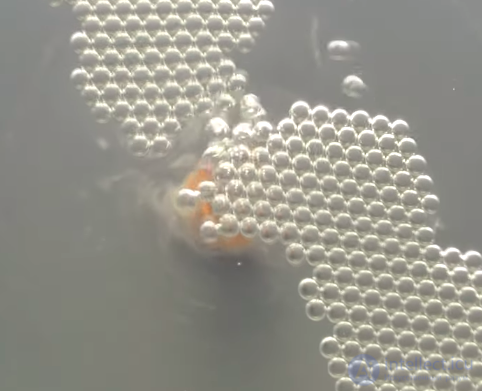
One of the most common defects in crystals is an empty position at a lattice site, not occupied by an atom. Physicists call it a vacancy. In the BLN model, a vacancy is a single burst bubble (Fig. 76). In full agreement with common sense and with the results of experiments on real crystals, the BLN model shows that the volume of one vacancy is somewhat smaller than the volume allotted to an occupied position. Indeed, after a bubble bursts, its former neighbors shift slightly into the resulting empty space and reduce it. This is almost impossible to see with the naked eye, but if one projects the film or photographic footage onto a screen and carefully measures the distances between bubbles, one can confirm that, compared to an occupied position, a vacancy is slightly compressed. For physicists, this evidence from the BLN model is not merely a qualitative illustration; it also has quantitative value.
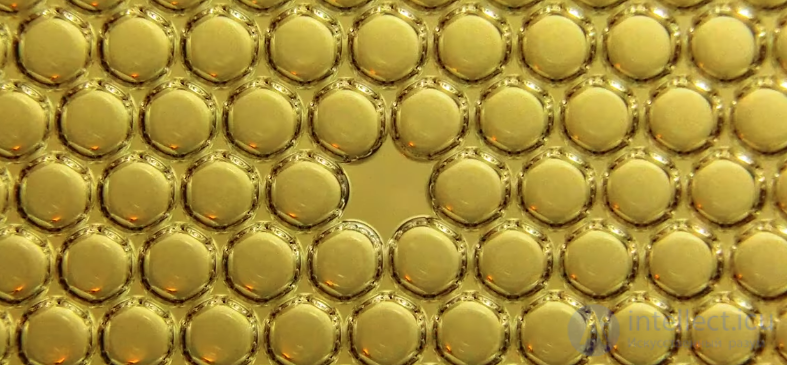
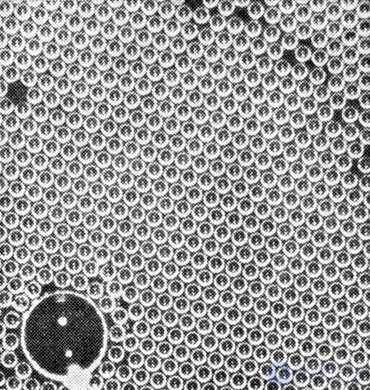
Quite often a crystal, owing to its history, contains a foreign inclusion that deforms the crystal. In solving many problems in the physics of crystals it is very important to know how the atoms surrounding the inclusion are displaced. It turns out that the presence of a foreign inclusion is felt not only by its immediate neighbors but also by atoms located at a considerable distance from the inclusion. The BLN model illustrates this vividly (see Fig. 76).
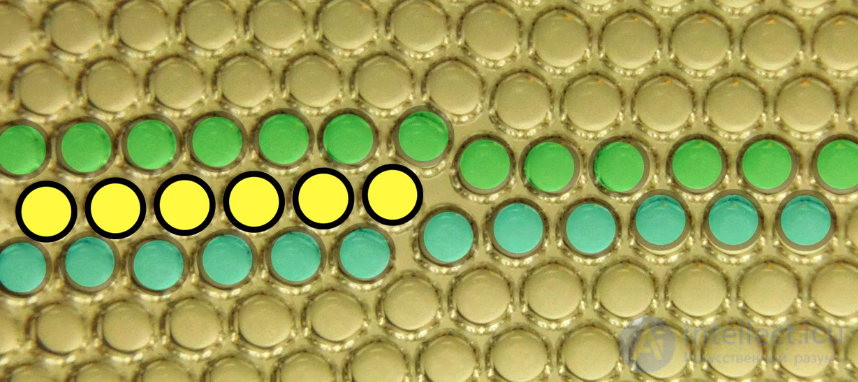
Figure Dislocation
Most crystalline bodies are polycrystals. This means that they consist of many arbitrarily oriented crystallites separated by boundaries. It is almost obvious that many properties of polycrystals (such as mechanical strength or resistance to electric current) should depend on the structure of the boundaries. The BLN model has proved very useful on this question as well: it suggested to crystal physicists how the structure of a boundary changes depending on the mutual orientation of the adjoining crystallites, on the presence of impurities located at the boundary, and much more. Here are a few examples.
In polycrystals a process can occur in which some regions (grains) grow at the expense of others, as a result of which the average grain size increases. This process is called recrystallization and occurs for an obvious reason: the larger the grain size, the smaller the total surface area of the boundaries, and hence the smaller the excess energy associated with the boundaries. The energy of a polycrystal decreases during recrystallization, and consequently this process can occur spontaneously (since it brings the system closer to a state of stable equilibrium in which the energy stored is minimal). Fig. 77 shows a film sequence illustrating the successive stages of a large grain "consuming" a small grain located within it.
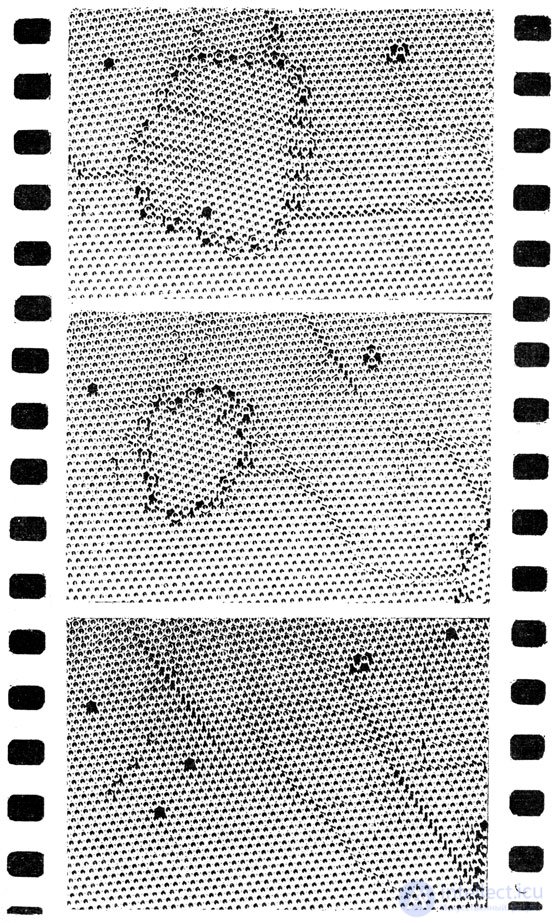
It turns out (this was predicted by theorists and carefully studied by experimenters in experiments with real crystals) that a moving boundary between grains "swallows" the vacancies it encounters along its path. In doing so, the boundary does not change its structure. The BLN model illustrates this phenomenon excellently (Fig. 78).
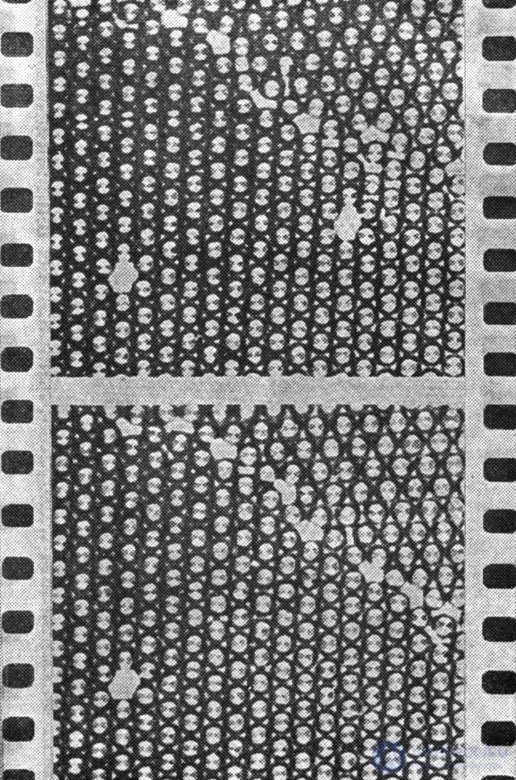
Assuming that the reader has come to feel both respect and trust toward the BLN model, we must now cool that enthusiasm somewhat, by drawing attention both to the limitations of the model and to the "half-truth" contained in it.
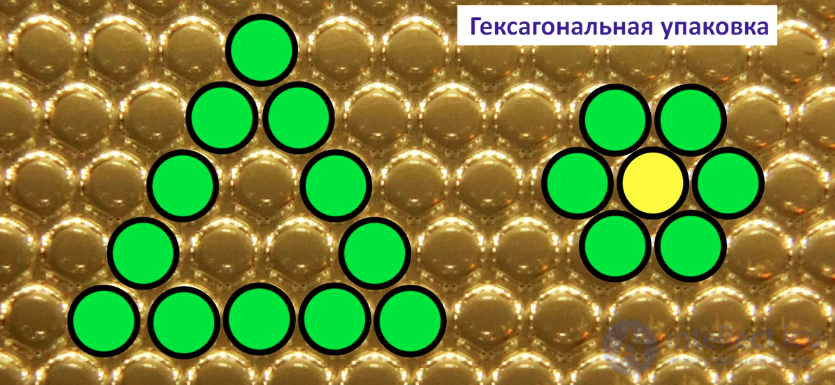
The BLN model is capable of modeling only one structure: two-dimensional, hexagonal, and close-packed. Real crystals, however, have a great many structures. The possibilities of the "dead" model are immeasurably richer, since in it one can arrange things in a countless number of ways and, consequently, can model any conceivable structure. Moreover, the BLN model in its present-day form is two-dimensional. Its authors tried to implement a spatial (multilayer) bubble model as well, but experimenting with it turned out to be far from simple, and the model did not take hold. In our laboratory we implemented both a two-dimensional and a three-dimensional BLN model and confirmed that the three-dimensional one is in fact unviable.
Let us not reproach the model for its weaknesses, some of which we have mentioned and some of which we have passed over. Let us be grateful to it for its strengths.
Crystal defects are any stable disruption of the translational symmetry of a crystal — of the ideal periodicity of the crystal lattice. By the number of dimensions in which the size of a defect substantially exceeds the interatomic distance, defects are divided into zero-dimensional (point), one-dimensional (line), two-dimensional (planar), and three-dimensional (volume) defects.
Zero-dimensional (or point) crystal defects include all defects associated with the displacement or replacement of a small group of atoms (intrinsic point defects), as well as with impurities. They arise during heating, doping, in the process of crystal growth, and as a result of radiation exposure. They can also be introduced as a result of implantation. The properties of such defects and the mechanisms of their formation are the most thoroughly studied, including their motion, interaction, annihilation, and evaporation.
In crystals, complexes consisting of several point defects are also often observed, for example: a Frenkel defect (vacancy + self-interstitial atom), a divacancy (vacancy + vacancy), an A-center (vacancy + oxygen atom in silicon and germanium), and others.
Point defects increase the energy of a crystal, since a certain amount of energy is expended in forming each defect. Elastic deformation accounts for a very small fraction of the energy of vacancy formation, since ion displacements do not exceed 1% and the corresponding deformation energy amounts to tenths of an eV. When an interstitial atom forms, the displacements of neighboring ions can reach 20% of the interatomic distance, and the corresponding lattice elastic deformation energy is several eV. The main fraction of the energy spent forming a point defect is associated with the disruption of the periodicity of the atomic structure and of the bonding forces between atoms. A point defect in a metal interacts with the entire electron gas. Removing a positive ion from a site is equivalent to introducing a point negative charge; the conduction electrons are repelled by this charge, which causes an increase in their energy. Theoretical calculations show that the formation energy of a vacancy in the FCC lattice of copper is about 1 eV, and that of an interstitial atom — from 2.5 to 3.5 eV.
Despite the increase in the energy of the crystal upon the formation of intrinsic point defects, they can exist in thermodynamic equilibrium in the lattice, since their formation leads to an increase in entropy. At elevated temperatures, the growth of the entropy term TS of the free energy {\displaystyle F=U-TS} due to the formation of point defects compensates for the growth of the total energy U of the crystal, and the free energy turns out to be minimal.
Equilibrium concentration of vacancies:
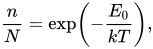
where E0 — is the formation energy of one vacancy, k — is the Boltzmann constant, T — is the absolute temperature. The same formula holds for interstitial atoms. The formula shows that the concentration of vacancies must depend strongly on temperature. The formula for the calculation is simple, but accurate quantitative values can be obtained only by knowing the value of the defect formation energy. Calculating this quantity theoretically is, however, quite difficult, so one must be content with only approximate estimates.
Since the formation energy of a defect appears in the exponent, this difference accounts for the enormous disparity in the concentrations of vacancies and interstitial atoms. For example, at 1000 °C in copper the concentration of interstitial atoms is only 10−39, which is 35 orders of magnitude lower than the concentration of vacancies at this temperature. In close-packed structures, characteristic of most metals, it is very difficult for interstitial atoms to form, and vacancies are the dominant point defects in such crystals (not counting impurity atoms).

Atoms undergoing vibrational motion continuously exchange energy. Due to the randomness of thermal motion, energy is distributed unevenly among different atoms. At some point an atom may receive such a surplus of energy from its neighbors that it takes up a neighboring position in the lattice. This is how the migration (movement) of point defects within the volume of crystals occurs.
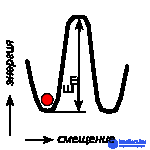
If one of the atoms surrounding a vacancy moves into the vacant site, the vacancy correspondingly moves to its former place. Successive elementary acts of movement of a given vacancy are carried out by different atoms. The figure shows that in a layer of close-packed spheres (atoms), for one of the spheres to move into the vacant site it must push spheres 1 and 2 apart. Consequently, to pass from a position at a site where the atom's energy is minimal to a neighboring vacant site where the energy is also minimal, the atom must pass through a state of elevated potential energy, overcoming an energy barrier. For this, the atom needs to receive a surplus of energy from its neighbors, which it loses while "squeezing" into the new position. The height of the energy barrier Em is called the activation energy of vacancy migration.
The main sources and sinks of point defects are linear and surface defects — see below. In large, nearly perfect single crystals, decomposition of a supersaturated solid solution of intrinsic point defects is possible, with the formation of so-called microdefects.
The simplest complex of point defects is a bivacancy (divacancy): two vacancies located at neighboring lattice sites. Another well-known complex is the so-called Frenkel pair – an interstitial atom and its associated nearby vacancy. Complexes consisting of two or more impurity atoms, as well as of impurity atoms and intrinsic point defects, play a major role in metals and semiconductors. In particular, such complexes can significantly affect the strength, electrical, and optical properties of solids.
One-dimensional (linear) defects are crystal defects whose size in one direction is much greater than the lattice parameter, while in the other two directions it is comparable to it. Linear defects include dislocations and disclinations. General definition: a dislocation is the boundary of a region of incomplete shear in a crystal. Dislocations are characterized by a shear vector (Burgers vector) and the angle φ between it and the dislocation line. At φ=0 the dislocation is called a screw dislocation; at φ=90° – an edge dislocation; at other angles – mixed, and can then be decomposed into screw and edge components. Dislocations arise during crystal growth, during its plastic deformation, and in many other cases. Their distribution and behavior under external influences determine the most important mechanical properties, in particular such as strength and ductility, as well as electrical conductivity, etc. A disclination is the boundary of a region of incomplete rotation in a crystal. It is characterized by a rotation vector.
The main representative defect of this class is the crystal surface. Other cases include material grain boundaries, including low-angle boundaries (which are associations of dislocations), twinning planes, and phase interfaces.
Volume defects. These include clusters of vacancies forming pores and channels; particles settling on various defects (decorating them), such as gas bubbles and mother-liquor bubbles; clusters of impurities in the form of sectors (hourglasses) and growth zones. As a rule, these are pores or inclusions of impurity phases. They represent a conglomerate of many defects. Their origin is a disruption of crystal growth conditions, decomposition of a supersaturated solid solution, or contamination of samples. In some cases (for example, during precipitation hardening), volume defects are deliberately introduced into the material to modify its physical properties.
The main method that helps eliminate defects in a crystal is the zone melting method. This method works well for silicon. A small part of the crystal is melted so that the melt can subsequently be recrystallized. Simple annealing is also used. Defects have a high diffusion coefficient at elevated temperature. Vacancies can migrate to the surface, hence one speaks of the "evaporation" of defects.
During plastic deformation of metals (for example, forging, rolling), numerous dislocations are generated, oriented differently in space, which hinders fracture of the crystal along the dislocation network. This increases the strength of the metal, but at the same time reduces its ductility.
In artificially grown rubies and sapphires for lasers, impurities of elements (Cr, Fe, Ti) are added – coloring centers, which participate in the generation of coherent light.
Часть 1 Crystal Structure and Lattice, Its Modeling, Crystal Defects
Часть 2 Bubble model of a crystal - Crystal Structure and Lattice,

Comments