
Lecture
Dielectric (insulator) (from Ancient Greek διά "through; separately," and Ancient Greek ἤλεκτρον — "amber") — a substance (material) that is relatively poor at conducting electric current. The electrical properties of dielectrics are determined by their ability to polarize in an external electric field. The term was introduced into science by the English physicist M. Faraday .
The concentration of free charge carriers in a dielectric does not exceed 108 cm−3. In electrodynamics, a dielectric is a medium with a small value of the dielectric loss tangent at the frequency under consideration (  ) , in which the conduction current is much smaller than the displacement current.
An "ideal dielectric" is understood to mean a medium with a value of  ; other dielectrics are called "real" dielectrics or dielectrics (media) "with losses." From the standpoint of the band theory of solids, a dielectric is a substance with a band gap width greater than 3 eV.
The study of dielectric properties concerns the storage and dissipation of electric and magnetic energy in materials . The concept of dielectrics is important for explaining various phenomena in electronics, optics, solid state physics, and cell biophysics.
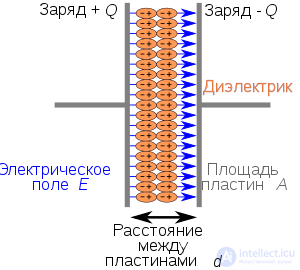
Diagram of a parallel-plate capacitor with a dielectric. Two plates with area  are located at a distance {\displaystyle d}
 apart. When charge
  is present on the plates, an electric field
  arises in the gap between the plates. The dielectric becomes polarized due to the displacement of charges in its molecules and atoms, reducing the overall internal field and increasing the electrical capacitance of the capacitor.
Although the term "insulator" implies low electrical conductivity, dielectric usually refers to materials with high polarizability. The latter is expressed by a number called the relative permittivity. The term "insulator" is usually used to denote electrical nonconductivity, whereas the term "dielectric" is used to emphasize a material's ability to store energy through polarization.
The term "dielectric" was coined by William Whewell in response to a request from Michael Faraday . An ideal dielectric is a material with zero electrical conductivity
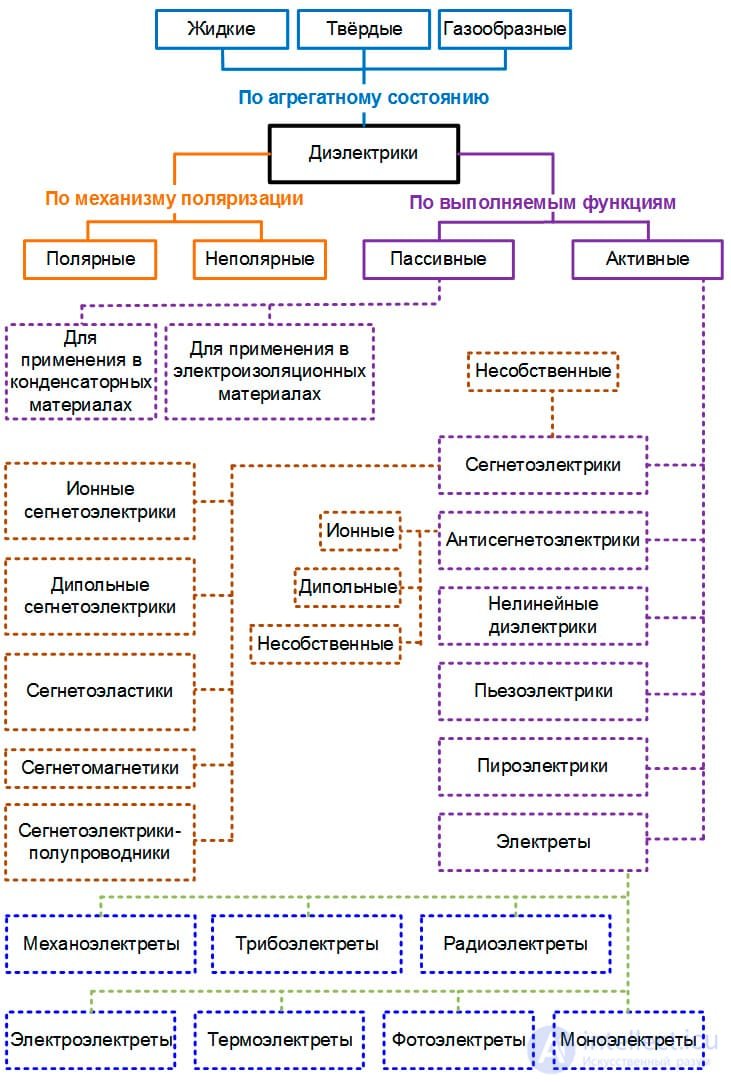
Figure 1 – Classification of dielectrics
Polarization is the state of a dielectric characterized by the presence of an electric moment in any element of its volume.
A distinction is made between polarization arising under the action of an external electric field, and spontaneous polarization, which exists in the absence of a field. In some cases, polarization also arises under the action of mechanical stresses.
The ability of various materials to polarize in an electric field is characterized by the relative permittivity
ε = Cd /C0 ,
where Cd – is the capacitance of a capacitor with the given dielectric; C0 – is the capacitance of the same capacitor in vacuum. The absolute permittivity of a dielectric should be defined as the product:
ε = ε0εdiel ,
where ε0 = 8.854⋅10−12F/m – is the electric constant (permittivity of vacuum).
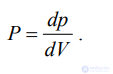
Polarization is accompanied by the appearance of bound electric charges on the surface of dielectrics, which reduce the field strength inside the substance. The quantitative characteristic of polarization is the polarization of the dielectric. Polarization P – a vector physical quantity equal to the ratio of the electric moment dp of an element of the dielectric to the volume dV of that element, expressed in C/m2:
The polarization of a homogeneous flat dielectric in a uniform electric field equals the surface density of the bound charges. For most dielectrics in weak electric fields, the polarization is proportional to the field strength:
P = ε0(ε−1)E = ε0χE ,
where χ – is the dielectric susceptibility.
In isotropic dielectrics, the directions of the vectors P and E coincide. In strong electric fields, the linear relationship between polarization and field strength breaks down.
Dielectric susceptibility (or polarizability) of a substance — a physical quantity, a measure of a substance's ability to polarize under the action of an electric field. The dielectric susceptibility  — is the coefficient of the linear relationship between the polarization of the dielectric
  and the external electric field
  in sufficiently weak fields:

In the SI system:

where  — is the electric constant; the product
  is called, in the SI system, the absolute dielectric susceptibility.
In the case of vacuum

For dielectrics, the dielectric susceptibility is generally positive. Dielectric susceptibility is a dimensionless quantity.
Polarizability is related to the permittivity ε by the relation :
 (CGS)
(CGS)
 (SI)
(SI)
In the general case, a substance cannot polarize instantaneously in response to an applied electric field, so the more general formula contains time:

This means that the polarization of a substance is a convolution of the electric field in the past with the time-dependent susceptibility as  The upper limit of this integral can be extended to infinity if we define
  for
for  An instantaneous response corresponds to the Dirac delta function
  .
.
In a linear system, it is convenient to use the continuous Fourier transform and write this relation as a function of frequency. Thanks to the convolution theorem, this integral becomes an ordinary product:

This dependence of the dielectric susceptibility on frequency leads to the dispersion of light in the substance.
The fact that, due to the principle of causality, polarization can depend only on the electric field in the past (that is, for  ), imposes constraints on the susceptibility
  called the Kramers–Kronig relations.
In anisotropic crystals, the susceptibility is characterized by a tensor  , so that the relationship between the polarization vector and the electric field strength vector is expressed as:

where summation is implied over repeated indices.
From the law of conservation of energy, it can be derived that the tensor is symmetric:

In isotropic crystals, the off-diagonal components of the tensor are identically zero, and all the diagonal components are equal to one another.
In the application of dielectrics, one of the most extensive classes of electrical engineering materials, the need to use both passive and active properties has become quite clearly defined.
Dielectrics are used not only as insulating materials.
The passive properties of dielectric materials are used when they are employed as electrical insulating materials and as dielectrics in conventional types of capacitors. Electrical insulating materials are dielectrics that do not allow the leakage of electric charges, that is, they are used to separate electrical circuits from one another, or to separate current-carrying parts of devices, instruments, and apparatus from conductive but non-current-carrying parts (from the housing, from "ground"). In these cases, the permittivity of the material does not play a special role, or it should be as small as possible so as not to introduce parasitic capacitances into the circuits. If the material is used as the dielectric of a capacitor of a certain capacitance and the smallest dimensions, then, all else being equal, it is desirable for this material to have a high permittivity.
Active dielectrics, whose dielectric properties depend on the applied voltage and the influence of the external environment, include ferroelectrics, piezoelectrics, pyroelectrics, electroluminophores, materials for emitters and shutters in laser technology, electrets, and others.

Comments