
Lecture
When electrical systems operate at high frequencies (typically above hundreds of kilohertz and higher), the flow of electric current through conductors can encounter certain physical phenomena. This is because at high frequencies the direction and magnitude of the current change at a high rate, which affects the distribution of current within the conductor. At high frequencies, an uneven distribution of electric current is observed across the cross section of the conductor:
the current density is maximal at the surface and decreases as it penetrates deeper into the conductor. This phenomenon is called the surface effect (skin effect).
The uneven distribution of current is explained by the action of the magnetic field of the same conductor. The magnetic flux linked with the wire is proportional to the current:
Φ = Li ,
where L – is the inductance of the conductor.
A change in the magnetic flux causes the appearance of a self-induction EMF
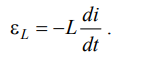
If the current varies according to a sinusoidal law i = Im sinωt , then the induced EMF is proportional to the frequency:
εL = −ωLIm cosωt .
The self-induction EMF has a direction opposite to the current in the wire and opposes its change in accordance with Lenz's law. When alternating current flows, an alternating magnetic field arises both outside and inside the conductor, and with respect to this field, different sections of the wire's cross section are not in identical conditions. Indeed, the flux linkage is maximal for the surface layers of the conductor. Therefore, the self-induction EMF is maximal at the center of the conductor and decays toward the surface. Correspondingly, the current density is weakened most strongly in the central parts of the conductor and to a lesser extent near the surface. As frequency increases, the "displacement" of current toward the surface of the conductor becomes more pronounced, since the self-induction EMF is proportional to frequency.
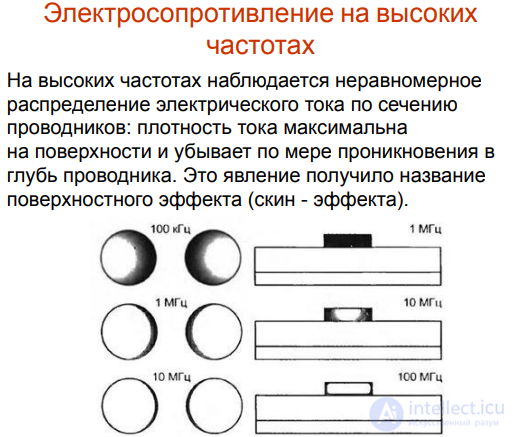
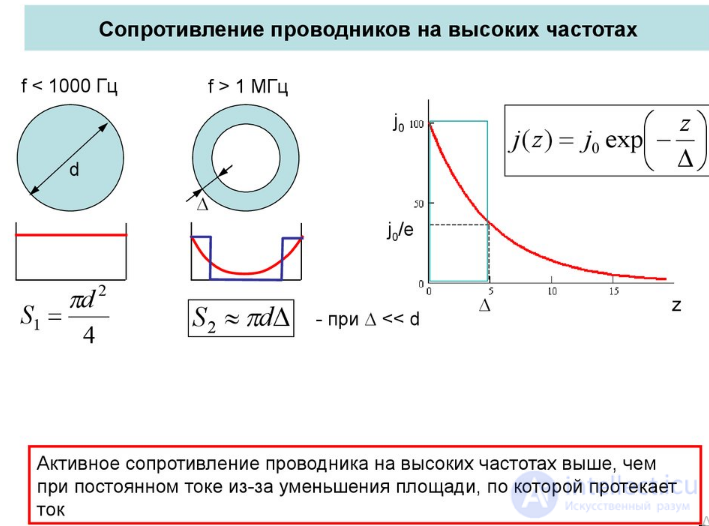
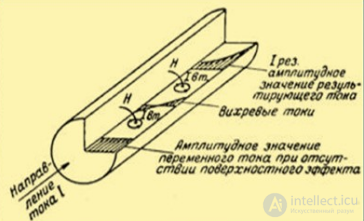
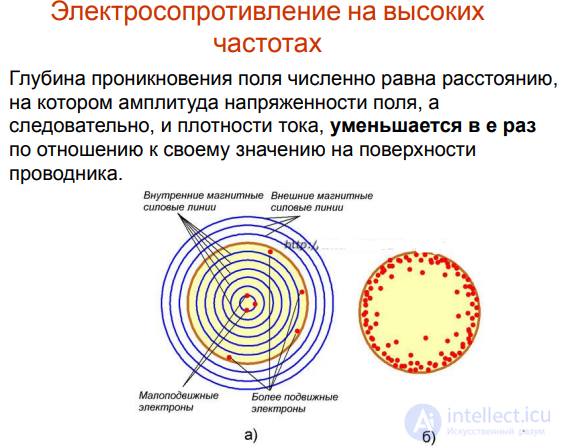
Skin effect – is a phenomenon in which, at high frequencies, current concentrates closer to the surface of a conductor, while part of the interior of the conductor remains less utilized for carrying current. This occurs due to the interaction between the magnetic field created by the flowing current and the conductor. As a result, at high frequencies the current concentrates in a thin layer at the surface of the conductor, while the inner layers experience a decrease in current.
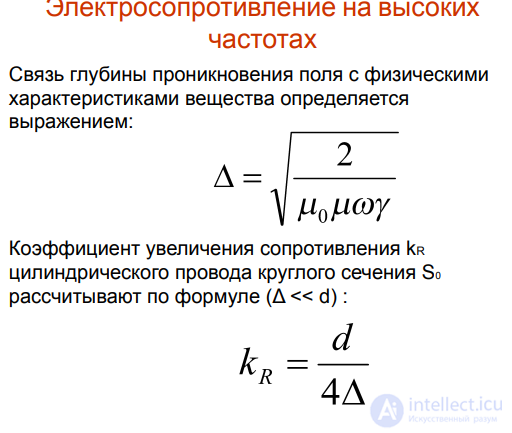
The skin effect is characterized by the penetration depth of the electromagnetic field into a metal conductor: the higher the frequency of the field, the shallower the depth to which it penetrates the conductor.
The skin effect leads to an increase in the effective resistance of the conductor at high frequencies, which can be a problem when transmitting large currents or high-frequency signals. To reduce the influence of the skin effect in conductors at high frequencies, special techniques are used, such as stranded wires and flat ribbon conductors.
It is important to understand that the behavior of conductors at high frequencies and the skin effect are closely related to the theory of electromagnetism and are widely applied in modern technologies, such as electric power transmission, radio communications, telecommunications, and other high-frequency applications.
The dependence of Rs (resistance) and Δ (field penetration depth) on the field frequency for some of the most important metals and alloys of high conductivity is shown in Fig. 2
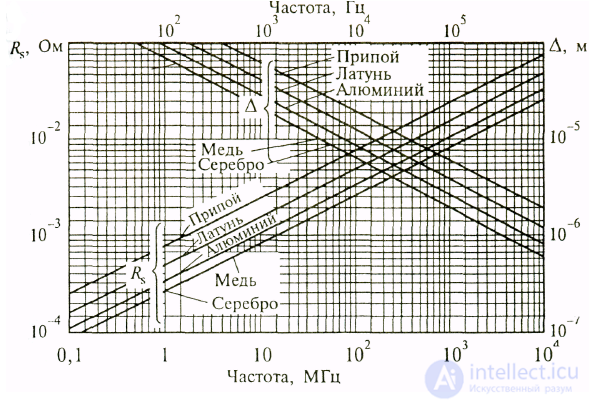
Fig. 2. Dependence of the skin-effect resistance Rs and the field penetration depth Δ on frequency for flat conductors. The values of Rs and Δ on the lower frequency scale are read directly; on the upper frequency scale, the Rs value is multiplied by 10—2, and Δ by 10—2
Electric power engineering: In electric power engineering, the skin effect can affect the transmission of high-frequency currents along electrical lines, which can lead to increased energy losses and overheating of wires. This is especially relevant for high-voltage lines and systems operating at radio-frequency-range frequencies.
Radio communications and telecommunications: In the field of radio communications and telecommunications, the skin effect can affect the quality of signal transmission through wires, antennas, and cables. It can lead to signal loss, distortion, and problems with data transmission at high frequencies.
Electronics: In high-frequency electronic devices, such as radio receivers, transmitters, radars, and others, the skin effect can affect wires, printed circuit boards, and other circuit elements, which may require special technical solutions to minimize its impact.
Induction heating: In industry, where induction heating is used, the skin effect can be a problem when working with wires and other materials that need to be heated at high frequencies.
High-frequency power applications: In some industrial systems, such as induction furnaces and high-frequency generators, the skin effect can affect the efficiency of electric power transmission and require special measures to reduce losses.
In general, the skin effect must be taken into account in all cases where working with high frequencies or transmitting high-frequency signals and currents matters. It can affect the performance, efficiency, and reliability of various systems and devices, so appropriate methods and technical solutions must be applied to reduce its impact.

Comments