
Lecture
Polarization of dielectrics — a phenomenon associated with the limited displacement of bound charges in a dielectric or the rotation of electric dipoles, usually under the action of an external electric field, and sometimes under the action of other external forces or spontaneously.
The polarization of dielectrics is characterized by the electric polarization vector. The physical meaning of the electric polarization vector is the dipole moment per unit volume of the dielectric. The polarization vector is sometimes referred to simply as the polarization.
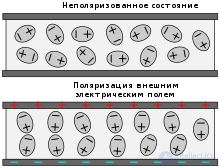
Schematic representation of dipole orientation in a dielectric medium under the action of an electric field
Polarization is the state of a dielectric characterized by the presence of an electric dipole moment in any (or almost any) element of its volume.
A distinction is made between polarization induced in a dielectric under the action of an external electric field, and spontaneous polarization, which arises in ferroelectrics in the absence of an external field. In some cases, polarization of a dielectric (ferroelectric) occurs under the action of mechanical stresses, friction forces, or as a result of a change in temperature.
Polarization does not change the total charge in any macroscopic volume within a homogeneous dielectric. However, it is accompanied by the appearance of bound electric charges of a certain surface density σ on its surface. These bound charges create an additional macroscopic field in the dielectric with field strength  , directed against the external field with field strength
  . As a result, the field strength
  inside the dielectric is expressed by the equation:

Depending on the mechanism of polarization, the polarization of dielectrics can be subdivided into the following types:
The polarization of dielectrics (with the exception of resonant polarization) is maximal in static electric fields. In alternating fields, due to the inertia of electrons, ions, and electric dipoles, the electric polarization vector depends on frequency.
Comparative parameters of different types of polarization
| Polarization | Particle displacement, nm, in a field of  V/m V/m |
Relaxation time, s | Particle concentration,  |
| Elastic (displacement) |  |
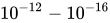 |
 |
| Thermal (hopping) |  |
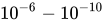 |
 |
| Space-charge (migration) | |
 |
 |
In a constant or sufficiently slowly time-varying external electric field, at a sufficiently small value of this field's strength, the polarization vector P, as a rule (ferroelectrics being an exception), depends linearly on the field strength vector E:
 (in the CGS system),
 (in the International System of Units (SI); further formulas in this section are given only in CGS, the SI formulas below differing only by the electric constant
  )
)
where  — a coefficient dependent on the chemical composition, concentration, structure (including the state of aggregation) of the medium, temperature, mechanical stresses, etc. (more strongly on some factors, more weakly on others, and of course also depending on the range of variation of each), called the (electric) polarizability (or more often, at least in the case where it is expressed as a scalar, the dielectric susceptibility) of the given medium. For a homogeneous medium of fixed composition and structure under fixed conditions, it can be considered a constant. However, in view of everything said above, in general depends on the point in space, time (explicitly or through other parameters), and so on.
For isotropic liquids, isotropic solids, or crystals of sufficiently high symmetry, is simply a number (a scalar). In the more general case (for crystals of low symmetry, under the action of mechanical stresses, etc.), is a tensor (a symmetric second-rank tensor, generally non-degenerate), called the polarizability tensor. In this case the formula can be rewritten as follows (in components):
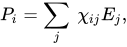
where the subscripted quantities correspond to the components of the vectors and tensor along the three spatial coordinates.
It can be noted that polarizability is one of the most convenient physical quantities for a simple illustration of the physical meaning of tensors and their application in physics.
As with any symmetric non-degenerate second-rank tensor, for the polarizability tensor one can choose (if the medium is inhomogeneous — that is, if the tensor depends on the point in space — then at least locally, while if the medium is homogeneous, then globally as well) a so-called principal basis — rectangular Cartesian coordinates in which the matrix  becomes diagonal, that is, takes a form in which, of the nine components , only three are nonzero:
  ,
,  , and
, and  . In this case, denoting
  for simplicity as
  , we obtain a simpler expression instead of the previous formula

The quantities are called the principal polarizabilities (or principal dielectric susceptibilities). If the medium is isotropic with respect to polarizability, then all three principal polarizabilities are equal to one another, and the action of the tensor reduces to simple multiplication by a number.
In sufficiently strong fields everything described above is complicated by the fact that, as the electric field strength grows, the linearity of the dependence of P on E is sooner or later lost.
The nature of the resulting nonlinearity and the characteristic field value at which the nonlinearity becomes noticeable also, of course, depend on the individual properties of the medium, conditions, etc.
Their connection with the types of polarization described above can be highlighted.
Thus, for electronic and ionic polarization, at fields approaching values on the order of the ratio of the ionization potential to the characteristic size of the molecule U0/D, one first observes an acceleration in the growth of the polarization vector as the field increases (an increase in the slope of the P(E) graph), which then smoothly transitions into dielectric breakdown.
Dipolar (orientational) polarization, at usually somewhat lower values of the external field strength — on the order of kT/p (where p is the dipole moment of the molecule, T is the temperature, and k is the Boltzmann constant) — that is, when the interaction energy of the dipole (molecule) with the field becomes comparable to the average energy of the thermal motion (rotation) of the dipole — instead begins to approach saturation (with further increase in field strength, the scenario of electronic or ionic polarization described above should sooner or later set in, ending in breakdown).
The dependence of the polarization vector on a rapidly time-varying external field is rather complex. It depends on the specific form of the time variation of the external field, the rapidity of this variation (or, say, the oscillation frequency) of the external field, and the prevailing polarization mechanism in the given substance or medium (which also turns out to differ for different time-dependences of the external field, frequencies, etc.).
With a sufficiently slow change in the external field, polarization as a whole occurs as in a constant field, or very close to it (although how slow the change in the field must be for this depends, often very strongly, on the prevailing type of polarization and other conditions, such as temperature).
One of the most common approaches to studying the dependence of polarization on the nature of a time-varying field is to investigate (theoretically and experimentally) the case of a sinusoidal time-dependence of the external field, and the dependence of the polarization vector's amplitude and phase shift on frequency (the polarization vector also varying sinusoidally in this case, at the same frequency).
Each polarization mechanism generally corresponds to a particular frequency range and general character of frequency dependence.
The frequency range in which it makes sense to speak of dielectric polarization as such extends from zero up to somewhere in the ultraviolet region, where field-induced ionization becomes intense.
Electronic polarization is the deformation and elastic displacement of the electron clouds of atoms and ions. A diagram of atoms in the absence and presence of an electric field is shown in Fig. 4.1. The establishment time of electronic polarization is vanishingly small (about 10–15 s). Therefore, electronic polarization manifests itself at all frequencies, up to 1014 … 1016 Hz.
Electronic polarization is observed in all types of dielectrics. The polarizability of particles under electronic polarization does not depend on temperature, while the permittivity ε decreases with increasing temperature due to expansion and the resulting decrease in the number of particles per unit volume.
Ionic polarization is characteristic of solids with an ionic structure and is caused by the displacement of ions over distances smaller than the lattice period. The ionic polarization of a rock-salt crystal, in which sodium ions are displaced in the direction of the electric field and chlorine ions against the direction of the field, is shown in Fig. 4.2.
The displacement of ions under the action of the field is opposed by the elastic forces of the chemical bond. The displacement of two oppositely charged ions gives rise to an elementary electric moment. The sum of all such elementary moments per unit volume determines the ionic contribution to the dielectric's polarization.
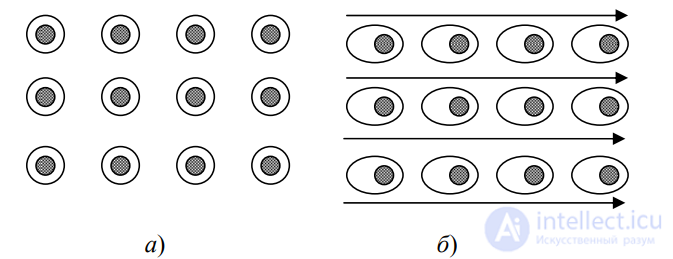
Fig. 4.1. Atoms (a) in the absence of an electric field, and (b) with a field applied
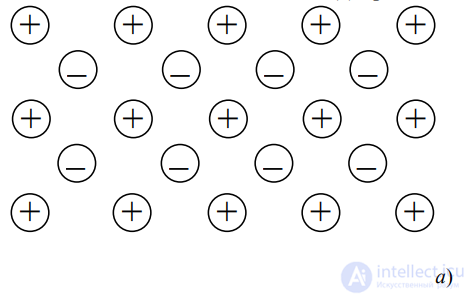
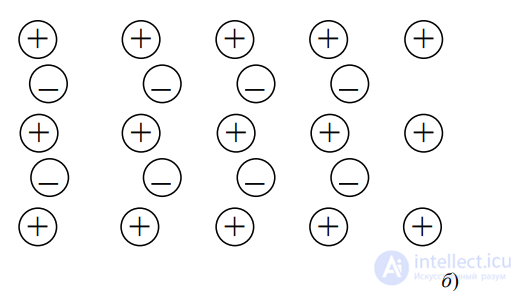
Fig. 4.2. Ionic lattice of rock salt:
a – in the absence of an electric field; b – displacement of ions under the action of a field. As temperature rises, the distances between ions increase due to thermal expansion of the material. In most cases this is accompanied by a weakening of the elastic bonding forces and an increase in the dielectric's polarization. The establishment time of ionic polarization is on the order of 10–13 s.
Dipole-relaxation polarization differs from electronic and ionic polarization in that dipolar molecules, which are in chaotic thermal motion, become partially oriented under the action of the field (Fig. 4.3), which is the cause of the polarization.
Dipole-relaxation polarization is possible if molecular forces do not prevent the dipoles from orienting along the electric field. As temperature increases, molecular forces weaken, which should strengthen dipole-relaxation polarization. However, at the same time, the energy of the thermal motion of the molecules increases, which reduces the orienting influence of the field.
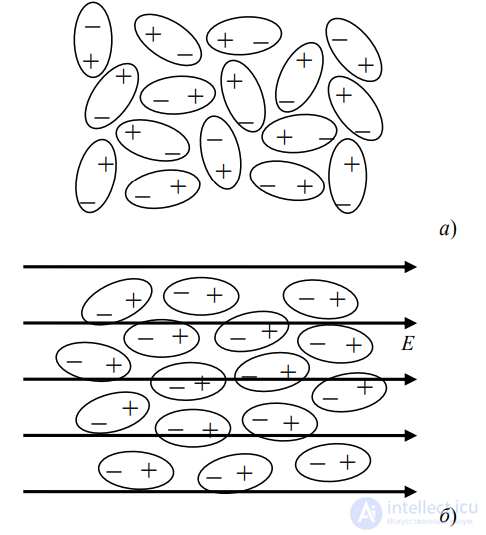
Fig. 4.3. Arrangement of dipolar molecules without a field (a) and with an electric field applied (b)
The rotation of dipoles in the direction of the field in a viscous medium requires overcoming a certain resistance, and therefore dipole-relaxation polarization is associated with energy losses and heating of the dielectric. In viscous liquids, the resistance to rotation of the molecules is so great that in high-frequency fields the dipoles do not have time to orient in the direction of the field, and dipole-relaxation polarization decreases with increasing frequency of the applied voltage.
Dipole-relaxation polarization is characteristic of polar liquids; this type of polarization can also be observed
in solid polar organic substances as well.
Ion-relaxation polarization is observed in ionic dielectrics with a loose packing of ions, for example in
inorganic glasses, and in certain crystalline substances.
In this case, weakly bound ions of the substance, under the action of an external electric field, receive, among the chaotic thermal jumps, an excess of jumps in the direction of the field and are displaced over distances exceeding the lattice constant. After the electric field is removed, the ions gradually return to their equilibrium positions, i.e., this mechanism can be classified as a form of relaxation polarization.

Comments