
Lecture
Along with metals and metal alloys, various composite materials, some oxides and conductive modifications of carbon are quite widely used as resistive, contact and current-carrying elements. As a rule, these materials have a narrowly specialized purpose.
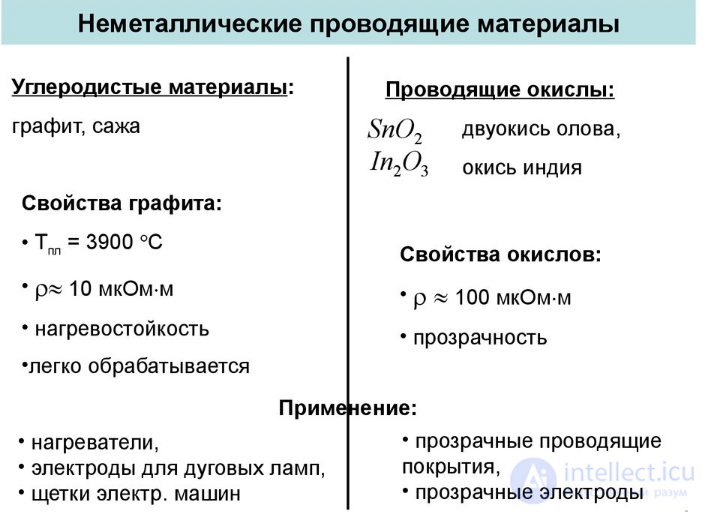
Carbon materials. Among solid non-metallic conductors, graphite – one of the forms of pure carbon – has found the widest application in electrical engineering. Along with low resistivity, the valuable properties of graphite are its significant thermal conductivity, resistance to many chemically aggressive environments, high heat resistance, and ease of machining. Natural graphite, anthracite and pyrolytic carbon are used for the production of electro-carbon products.
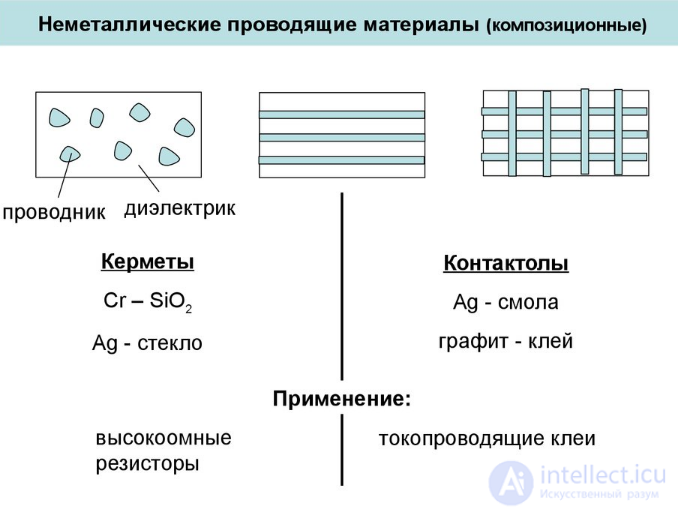
Composite conductive materials. Composite materials are a mechanical mixture of a conductive filler with a dielectric binder. By varying the composition and the distribution pattern of the components, it is possible to control the electrical properties of such materials within fairly wide limits. A characteristic feature of all composite materials is the frequency dependence of conductivity and aging under prolonged loading. In a number of cases, a noticeable nonlinearity of electrical properties is observed.
Metals, graphite, carbon black, some oxides and carbides are used as components of the conductive phase. The functions of the binding substance can be performed by both organic and inorganic dielectrics.
Among the variety of combined conductive materials, contactols and cermets deserve the most attention.
Contactols, used as conductive adhesives, paints, coatings and enamels, are low-viscosity or paste-like polymer compositions. Various synthetic resins (epoxy, phenol-formaldehyde, silicone, etc.) are used as the binding substance in them. The conductive filler consists of finely dispersed metal powders (silver, nickel, palladium). The viscosity required for contactols before application is provided by the introduction of solvents (acetone, alcohol, etc.).
Cermets are metal-dielectric compositions with an inorganic binder. They are intended for the manufacture of thin-film resistors.
Conductive materials based on oxides. The overwhelming majority of pure metal oxides under normal conditions are good dielectrics. However, with incomplete oxidation (when the stoichiometric composition is disrupted due to the formation of oxygen vacancies), as well as with the introduction of certain impurities, the conductivity of the oxides increases sharply. Such materials can be used as contact and resistive layers. Of the greatest practical interest in this regard is tin dioxide. Thin layers of tin dioxide have high optical transparency in the visible and infrared parts of the spectrum. The combination of high electrical conductivity and optical transparency makes it possible to use tin dioxide as transparent conductive layers.
Besides tin dioxide, films of indium oxide In2O3 also possess high electrical conductivity and transparency in the visible region of the spectrum. They have a similar application.

Comments