
Lecture
ferromagnetism — the appearance of spontaneous magnetization below the Curie temperature as a result of the ordering of magnetic moments, in which most of them are parallel to one another. This is the primary mechanism by which certain materials (for example, iron) form permanent magnets or are attracted to magnets. Substances in which ferromagnetic ordering of magnetic moments arises are called ferromagnets
In physics it is customary to distinguish several types of magnetism. Ferromagnetism (together with the closely related effect of ferrimagnetism) is the strongest type of magnetism and is responsible for the physical phenomenon of magnetism in magnets encountered in everyday life. Substances with the three other types of magnetism — paramagnetism, diamagnetism, and antiferromagnetism — respond more weakly to magnetic fields, but the forces are usually so weak that they can only be detected using sensitive instruments in a laboratory.
A everyday example of ferromagnetism is the refrigerator magnet used to hold notes on the refrigerator door. It is also used in many household appliances: aquarium filters and washing machines (the rotor of a synchronous motor combined with the impeller of a centrifugal pump), low-power DC motors as field excitation, and brushless motors for computer fans. The attraction between a magnet and a ferromagnetic material is a quality of magnetism that has been observed since ancient times
Permanent magnets, produced from materials that can be magnetized by an external magnetic field and remain magnetized after the external field is removed, are made of ferromagnetic or ferrimagnetic substances, as are the materials attracted to them. Only a few chemically pure substances possess ferromagnetic properties. The most common of them are iron, cobalt, nickel, and gadolinium. Most of their alloys, as well as some rare-earth compounds, exhibit ferromagnetism. Ferromagnetism is very important in industry and modern technology and forms the basis for many electrical and electromechanical devices, such as electromagnets, electric motors, generators, transformers, and magnetic storage media, tape recorders and hard disks, as well as for the nondestructive testing of ferrous metals.
Ferromagnetic materials can be divided into magnetically soft materials, such as annealed iron, which can be magnetized but does not tend to remain magnetized, and magnetically hard materials, which retain remanent magnetization. Permanent magnets are made from «hard» ferromagnetic materials, such as alnico, and ferrimagnetic materials, such as ferrite, which during manufacturing undergo special processing in a strong magnetic field to align their internal microcrystalline structure, making them difficult to demagnetize. To demagnetize a ''saturated magnet'', a certain magnetic field must be applied, which depends on the material's coercive force. «Hard» materials have high coercive force, whereas «soft» materials have low coercive force. The overall strength of a magnet is measured by its magnetic moment or, alternatively, by the total magnetic flux it produces. The local strength of magnetism in a material is characterized by its magnetization.
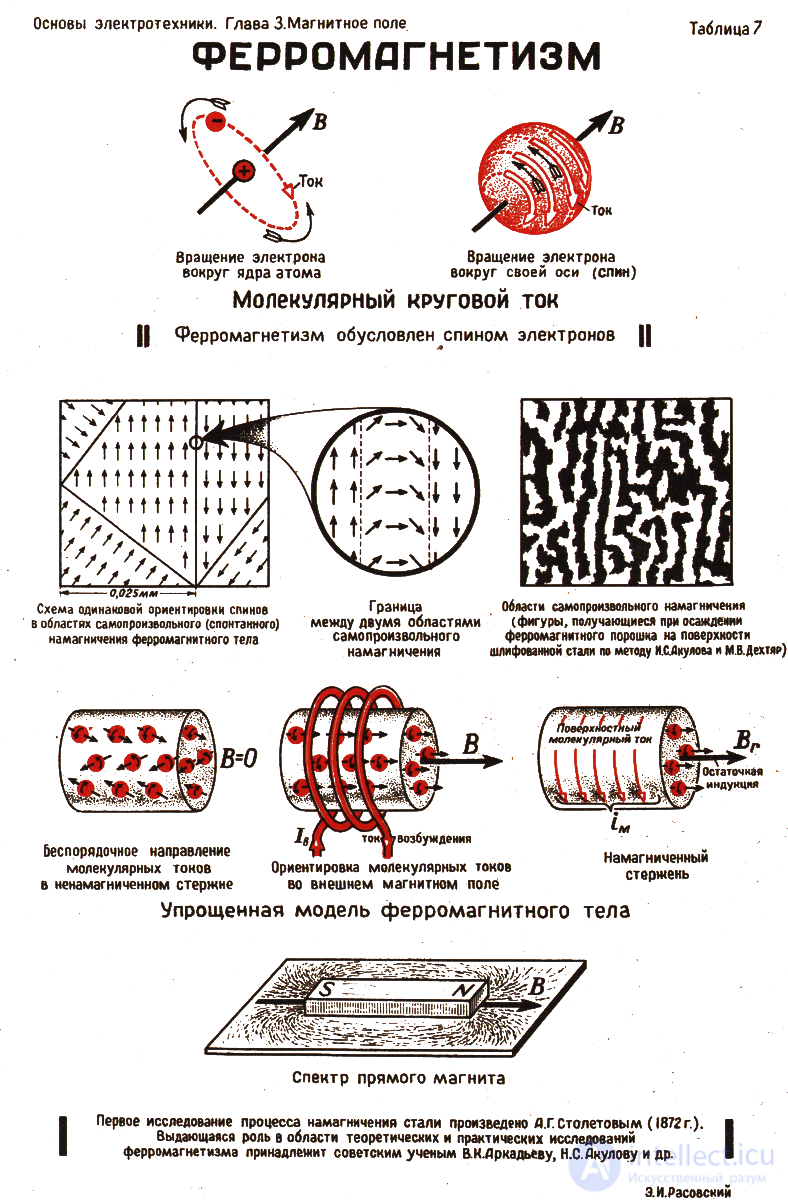
Historically, the term ferromagnetism was used for any material that could exhibit spontaneous magnetization: that is, a net magnetic moment in the absence of an external magnetic field, any material that could become a magnet. This general definition is still widely used today.
However, in a landmark 1948 paper, Louis Néel showed that there are two levels of magnetic ordering that lead to such behavior. One of them is ferromagnetism in the strict sense of the word, where all magnetic moments are aligned — pointing in the same direction. The other is ferrimagnetism, in which some magnetic moments point in the opposite direction but contribute less, so that spontaneous magnetization still exists.
In the special case where the opposing moments completely balance one another, the alignment is known as antiferromagnetism. Consequently, antiferromagnets do not possess spontaneous magnetization.
| Material | Curie temperature (K) |
|---|---|
| Co | 1388 |
| Fe | 1043 |
| Fe 2 O 3 * | 948 |
| FeOFe 2 O 3 * | 858 |
| NiOFe 2 O 3 * | 858 |
| Cu OFe 2 O 3 * | 728 |
| MgOFe 2 O 3 * | 713 |
| Mn Bi | 630 |
| Ni | 627 |
| Nd 2 Fe 14 B | 593 |
| Mn Sb | 587 |
| MnOFe 2 O 3 * | 573 |
| Y3Fe5O12 * | 560 |
| CrO 2 | 386 |
| Mn As | 318 |
| Gd | 292 |
| Tb | 219 |
| Dy | 88 |
| EuO | 69 |
| * Ferrimagnetic material |
Ferromagnetism is an unusual property that occurs in only a few substances. The most common are the transition metals – iron, nickel, cobalt, and their alloys, as well as alloys of rare-earth metals. This property depends not only on the chemical composition of the material but also on its crystal structure and microstructure. There are ferromagnetic metallic alloys whose components are not themselves ferromagnetic. Such alloys are called Heusler alloys (named after Fritz Heusler). Conversely, there are nonmagnetic alloys, such as stainless steel, composed almost entirely of ferromagnetic metals.
Amorphous (noncrystalline) ferromagnetic metallic alloys can be obtained by very rapid quenching (cooling) of the liquid alloy. Their advantage is that their properties are almost isotropic (independent of direction); this leads to low coercive force, low hysteresis losses, high magnetic permeability, and high electrical resistivity. One typical example of such materials is an alloy consisting of a transition metal and metalloids. For example, of 80% transition metal (usually Fe, Co, or Ni) and 20% metalloid component (B, C, Si, P, or Al), which lowers the melting point.
Rare-earth magnets are a relatively new class of exceptionally strong ferromagnetic materials. They contain lanthanides, which are known for their ability to carry large magnetic moments on strongly localized f-orbitals.
The table lists ferromagnetic and ferrimagnetic compounds, along with the Curie temperature above which they cease to exhibit spontaneous magnetization.
Most ferromagnetic materials are metals, since conduction electrons are often responsible for ferromagnetic interactions. Therefore, developing ferromagnetic insulators, especially multiferroic materials that exhibit both ferromagnetic and ferroelectric properties, is a challenging task.
A number of actinide compounds are ferromagnetic at room temperature or exhibit ferromagnetism upon cooling. PuP is a paramagnet with a cubic crystal lattice at room temperature, but undergoes a structural transition to a tetragonal phase with ferromagnetic order upon cooling below its TC = 125 K. In the ferromagnetic state, the easy magnetization axis of PuP is oriented along the <100> direction.
In NpFe 2 the easy axis is <111>. Above TC ≈ 500 K, NpFe 2 is also paramagnetic and has a cubic crystal structure. Cooling below the Curie temperature causes a rhombohedral distortion, in which the rhombohedral angle changes from 60° (cubic phase) to 60.53°. Put another way, this distortion can be described by considering the lengths c along the single trigonal axis (after the onset of distortion) and a as the in-plane distance perpendicular to c. In the cubic phase this reduces to c/a=1. At temperatures below Tc

This is the largest distortion among all actinide compounds] NpNi 2 undergoes a similar lattice distortion below TC = 32 K with a strain of (43 ± 5) × 10 −4 . NpCo 2 turns out to be ferrimagnetic below 15 K.
In 2009, a group of physicists at MIT demonstrated that lithium gas, cooled to below one kelvin, can exhibit ferromagnetism. The research team cooled fermionic lithium-6 to below 150 nK (150 billionths of a kelvin) using infrared laser cooling. This is the first demonstration of ferromagnetism in a gas.
In 2018, a group of physicists from the University of Minnesota demonstrated that body-centered tetragonal ruthenium exhibits ferromagnetism at room temperature.
Recent studies have shown that ferromagnetism can be induced in some materials by electric current or voltage. Antiferromagnetic LaMnO3 and SrCoO switch into a ferromagnetic state under current. In July 2020, scientists reported the creation of ferromagnetism in the widely used diamagnetic material pyrite, under an applied voltage. In these experiments the ferromagnetism was confined to a thin surface layer.
The Bohr — van Leeuwen theorem, proved in the 1910s, established that theories of classical physics cannot explain any form of magnetism, including ferromagnetism. Magnetism is now regarded as a purely quantum-mechanical effect. Ferromagnetism arises from two quantum-mechanical effects: spin and the Pauli exclusion principle.
One of the fundamental properties of the electron (besides the fact that it carries charge) is that it possesses a magnetic dipole moment, that is, it behaves like a tiny magnet, creating a magnetic field. This dipole moment arises from a more fundamental property of the electron — its spin. Because of its quantum nature, an electron's spin can be in one of two states: with the magnetic field pointing «up» or «down» (for any choice of up and down directions). The spin of electrons in atoms is the primary source of ferromagnetism, although there is also a contribution from the electron's orbital angular momentum relative to the atomic nucleus. When these magnetic dipoles in a piece of matter are aligned (their spins pointing in the same direction), their individual magnetic fields add together to create a much larger macroscopic field.
However, materials composed of atoms with filled electron shells have a total magnetic dipole moment of zero, since all the electrons are paired with opposite spins. In that case the magnetic moment of each electron is cancelled by the opposite moment of the second electron in the pair. Only atoms with partially filled shells (that is, unpaired spins) can have a net magnetic moment, so ferromagnetism arises only in materials with partially filled shells. According to Hund's rules, the first few electrons in a shell preferentially have identical spins, thereby increasing the total magnetic dipole moment.
These unpaired electrons (often simply called «spins», although they also usually include orbital angular momentum) tend to align parallel to an external magnetic field — an effect called paramagnetism. However, ferromagnetism involves an additional phenomenon: in some substances, magnetic dipoles tend to spontaneously align in the direction of the external magnetic field, giving rise to spontaneous magnetization, even in the absence of an applied magnetic field.
When two neighboring atoms have unpaired electrons, the orientation of their spins (parallel or antiparallel) affects whether these electrons can occupy the same orbital as a result of the exchange interaction. This, in turn, affects the arrangement of the electrons and the Coulomb interaction, and hence the energy difference between these states.
The exchange interaction is related to the Pauli exclusion principle, according to which two electrons with the same spin cannot occupy the same quantum state. This is a consequence of the spin-statistics theorem and the fact that electrons are fermions. Consequently, under certain conditions, when the orbitals of unpaired outer valence electrons from neighboring atoms overlap, the electric charges in space are farther apart when the electrons have parallel spins than when they have oppositely directed spins. This lowers the electrostatic energy of the electrons in the case of parallel spins compared to their energy when the spins are antiparallel, so the state with parallel spins is more stable. This energy difference is called the exchange energy.
The exchange energy can be several orders of magnitude larger than the energy difference associated with the magnetic dipole-dipole interaction due to dipole orientation[18], by virtue of which magnetic dipoles tend to align antiparallel. It has been shown that in some doped semiconductor oxides, RKKY exchange interaction gives rise to periodic long-range magnetic interactions, which is important for the study of spintronic materials.
Materials in which the exchange interaction is much stronger than the competing magnetic dipole-dipole interaction are often called magnetic materials. For example, in iron (Fe) the strength of the exchange interaction is about 1000 times greater than the magnetic dipole interaction. Consequently, below the Curie temperature, practically all the magnetic dipoles in a ferromagnetic material will be aligned. Besides ferromagnetism, the exchange interaction is also responsible for other types of spontaneous ordering of atomic magnetic moments occurring in solids with magnetic properties: antiferromagnetism and ferrimagnetism. There are different mechanisms of exchange interaction that produce magnetism in various ferromagnets, ferrimagnets, and antiferromagnets. These mechanisms include exchange interaction, RKKY interaction, double exchange, and superexchange interaction.
Although the exchange interaction maintains spin alignment, it does not align them in any particular direction. Without magnetic anisotropy (for example, a material composed of magnetic nanoparticles), the spins in a magnet change direction randomly due to thermal fluctuations, and the magnet becomes superparamagnetic. There are several types of magnetic anisotropy, the most common of which is associated with the magnetocrystalline structure. This manifests itself as a dependence of energy on the direction of magnetization relative to the principal axes of the crystallographic lattice. Another common source of anisotropy is inverse magnetostriction, which is caused by internal strains. Single-domain magnets can also have shape anisotropy due to magnetostatic effects that depend on the shape of the particles. As the temperature of a magnet increases, the anisotropy tends to decrease, and a blocking temperature often arises, at which a transition to superparamagnetism occurs
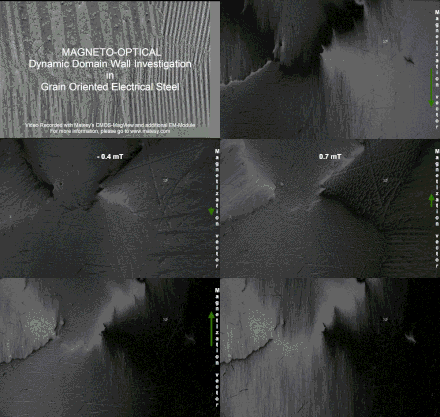
Motion of magnetic domains in grain-oriented silicon steel.
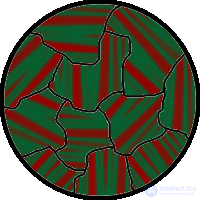
Kerr micrograph of a metal surface, showing magnetic domains with red and green stripes indicating opposite directions of magnetization.
The above might seem to imply that every volume of ferromagnetic material should have a strong magnetic field, since all spins are aligned, but iron and other ferromagnets are often found in a «non-magnetic» state. The reason is that a bulk piece of ferromagnetic material is divided into tiny regions called magnetic domains[21] (also known as Weiss domains ). Within each such region the spins point in the same direction, but (if the bulk material is in its lowest-energy configuration, i.e., not magnetized), the spins of the individual domains point in different directions, and their magnetic fields cancel each other out, so the body has no large overall magnetic field.
Ferromagnetic materials spontaneously break up into magnetic domains because the exchange interaction is a short-range force, so over large distances many atoms tend to lower their energy by orienting in opposite directions. If all the dipoles in a piece of ferromagnetic material are aligned in parallel, this creates a large magnetic field extending into the space around it. It contains a great deal of magnetostatic energy. The material can reduce this energy by splitting into a number of domains pointing in different directions, so that the magnetic field is confined to small local fields within the material, thereby reducing the volume occupied by the field. The domains are separated by thin domain walls a few atoms thick, in which the direction of the dipole magnetization smoothly rotates from the direction of one domain to the direction in the other.
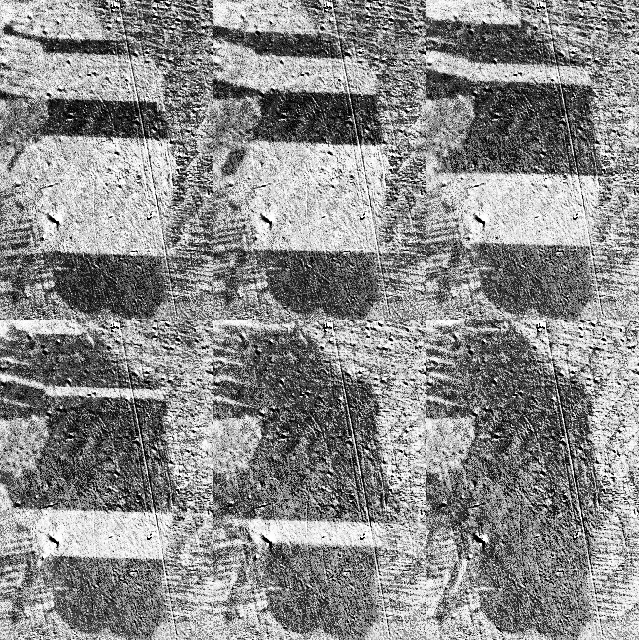
Moving domain boundaries in a grain of silicon steel, driven by an increasing external magnetic field pointing downward, observed under a Kerr microscope. The white regions are domains with upward-directed magnetization, the dark regions are domains with downward-directed magnetization.
Thus, a piece of iron in its lowest-energy state («non-magnetic») usually has a weak magnetic field or none at all. However, the magnetic domains in the material are not static; they are simply regions where the electron spins are spontaneously aligned due to their magnetic fields, and thus their sizes can be changed by applying an external magnetic field. If a sufficiently strong external magnetic field is applied to the material, the domain walls will move. This motion is accompanied by the rotation of the electron spins in the domain walls, turning under the action of the external field so that the spins in neighboring domains become aligned in the same direction, thereby reorienting the domains so that a greater number of dipoles are aligned with the external field. The domains will remain aligned when the external field disappears, creating their own magnetic field extending into the space around the material, thus forming a «permanent» magnet. The domains do not return to their original minimum-energy configuration when the field is removed, because the domain walls tend to become «pinned» or «caught» on defects in the crystal lattice, preserving their parallel orientation. This is demonstrated by the Barkhausen effect: when the magnetic field changes, the magnetization changes through thousands of tiny discontinuous jumps as the domain walls suddenly shift past defects.
The magnetization as a function of the external field is described by a hysteresis curve. Although the state of aligned domains found in a piece of magnetized ferromagnetic material does not have minimal energy, i.e., it is metastable, it can persist for long periods of time. This is shown by samples of magnetite from the sea floor, which have retained their magnetization for millions of years.
Heating and then cooling (annealing) a magnetized material, forging it by hammer blows, or applying a rapidly oscillating magnetic field from a demagnetizing coil releases the domain walls from their pinned state, and the domain boundaries tend to move back to a lower-energy configuration with a smaller external magnetic field, thereby demagnetizing the material.
Industrial magnets are made from «hard» ferromagnetic or ferrimagnetic materials with very large magnetic anisotropy, such as alnico and ferrites, which have very strong magnetization along one crystal axis, the «easy axis». During manufacturing, the materials undergo various metallurgical processes in a powerful magnetic field, which aligns the crystal grains so that their «easy» magnetization axes are oriented in the same direction. Thus, the magnetization and the resulting magnetic field are «built into» the crystal structure of the material, which makes it very difficult to demagnetize.
As temperature rises, thermal motion, or entropy, competes with ferromagnetic ordering. When the temperature rises above a certain point, called the Curie temperature, a second-order phase transition occurs, and the system can no longer sustain spontaneous magnetization, so its ability to become magnetized or to be attracted to a magnet disappears, although it still responds as a paramagnet to an external magnetic field. Below this temperature, spontaneous symmetry breaking occurs and the magnetic moments align with their neighbors. The Curie temperature is the critical point at which the magnetic susceptibility diverges, and, although there is no net magnetization, domain spin correlations fluctuate at all spatial scales.
The study of ferromagnetic phase transitions, especially using the simplified Ising model, had an important influence on the development of statistical physics. There it was first shown that mean-field theory approaches are unable to predict the correct behavior at the critical point (which was found to fall into a universality class including many other systems, such as liquid-gas transitions), and had to be replaced by renormalization group theory.

Comments