
Lecture
When considering chemical bonds in materials, the fundamental elementary particles are protons, neutrons, and electrons.
Atomic nuclei consist of protons and neutrons; electrons occupy the allowed shells around the nucleus, compensating its charge.
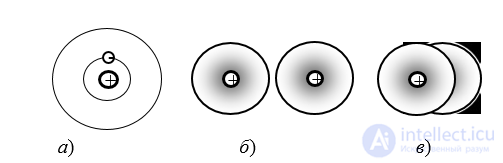
The hydrogen atom consists of one proton and one electron. In the classical picture (the planetary model), the electron orbits around the nucleus (Fig. 1.2, a). In quantum mechanics, the electron's motion is described by a wave function possessing spherical symmetry, so that the electron's charge distribution forms a diffuse cloud (Fig. 1.2, b). In a hydrogen molecule (Fig. 1.2, c) the atomic nuclei are located at a distance of 0.74 Å. The radius of a single atom's electron cloud is approximately 1 Å.
a) b) c)
Fig. 1.2. Structure of the hydrogen atom and molecule:
a – the simplest model of the hydrogen atom in the classical picture (the outer orbit is allowed but not filled in the unexcited state of the atom); b – a model of hydrogen atoms far apart from one another in the quantum-mechanical picture; c – the hydrogen molecule (the gradient shading shows the electron charge density)
In an atom, the allowed orbits for electrons are only those whose circumference (2πr) accommodates a whole number of de Broglie wavelengths λ:
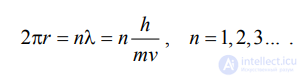
Based on this postulate, let us determine the radius of the stationary orbits and the corresponding electron energy levels:
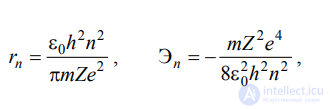
where ε0 = 8.85⋅10−12  Fm is the permittivity of free space; Z is the nuclear charge.
Atoms, ions, molecules. Gases, liquids, and solids can consist of atoms, molecules, or ions. The sizes of atoms are on the order of one or several angstroms (1 Å = 10–10 m); the sizes of positive ions – atoms stripped of some electrons – are smaller than the sizes of the atoms, and the sizes of negative ions, which have gained extra electrons, are larger than the sizes of the corresponding atoms.
When particles are brought sufficiently close together, interaction forces arise between them. Regardless of the nature of these forces, their general character remains the same (Fig. 1.3): at relatively large distances, attractive forces Fattr arise, increasing as the distance r between the particles decreases (curve 1); at small distances, repulsive forces Frep arise, which increase much faster than Fattr as r decreases (curve 3). At a distance r = r0, the repulsive forces balance the attractive forces, and the resultant force F becomes zero (curve 2). Several types of chemical bonding are distinguished.
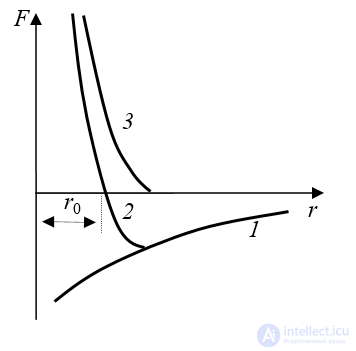
Fig. 1.3. Dependence of the interaction force between atoms on the distance between them
Homopolar (covalent) bond. With this type of bond, the union of atoms into a molecule is achieved through electrons that become shared between pairs of atoms. The density of the negatively charged cloud between the positive nuclei is greatest, for example in the hydrogen molecule in Fig. 1.2, c. Such a bond is called homopolar, or covalent. The appearance of a state with increased electron charge density in the internuclear space is what gives rise to attractive forces.
Molecules with a homopolar bond can be nonpolar or polar (dipolar), depending on their symmetric or asymmetric structure (Fig. 1.4).
The homopolar bond is typical for organic molecules. At the same time, it can also be observed in solids of inorganic origin, if their crystal lattices are composed of atoms. Examples of such substances are diamond, silicon, germanium, silicon carbide (SiC), and others.
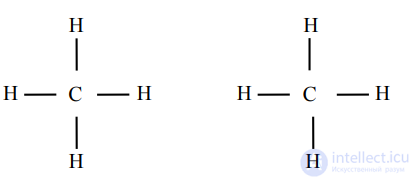
Fig. 1.4. Examples of a nonpolar (left) and a polar (right) molecule
The covalent bond is characterized by high strength. This is confirmed by high hardness and a high melting point.
Heteropolar (ionic) bond arises as a result of the transfer of valence electrons from a metallic atom to a metalloid atom, which is the cause of electrostatic attraction between oppositely charged ions. This type of bond exists in ionic crystals. A typical example of ionic crystals is the halide salts of alkali metals.
Alkali metal atoms have the lowest electronegativity, since they readily give up an electron and have a low electron affinity energy. Conversely, halogen atoms have the highest electronegativity, since they readily accept an electron to complete their outer electron shell.
 Metallic bond exists in systems built from positive ions situated among free, collectivized electrons. The metallic bond in Molecule 1 can be regarded, to some extent, as covalent, since it is based on the sharing of outer valence electrons. The distinguishing feature of the metallic bond is that all atoms of the crystal participate in sharing electrons, and the shared electrons are not localized near their own atoms but move freely throughout the whole lattice, forming an «electron gas». Having no localized bonds, metallic crystals in Molecule 2 (unlike ionic crystals) are not destroyed when the positions of the atoms change, i.e. they possess plasticity under deformation. Thanks to the presence of free electrons
metals possess high electrical and thermal conductivity.
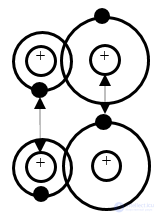
Molecular bond, or van der Waals bond, is observed in a number of substances between molecules with covalent bonds. Intermolecular attraction in this case is possible through the correlated motion of valence electrons in neighboring molecules (Fig. 1.5). At any given moment, the electrons should be as far apart from each other as possible and as close as possible to the positive charges (the nuclei). The van der Waals bond is the most universal, arising between any particles, but it is also the weakest bond, with an energy roughly two orders of magnitude lower than that of ionic and covalent bonds. The molecular bond is easily broken by thermal motion. Therefore molecular crystals have low melting points (for example, paraffin has a melting point of 50 … 52°C).

Comments