
Lecture
Any substance, when placed in a magnetic field, acquires a certain magnetic moment М. The magnetic moment per unit volume of a substance is called the magnetization JM :
jM = M/V .
For a nonuniformly magnetized body
jM = dM/dV .
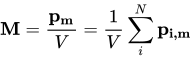
Magnetization (also: the magnetization vector) — a vector physical quantity characterizing the magnetic state of a macroscopic physical body. It is usually denoted by the letter M, less often J. It is defined as the magnetic moment per unit volume of a substance:
 ,
,
where  — is the vector of the total magnetic moment of all N atoms in the volume V, and
  — is the magnetic dipole moment of the i-th individual atom. In the SI system it is measured in A/m (amperes per meter).
In the general case (the case of a medium that is inhomogeneous for one reason or another), the magnetization is a function of the coordinates and is expressed as:

where  — is the total magnetic moment of the molecules in the volume dV.
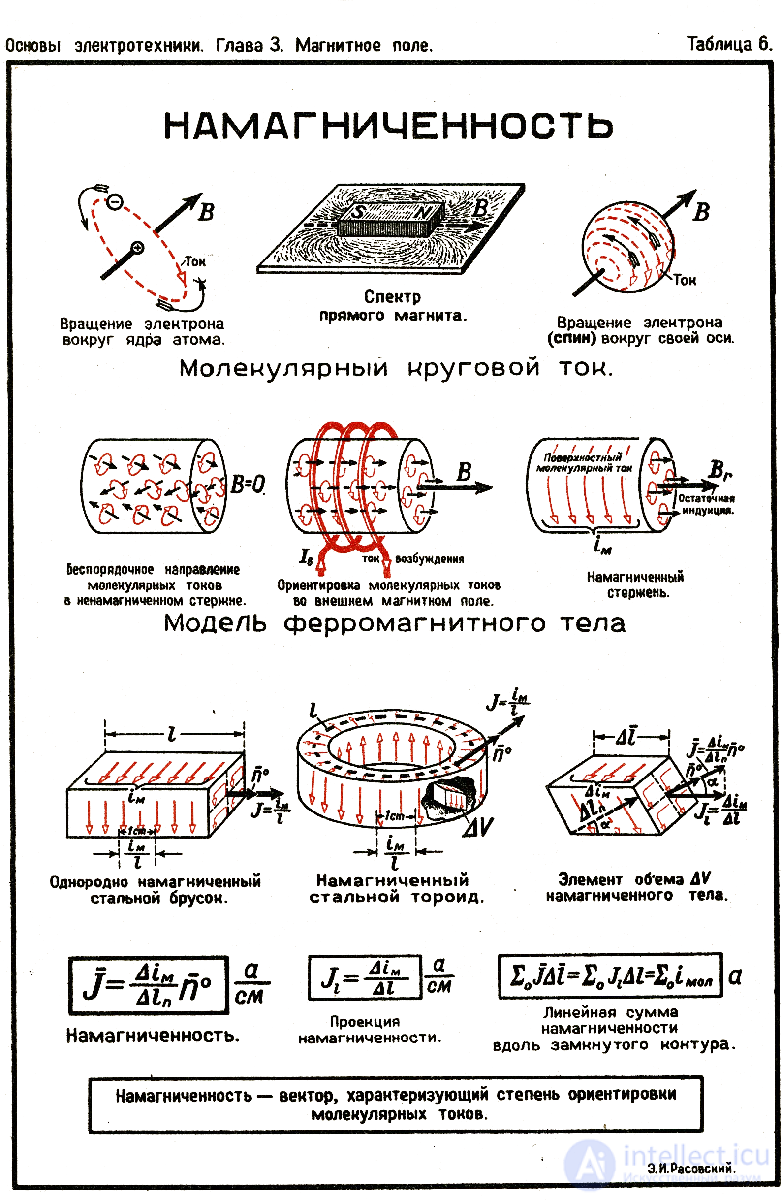
The magnetization M is a quantitative characteristic of magnetizing — the phenomenon of partial ordering of the directions of the magnetic moments of individual atoms and/or magnetic domains of a substance upon the application of a magnetic field. The semantic relationship between the concepts of "magnetizing" and "magnetization" is analogous to the relationship between "the phenomenon of polarization" and "polarization" P in the physics of dielectrics. In the English-language literature, a single word, magnetization, is used both for the phenomenon and for its numerical characteristic. The magnetizing effect is most noticeable in ferromagnetic media.
Magnetic moments, at the microscopic level, are created by so-called molecular currents, caused by the local motion of charges (for example, electrons) within a molecule. They appear in magnetic materials wherever conduction currents flow, and at points of inhomogeneity of the medium.
Magnetization is mathematically related to the volume density of molecular currents through the relation:

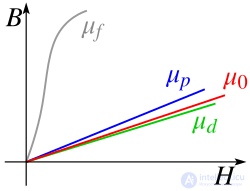
Dependence of the magnetic induction B on the magnetic field strength H in various media:
 — in vacuum;
 — in a diamagnetic material;
 — in a paramagnetic material;
f — in a ferromagnetic material.
The relation between M and the magnetic field strength H in diamagnetic and paramagnetic materials is usually linear (at least for not too large values of the magnetizing field):
,
the quantity χm is called the magnetic susceptibility, and
  (SI system) or
  (CGS) — the magnetic permeability.
In ferromagnetic materials there is no unique relation between M and H because of magnetic hysteresis; this relation depends on the prior history of magnetization of the body.
The magnetic induction is determined via the magnetization as:
 (in the SI system);
 (in the CGS system).
With respect to anisotropic media, longitudinal and transverse magnetization are distinguished relative to the direction of the vector H. In such cases a tensor of magnetic susceptibility is introduced.
Magnetization is a vector quantity and can be parallel and antiparallel to the external field. In the SI system, magnetization is expressed in units of magnetic field strength (A/m). Magnetization is related to the magnetic field strength by the relation
jM = kM H , (5.1) where kM – is a dimensionless quantity characterizing the ability of a given substance to become magnetized in a magnetic field and called the magnetic susceptibility.
The magnetic susceptibility is numerically equal to the magnetization at unit field strength. In addition to the volume magnetic susceptibility, the concepts of specific and molar magnetic susceptibilities are sometimes used, which refer respectively to a unit mass or to a mole of the substance.
A magnetized body located in an external field creates its own magnetic field, which in isotropic materials is directed parallel or antiparallel to the external field. Therefore, the total magnetic induction in the substance is determined by the algebraic sum of the induction of the external and intrinsic fields:
B = B0 + Bi = µ0H +µ0JM , (5.2)
where µ0 = 4π10–7 H/m – is the magnetic constant in the SI system.
From (5.1) and (5.2) it follows that:
B = µ0H(1+ kM )= µ0µH ,
where µ = 1 + kM – is the relative magnetic permeability, showing how many times the magnetic induction В of the field in a given medium is greater than the magnetic induction Во in vacuum.
The root cause of the magnetic properties of a substance are internal hidden forms of motion of electric charges, representing elementary circular currents possessing magnetic moments. Such currents are electron spins and the orbital rotation of electrons in atoms. The magnetic moments of protons and neutrons are approximately a thousand times smaller than the magnetic moment of the electron. Therefore, the magnetic properties of an atom are determined entirely by the electrons, and the magnetic moment of the nucleus can be neglected.

Comments